03The full analysis
A first-principles guide to why screening on demonstrated skill beats screening on degrees and titles once measuring skill at scale becomes cheap, and how the winning operators actually wire it into every stage of the funnel.
Roughly 70 to 85 percent of surveyed employers now say they practice skills-based hiring, yet a Harvard and Burning Glass Institute study found that fewer than 1 in 700 hires were actually affected by dropped degree requirements, about 97,000 out of 77 million annual hires - The Burning Glass Institute and Harvard Business School. That gap between what employers claim and what employers do is the single most important fact in the entire 2026 skills-based-hiring debate, because it means the movement is real and its practice is mostly rhetorical at the same time. The headline adoption numbers describe a consensus. The 1-in-700 number describes the truth underneath it.
The problem this creates for any operator is that the loudest voices in the field are describing two different things and calling them by the same name. One camp points to the survey data and declares skills-based hiring the dominant paradigm of the decade. The other camp points to the follow-through data and dismisses it as a fad that changed job-posting language and nothing else. Both are reading real data from credible institutions, and they appear to contradict each other, which leaves talent leaders without a usable frame for deciding whether to invest in assessments, skills graphs, and internal marketplaces or to treat the whole thing as a passing fashion. The contradiction dissolves the moment you separate the 37 percent of employers who wired skills into every funnel stage from the 45 percent who changed a sentence in a req and called it done.
This guide reconstructs the whole picture from first principles. We start with why demonstrated skill beats proxies once the cost of measuring it collapses, then adjudicate the adoption-versus-follow-through gap on its merits, then trace how skills are actually assessed across the funnel and where each stage silently reverts to proxies. From there we map the skills-data and ontology layer that is the real moat, survey the platform landscape in three tiers, examine the AI-cheating arms race that is quietly breaking take-home assessments, quantify the measurable return, and name the failure modes that kill most programs. We close with a concrete operator playbook and a decision framework. This piece sits alongside our State of AI in Recruiting: 2026, which covers the broader automation of the hiring function itself.
Contents
- Why Skills Beat Proxies (From First Principles)
- Adoption Reality vs Rhetoric
- How Skills Are Actually Assessed Across the Funnel
- The Skills-Data and Ontology Layer
- The Platform Landscape in Three Tiers
- The AI-Cheating Arms Race in Assessments
- The Measurable Return
- The Real Failure Modes
- The 2026 Operator Playbook
- Outlook: What to Watch Through 2027
1. Why Skills Beat Proxies (From First Principles)
The structural question underneath skills-based hiring is not "are degrees fair" or "is talent everywhere." It is narrower and more useful: what does an employer actually want to know about a candidate, and what is the cheapest reliable way to learn it? An employer wants to predict future job performance. It cannot observe future performance directly, so it buys the best available proxy for it. For roughly a century, the cheapest available proxy was a credential (a degree, a title, a prestige signal, a count of years) because directly evaluating whether a person can do the work was slow, expensive, and did not scale. The whole architecture of proxy-based hiring is an artifact of that cost, not a considered belief that a diploma is the best predictor of performance.
Reason about what a proxy is doing economically. A degree is a coarse, high-variance signal that correlates loosely with performance and correlates strongly with access, tolerance for four years of structured work, and family resources. It was never the strongest predictor. It was the strongest predictor you could obtain for near-zero marginal cost, because the candidate paid for the credential themselves and handed it over on a resume. Screening on it cost the employer one glance. Screening on demonstrated skill, by contrast, meant designing a work sample, administering it, and grading it, which cost real money and time per candidate. So employers rationally screened on the cheap proxy and reserved expensive skill evaluation for the final few. That was an efficient allocation of scarce evaluation budget, and it held for as long as skill evaluation stayed expensive.
The predictive-validity literature has said for decades that this was a compromise, not an optimum. Work samples, general mental ability, and structured interviews all outpredicted unstructured interviews and educational credentials. The widely cited Schmidt and Hunter meta-analyses put the validity of general mental ability for job performance above 0.5, but that figure is now contested, and honesty requires flagging it rather than repeating it as gospel. A 2022 re-analysis by Sackett, Zhang, and colleagues corrected for range-restriction assumptions and put general mental ability's operational validity for job performance notably lower, around 0.31, and reshuffled the ranking of predictors - Sackett et al. (2022), Journal of Applied Psychology. Treat the older 0.5-plus coefficients as an upper bound, not a settled constant. The direction survives the correction: skill-relevant signals beat credential signals, and a degree is a weak predictor dressed up as a strong one.
It is worth dwelling on why the contested-validity point matters for an operator rather than treating it as an academic footnote, because vendors lean heavily on the old coefficients to sell assessments. If a vendor tells you their cognitive test has a validity of 0.51 and a degree screen has a validity of 0.10, the implied lift looks enormous and the purchase looks obvious. Under the corrected figures the gap narrows, the cognitive test is still better than the degree but by less, and the marginal value of the assessment depends far more on how it is deployed than on its headline coefficient. This is the first-principles reason to distrust any single-number ROI claim: the predictive edge of a skill signal over a proxy is real but smaller and more conditional than the marketing suggests, and it is destroyed entirely if the signal is measured and then ignored at the decision. The validity literature justifies the shift toward skill measurement; it does not justify believing any particular assessment will transform your hiring on its own. The lift lives in the funnel discipline, not the coefficient.
There is a second-order point hiding in the phrase "coarse, high-variance signal" that deserves unpacking, because it explains why the degree proxy is worse than its average validity implies. A proxy with high variance is not merely weak on average; it is wrong in both directions in ways that are systematically costly. It rejects genuinely skilled people who lack the credential (a false negative that shrinks the talent pool exactly where skills are scarce) and it accepts credentialed people who lack the skill (a false positive that lands as a bad hire). The average-validity number blends these two error types into one figure and hides that the proxy's damage is concentrated at the tails, where the highest-upside and highest-risk candidates sit. Direct skill measurement does not just raise the average; it compresses the variance, cutting both the missed-star error and the bad-hire error at once. That variance compression, not the modest bump in average validity, is the real economic case for measuring skill, and it is why the return shows up most clearly as pool expansion (fewer false negatives) and retention (fewer false positives) rather than as a dramatic jump in any single predictive coefficient.
Now apply the cost logic to what changed. The reason skills-based hiring is a 2026 story rather than a 1996 story is that the marginal cost of evaluating demonstrated skill at scale collapsed. Automated work-sample tests, structured skill-based interview kits, coding assessments graded by machine, and AI-inferred skills extracted from work artifacts turned a per-candidate evaluation that used to cost hours of a hiring manager's time into something that runs for cents at the top of the funnel. Once the cheap thing (skill evaluation) stopped being expensive, the economic justification for the coarse proxy evaporated. This is the same pattern every technology shift follows: a proxy exists only because the real measurement was too costly, and the proxy dies when the real measurement gets cheap. Degrees did not become less predictive in 2026. Measuring skill directly became affordable, which removed the reason to settle for the proxy.
The screening decision is an economic trade-off, not a belief about diplomas
The first-principles payoff is a prediction the consensus misses. If skills-based hiring is driven by the collapsing cost of measuring skill, then it will advance fastest exactly where skill is cheapest and most objective to measure (software, data, technical trades, customer support scripts) and slowest where skill is expensive, subjective, or bound up with judgment that resists a clean work sample (senior strategy, executive leadership, novel research). This is why the movement looks strongest in technical hiring and weakest at the top of the org chart, and it explains the follow-through gap better than any story about corporate willpower. Employers did not fail to drop degree requirements because they lacked commitment. Many failed because, for the roles they were talking about, they never built the cheap skill-measurement substitute that the whole model depends on, so they kept quietly reaching for the proxy at the moment of decision. That substrate, the assessment layer and the skills-data layer, is the real subject of this guide, and it is covered in adjacent depth in our Talent Acquisition Tech Market Map: 2026.
2. Adoption Reality vs Rhetoric
The most useful thing this guide can do is adjudicate the gap between the adoption surveys and the follow-through studies, because that gap is what makes the topic feel unresolvable. It is resolvable. The two bodies of evidence are not measuring the same thing, and once you specify exactly what each measures, the apparent contradiction shrinks from a war of conclusions to a difference of what counts as "doing" skills-based hiring. The surveys measure claimed practice. The follow-through studies measure changed outcomes. A firm can honestly answer yes to the first while producing nothing detectable in the second, and most do.
Start with the adoption numbers, which are real and rising. The National Association of Colleges and Employers found in its Job Outlook 2026 survey that 70 percent of employers use skills-based hiring practices, up from 65 percent the prior year - National Association of Colleges and Employers. TestGorilla's more expansive State of Skills-Based Hiring survey put the figure at 85 percent of employers using skills-based hiring in 2025, up from 81 percent in 2024, with 53 percent reporting they had eliminated degree requirements, up from 30 percent the prior year - TestGorilla, State of Skills-Based Hiring 2025. The two surveys diverge (70 versus 85) not because one is wrong but because they define the practice differently and sample different populations: NACE surveys campus-recruiting employers with a tight definition, while TestGorilla surveys a broader base with a more expansive one that counts any use of a skills test. Both are directionally honest, and both are measuring stated practice, which is exactly the thing that inflates.
Share of employers claiming skills-based hiring practices, by source and year
Source: NACE Job Outlook 2026 and TestGorilla State of Skills-Based Hiring 2025
The definitional divergence itself is worth a first-principles beat, because it is not a flaw in the surveys but a feature of how the practice is measured, and understanding it prevents the most common misreading. NACE's tighter number reflects a population of employers who run formal campus-recruiting programs and a definition that ties "skills-based hiring" to specific funnel practices, so it captures something closer to real deployment. TestGorilla's broader number reflects a wider base and a definition that counts any use of a skills test, so it captures intent and light-touch adoption alongside real deployment. Neither is the true rate, because there is no single true rate: adoption is a spectrum from "we added one quiz" to "we rebuilt the entire funnel around demonstrated skill," and each survey draws its line at a different point on that spectrum. The operator lesson is to never argue about whether the number is 70 or 85, because both are answers to the question "how many employers say they do some version of this," and that question has almost no bearing on whether any given employer's hires actually changed. The number that has bearing is the follow-through rate, which is a different measurement entirely.
Now set the follow-through evidence against it. The Burning Glass Institute and Harvard Business School tracked what actually happened after the wave of high-profile degree-requirement removals, and the result is stark: despite widespread announcements, fewer than 1 in 700 hires in 2023 were affected by the dropped requirements. Their taxonomy is the single most useful frame in the field. About 45 percent of companies that announced skills-based hiring made no real change in practice (they are in-name-only, they rewrote the posting and kept hiring the same people), about 37 percent followed through as genuine leaders and increased the share of workers hired without degrees by nearly 20 percent, and about 18 percent were backsliders who made short-term gains and then reverted - The Burning Glass Institute and Harvard Business School. Read the survey number and the follow-through number together and the structure snaps into focus. The 70-to-85 percent is the announcement rate. The 37 percent is the operating rate. The distance between them is the rhetoric.
What companies that announced skills-based hiring actually did next
Source: The Burning Glass Institute and Harvard Business School
Why does the gap open, and open so wide? The first-principles answer follows directly from Section 1: announcing skills-based hiring is free, while practicing it requires building the cheap skill-measurement substrate that the model depends on, and that substrate costs money, ownership, and process discipline that most firms never allocated. Removing "bachelor's degree required" from a job posting is a one-line edit any recruiter can make in an afternoon. Actually screening on demonstrated skill requires an assessment that predicts performance, a scorecard the hiring manager is forced to use, and a skills taxonomy that says what "the skill" even is. Firms did the free part and skipped the expensive part, so the moment a resume without a degree hit a hiring manager's desk, the manager fell back on the proxy they always used, because nothing structural stopped them. The in-name-only 45 percent is not lying on the survey. They genuinely changed the language. They just never changed the decision.
The backslider category deserves its own attention because it reveals something the leader-versus-in-name-only split alone would miss: skills-based hiring is not a state you achieve and keep, but a discipline you either sustain or lose. The 18 percent who made short-term gains and then reverted did not fail to try; they tried, moved the needle, and then let the funnel drift back to proxies, which tells you the reversion pressure is constant and structural rather than a one-time hurdle. Reason about why a program would backslide after succeeding. The most likely mechanism is that the enforcement mechanisms (the scorecard as a gate, the required assessment, the monitored override rate) depend on active maintenance, and when the internal champion leaves, the hiring volume spikes, or a fast-hire crisis makes the proxy tempting again, the discipline lapses and the old habits reassert themselves. This is the same dynamic that kills diets and process-improvement programs: the default state has gravity, and staying out of it requires ongoing energy. The backslider data is the clearest evidence that a skills-based-hiring program is a system to be operated, not a switch to be flipped, which is the single most important reframing this guide can offer a leader who thinks the hard part is the launch.
Deloitte's data corroborates the operating rate from a different angle and should keep any enthusiast humble. Deloitte found that fewer than 1 in 5 organizations have adopted skills-based approaches to a significant extent, meaning at scale and in a repeatable way rather than as a pilot or a posting change - Deloitte. That "fewer than 1 in 5" sits right alongside Burning Glass's 37 percent leaders once you account for the stricter bar (at scale and repeatable is harder than any follow-through at all), and together they define the real market. The practical lesson for an operator is to stop citing the 85 percent as evidence that skills-based hiring works, because the 85 percent is announcements, and start asking the only question that separates a leader from an in-name-only firm: what share of your actual hires changed. If the answer is "we updated the postings," you are in the 45 percent, and no amount of survey participation moves you out of it.
3. How Skills Are Actually Assessed Across the Funnel
The abstraction "skills-based hiring" hides an operational reality: skills are assessed at several distinct stages of the funnel, each with a different instrument, a different cost, and a different failure mode, and the whole program is only as skills-based as its weakest stage. Understanding where in the funnel the skill signal enters and where it silently drops out is the difference between a program that changes hires and a program that changes postings. The seam between rhetoric and practice runs stage by stage, and it is worth walking the funnel from top to bottom to see exactly where proxies creep back in.
Sourcing is the first stage, and it is where skills-based hiring either widens the pool or fails before it starts. In a proxy funnel, sourcing runs on titles and pedigree: search for the job title, filter by employer prestige, screen by school. In a skills funnel, sourcing runs on demonstrated capability: search on the skills the role actually requires, which surfaces candidates whose titles or backgrounds would never have matched a keyword search. This is where the talent-pool expansion that skills-based hiring promises actually comes from, and it is entirely dependent on the skills-data layer covered in the next section, because you cannot search on a skill you have not defined. The sourcing shift is the highest-leverage and most-skipped stage, and we map the tooling for it in full in our Sourcing Tools Landscape: 2026 Buyer Guide.
A program is only as skills-based as its weakest stage
Screening is the stage where skills-based hiring is most commonly claimed and most commonly hollow. NACE found that 65 percent of employers using skills-based hiring apply it at the screening stage, typically through a work-sample test, a coding challenge, or a validated skills assessment that gates who advances - National Association of Colleges and Employers. The instrument matters enormously here. A genuine work sample (do a scaled-down version of the actual job) carries the highest predictive validity and is hard to fake with a resume. A generic aptitude quiz bolted onto an otherwise proxy-based funnel is theater. The failure mode at screening is subtle: firms add a test but do not gate on it, so a strong resume with a mediocre test score still advances because the recruiter trusts the pedigree over the sample. The test becomes decoration, and the funnel reverts to proxies at the exact stage that was supposed to fix it.
There is a design trade-off inside the screening stage that most buyers get wrong, and naming it separates a program that captures the pool-expansion return from one that quietly destroys it. A work sample can be authentic (close to the real job, high validity, high candidate effort) or convenient (a short generic quiz, lower validity, low candidate effort), and the two pull against each other. Authentic samples predict better but impose more friction, which raises drop-off, especially among the exact non-traditional candidates the program is meant to reach, who often cannot spend three unpaid hours on a take-home. Convenient quizzes reduce friction but predict little, so they filter on something close to noise while wearing the costume of skill measurement. The resolution is not to pick one but to sequence them: a short, low-friction, high-signal screen early (to widen rather than narrow the pool) and a deeper authentic evaluation later in the funnel (where the candidate has enough context to justify the effort). Firms that front-load a heavy take-home push away the career-changers and non-degree candidates they claim to want, then conclude skills-based hiring "did not expand our pool," when in fact their own screening design did the excluding. The instrument is not neutral; its friction profile decides who reaches the decision.
Interviewing is where NACE finds the highest claimed usage, and where the gap between structured and unstructured practice matters most. 87 percent of employers using skills-based hiring say they apply it at the interview stage, but "skills-based interviewing" spans everything from a rigorously structured, competency-scored, behaviorally anchored interview to a friendly unstructured chat that the interviewer later rationalizes as skill-focused - National Association of Colleges and Employers. The predictive-validity literature is unambiguous that structured interviews sharply outperform unstructured ones, so an interview stage that claims to be skills-based but runs unstructured is another place the proxy sneaks back through interviewer intuition, which is heavily biased toward pedigree and similarity. The mechanics of scoring interviews at scale, and the tools that enforce structure, are the subject of our Interview Intelligence: Category Deep Dive.
The proxy that is quietly dying in the numbers is grade-point average, and its decline is the cleanest single indicator that the screening stage is genuinely shifting. NACE found that only 42 percent of employers now screen candidates by GPA, down sharply from 73 percent in 2019 - National Association of Colleges and Employers. GPA is a pure proxy: it correlates with conscientiousness and access far more than with job performance, and its 31-point collapse over six years is exactly what you would expect as cheap skill measurement displaces cheap proxy measurement at the top of the funnel. The practical read for an operator auditing their own funnel is to walk each of the four stages and ask a single question at each: does a skill signal actually gate the decision here, or is it present but ignored while a proxy makes the call. Wherever the honest answer is "present but ignored," that stage is in-name-only, and fixing it is worth more than adding a fifth instrument the funnel will also ignore.
4. The Skills-Data and Ontology Layer
Everything above depends on one thing that almost no one talks about at the start of a skills-based-hiring project and everyone blames at the end of a failed one: the skills data itself. You cannot source on a skill, screen on a skill, or score an interview against a skill until you have named the skill, defined it precisely enough to be measured, and connected it to the role, the assessment, and the labor market. This naming-and-connecting layer is the skills ontology, and it is the real moat in skills-based hiring, because the assessment tools and the marketplace tools are commoditizing while a governed, current, well-connected skills graph is genuinely hard to build and harder to keep alive.
Reason from first principles about why the ontology is the hard part. A skill is not a self-evident atom. "Python" means one thing for a data engineer and another for a quantitative researcher; "leadership" is nearly meaningless without a level, a context, and observable behaviors attached. To hire on skills, an organization needs a shared vocabulary that says which skills exist, how they relate (this skill is adjacent to that one, this skill is a prerequisite for that role), and what evidence counts as demonstrating each. Building that vocabulary once is a large project. Keeping it current as the meaning of skills drifts (what "prompt engineering" or "AI fluency" requires changes every few months) is a permanent one. The ontology is not a spreadsheet you fill in once. It is a living system that decays the moment you stop feeding it, which is why so many programs die of a stale taxonomy that no one owns.
There are three broad approaches to building the skills graph, and they trade off precision against freshness in ways an operator should understand before buying. The first is the curated taxonomy: a large, hand-built or licensed library of skills with definitions and relationships, offered by vendors like Workday, iMocha, and Cornerstone (whose SkyHive acquisition adds real-time labor-market skills data across 180-plus countries). The second is the inferred graph: rather than asking people to self-report skills (which is stale and biased), infer skills from actual work artifacts, which is the approach TechWolf takes by reading work data to build a live skills graph. The third is the hybrid, where a curated taxonomy is continuously updated with inferred and labor-market signals. Vendors publish skill-count figures for their libraries (tens of thousands of skills is a common claim), but those numbers drift and are marketing-adjacent, so verify any specific count against the vendor's current materials rather than repeating a figure from a year-old deck.
Inferring skills from work artifacts rather than self-reported profiles
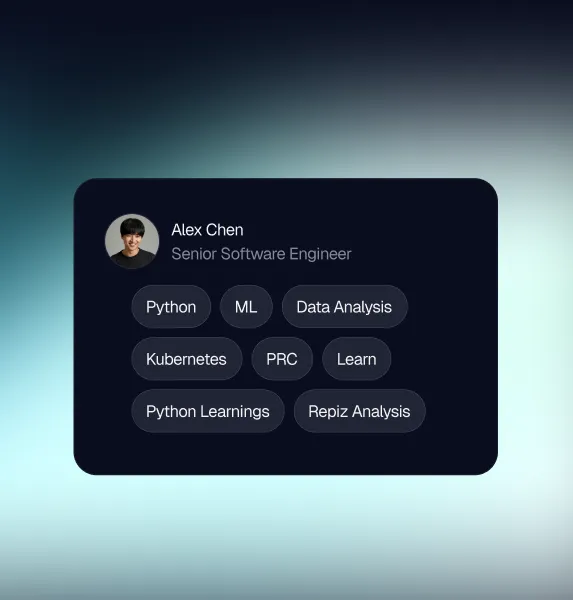
The inferred approach deserves a first-principles beat because it addresses the single biggest failure mode of the curated approach: staleness. A self-reported or hand-curated skills profile is a snapshot that is wrong the day after it is taken, because people acquire and lose skills continuously and never update their profile. Inferring skills from work data (the code someone actually writes, the tickets they actually resolve, the documents they actually produce) keeps the graph current by construction, because it reads the present rather than trusting the past. TechWolf's positioning as the data layer that connects tasks, skills, and jobs by reading actual work patterns is the clearest articulation of why inference beats self-report - TechWolf. The trade-off is that inference requires access to sensitive work data and careful governance, which is exactly why it lands as an enterprise-only capability and why the ontology problem is as much about ownership and privacy as it is about data science.
The inference-versus-self-report distinction also reveals a subtle bias problem that the curated approach quietly imports and the inferred approach can partly correct. Self-reported skills are not just stale; they are systematically skewed by confidence, which correlates with demographics rather than competence. Studies of self-assessment consistently find that some groups over-claim skills while others under-claim identical ability, so a hiring or mobility system that runs on self-reported profiles bakes that confidence gap directly into its decisions, penalizing the under-claimers and rewarding the over-claimers regardless of actual skill. Inferring skills from work artifacts sidesteps the confidence channel because it reads what a person did rather than what they say they can do, which is a genuine fairness advantage and not just a freshness one. The catch is that inference introduces its own bias risk: if the work data itself reflects unequal access to high-visibility projects, the inferred graph can encode that inequality as if it were skill. So neither approach is bias-free, and the honest framing is that inference trades the confidence bias of self-report for the access bias of work-data, which is a better trade for most organizations but still a trade that requires governance rather than trust. This is the same accountability logic that runs through AI-driven hiring decisions generally, which we examine in our AI Hiring Liability: Mobley v. Workday and 2026.
The ownership question is where most skills programs quietly fail, and naming it is the practical contribution of this section. A skills ontology that no single team owns becomes an orphan: HR treats it as an L&D artifact, L&D treats it as a recruiting artifact, and recruiting treats it as an HRIS configuration, so no one refreshes it, no one arbitrates when the same skill is named three ways, and within a year it is a stale glossary that hiring managers ignore. The organizations that succeed assign a named owner (often a skills architect or a workforce-intelligence function) with a mandate to keep the ontology current, arbitrate definitions, and connect it to both the hiring funnel and the learning system. Without that owner, the ontology decays, and when the ontology decays, the sourcing, screening, and interviewing stages all revert to proxies because they no longer have a reliable skill vocabulary to run on. The moat is not the size of the skills library. It is whether anyone is tending it, which is why we treat the disconnect between HR and L&D as a primary failure mode in Section 8.
5. The Platform Landscape in Three Tiers
The vendor landscape for skills-based hiring is easiest to reason about as three tiers that map directly to the stages and the data layer above: pre-employment assessments that measure skill at the top of the funnel, skills-intelligence platforms that build and maintain the graph, and internal talent marketplaces that apply the graph to redeploy people already inside the company. Most buyers shop one tier at a time and end up with tools that do not share a skills vocabulary, which is the tooling-side version of the ownership failure. Understanding the tiers, and the fact that they only work when they share an ontology, is the first step to buying well rather than accumulating disconnected point tools.
The assessment tier is the most mature and the most commoditized, and it is where a skills program most visibly touches candidates. TestGorilla runs an AI-powered skills-assessment platform that screens candidates on demonstrated ability rather than resumes, and it is also the publisher of the widely cited adoption survey (the 85 percent and 53 percent figures), with public tiered SaaS pricing including a free plan - TestGorilla. For technical hiring specifically, HackerRank provides developer assessments, interviews, and upskilling with public per-seat pricing - HackerRank, and CodeSignal offers an AI-native platform for technical assessment, AI-powered interviews, and learning - CodeSignal. iMocha positions above pure assessments as a skills-intelligence platform that validates candidate and employee capabilities across a large library and feeds hiring, internal mobility, and workforce planning, on enterprise quote-based pricing - iMocha. The assessment tier is where the cheap-skill-measurement thesis is realized in practice, and it is also where the AI-cheating arms race of Section 6 is fought hardest.
What a skills-based approach actually evaluates
The skills-intelligence tier is where the ontology lives, and it is far less commoditized because the moat is the graph, not the interface. Eightfold AI runs a talent-intelligence platform built on a deep skills graph with AI agents for hiring and workforce decisions, deployed across enterprise hiring and internal mobility, on enterprise SaaS pricing as a venture-backed unicorn - Eightfold AI. TechWolf infers skills from actual work artifacts to keep a live skills graph current, which is the freshness advantage from Section 4, on enterprise SaaS pricing - TechWolf. Cornerstone OnDemand, which acquired SkyHive, adds real-time labor-market skills intelligence to a workforce-readiness and learning platform operating across 180-plus countries - Cornerstone OnDemand, and Workday carries the skills graph inside the dominant enterprise HCM system of record where requisitions, approvals, and reporting actually happen - Workday. This tier is where the difference between a leader and an in-name-only firm is decided, because it is the layer that makes skill a first-class object the whole funnel can query.
The internal-marketplace tier deserves a first-principles argument because its ROI logic is the strongest in the entire landscape and yet it is the least adopted, which is a puzzle worth solving. Reason about what an external hire actually costs versus an internal redeployment. An external hire carries sourcing cost, assessment cost, weeks or months of time-to-fill, a signing premium, and a long ramp during which the new hire produces little while learning the organization. An internal move against a skills graph carries almost none of that: the person already knows the company, ramps in days rather than months, and the "sourcing" is a query against existing employees. If a firm has a current skills graph, filling a role internally is structurally cheaper and faster than filling it externally, often by a wide margin. So why is the marketplace tier under-adopted? Because it requires the one thing most organizations lack: a current, trusted, company-wide skills graph, plus a culture where managers do not hoard talent. The marketplace is not under-adopted because its value is unclear; it is under-adopted because it sits at the top of the dependency stack, requiring the ontology that most firms never finished building. This is why the internal marketplace is the truest test of whether a skills program is real: you cannot redeploy on skills you have not mapped.
The application tiers, internal marketplaces and credentialing, are where the skills graph pays off beyond the initial hire, and they are the most under-adopted despite the strongest ROI logic. Gloat pioneered the internal talent marketplace, using a skills graph to match existing employees to projects, gigs, and open roles inside the company, which turns a hiring problem into a redeployment problem and is often cheaper and faster than external hiring - Gloat. Adjacent to hiring sit the credentialing and apprenticeship models: Credly by Pearson issues verifiable digital skill credentials that travel across employers, and Multiverse runs apprenticeship-to-hire programs that build skills on the job and convert them into employment, an explicit answer to the experience-gap problem we cover in our Entry-Level Hiring Collapse: AI and 2026. The strategic point across all three tiers is that they only compound when they share one ontology, and buying them as disconnected point tools is how a program ends up with three skills vocabularies and no skills-based hiring.
The investment context explains why all three tiers are consolidating rapidly, and it matters for buyers weighing whether a vendor will still exist in three years. Investment poured into HR and work technology reached $4.93 billion through the first three quarters of 2025, up 20 percent year over year, with Q3 2025 alone drawing $1.37 billion across 35 deals including four mega-deals exceeding $100 million each - WorkTech, Q3 2025 Global Work Tech VC Report. That capital is flowing disproportionately toward the skills-intelligence and AI-native layers, which is why the assessment tier is commoditizing (capital chases the moat, not the commodity) and why the skills-graph vendors are the ones raising mega-rounds. For a buyer, the read is that the assessment tier is safe to shop on price and features because it is mature and competitive, while the skills-intelligence tier is a longer-term bet where vendor durability, data governance, and ontology quality matter more than the demo. We map the full competitive structure of this market, including buyer sentiment, in our Talent Acquisition Tech Market Map: 2026.
6. The AI-Cheating Arms Race in Assessments
The entire skills-based-hiring thesis rests on one assumption that generative AI is actively undermining: that a skills assessment measures the candidate's skill rather than the candidate's tool. If a work-sample test can be silently completed by a language model, the test no longer predicts the candidate's performance, and the cheap-skill-measurement substrate that the whole model depends on cracks at its foundation. This is not a hypothetical risk in 2026. It is the defining operational crisis of the assessment tier, and it has already broken the most common assessment format, the unproctored take-home, more or less completely.
The scale of the shift is documented and dramatic. CodeSignal's detection data found that 35 percent of proctored assessments were flagged for cheating or fraud in 2025, up from 16 percent in 2024, more than double in a single year - CodeSignal. The distribution is as telling as the level. Cheating on entry-level junior assessments hit 40 percent, nearly tripling from 15 percent in 2024, because junior candidates face the fiercest competition and the lowest perceived risk. And the rate varied sharply by region, reaching 48 percent in Asia-Pacific against 27 percent in North America - CodeSignal. Note the crucial detail: these are flagged rates on proctored assessments, the ones with detection running. The unproctored take-home has no such floor, which is why the industry now treats it as broken rather than merely risky.
Share of proctored assessments flagged for cheating or fraud (CodeSignal detection data)
Reason about why this happened from the candidate's incentive structure, because that is where the mitigation has to start. A candidate facing a take-home assessment with a language model open in another tab confronts a simple calculation: the tool dramatically raises their score, the marginal cost of using it is near zero, and the probability of detection on an unproctored test is low. HackerRank, citing TestPartnership research, found that 83 percent of candidates said they would use AI assistance on assessments if they believed employers would not detect it - HackerRank. That 83 percent is the whole problem in one number: it means the honest-candidate assumption that unproctored assessments rely on is false for the overwhelming majority, and any test that depends on candidates choosing not to use an available tool is not measuring skill. It is measuring restraint, which no employer wants to hire for.
The regional variation in the CodeSignal data (48 percent in Asia-Pacific against 27 percent in North America) is not a curiosity to skip past; it carries a lesson about how cheating norms form and why a global hiring program cannot apply one authenticity standard everywhere. Reason about what drives a 21-point regional gap. It is unlikely to be a difference in candidate character and far more likely to be a difference in competitive intensity, local norms around assessment tools, and the perceived legitimacy of using AI assistance where the labor market is most saturated. Where hundreds of qualified candidates chase each role and everyone assumes everyone else is using the tools, the individual incentive to abstain collapses, and cheating becomes a coordination equilibrium rather than an individual choice. This means an employer running a single unproctored assessment across regions is not measuring skill on a level field; it is measuring skill in North America and measuring tool-access in the most saturated markets, then comparing the two as if they were the same signal. The operational implication is that authenticity controls have to be uniform and strong everywhere precisely so that the measured skill is comparable across regions, because a mixed-integrity assessment produces a hiring signal that is silently biased by geography.
The detection stack that vendors have built in response is genuinely sophisticated, and understanding it is essential for any operator relying on assessments to gate hires. Modern detection combines behavioral telemetry (keystroke dynamics, paste patterns, tab-switching, timing anomalies that reveal a human transcribing a model's output), suspicion scoring that aggregates signals into a confidence estimate, and leak-sweeping that monitors whether question content has appeared online or in a model's likely training exposure. CodeSignal's own framing is that detection is now an arms race in which the defenses have to evolve as fast as the tools, which is why the flagged rate rising is partly a sign of better detection catching more, not only more cheating occurring. The practical implication is that an assessment without a serious detection layer is not a lighter version of a good assessment. It is a broken instrument that produces confident, wrong signals about candidate skill.
There is a deeper strategic response to the cheating problem that reframes it entirely, and the sharpest operators are already making it: if the model can do the assessment, maybe the assessment should assume the model is present and measure what the candidate does with it. The old assessment asked "can you write this function unaided," which is now unmeasurable and, for many roles, no longer the relevant skill, because the real job now involves working alongside AI tools. A next-generation assessment asks "here is the model, now solve a harder problem that the model alone cannot solve, and show me your judgment in directing, checking, and correcting it." This reframes cheating out of existence for the roles where AI use is part of the actual work, because using the tool is the point rather than the violation. The catch is that this only works where the job genuinely involves AI-augmented work and where the assessment is hard enough that the model is necessary but not sufficient, which requires far more design effort than a static coding puzzle. For roles where unaided skill genuinely matters (security-critical work, foundational reasoning), proctored authenticity remains the answer. The strategic point is that the cheating crisis is forcing a useful question that skills-based hiring should have asked anyway: what skill are we actually trying to measure, the skill of working without tools or the skill of working with them.
The strategic conclusion for skills-based hiring is uncomfortable but clear, and it reshapes how the whole model should be operated. Unproctored take-home assessments, long the default because they are candidate-friendly and cheap, are now largely unreliable as a skill signal, which means the assessment stage has to move toward proctored, telemetry-instrumented, authentic tests or toward live, interactive evaluation where a human observes the work in real time. This raises cost and friction at exactly the stage that skills-based hiring made cheap, which partially reverses the cost collapse that drove the whole movement. The honest read is that generative AI simultaneously made skill measurement cheaper (by enabling AI-graded assessments and inferred skills graphs) and made the cheapest form of skill measurement (the unproctored take-home) untrustworthy, so operators have to spend some of the savings back on authenticity. This same fraud dynamic extends beyond assessments into identity and deepfake verification, which we cover in depth in our Hiring Fraud and the Deepfake Verification Stack: 2026.
7. The Measurable Return
Skills-based hiring is only worth the operational cost of building the substrate if it produces a measurable return, and the honest state of the evidence is that the return is real, well-documented in specific programs, and frequently overstated when vendors extrapolate a single case into a universal law. The disciplined approach is to separate the return into its three genuine sources (speed, quality and retention, and pool expansion), attach each to specific evidence, and resist the temptation to add them into one heroic number. An operator who understands where the return comes from can predict whether their own program will capture it, which matters far more than any headline percentage.
The speed return is the best-documented and the easiest to capture, because it flows directly from the cheap-measurement thesis. When a validated skills assessment gates the top of the funnel, it removes the slow, subjective resume-and-screening rounds that consume most of the calendar in a proxy funnel. An IBM study reported that HR departments using AI for recruitment cut time-to-hire by about 24 percent while improving candidate quality by 6 percent - WeCreateProblems, citing an IBM study. PwC went further: its UK external-recruitment team piloted skills-first practices on a specific business area and reduced mean hiring time by 45 percent versus business-as-usual methods, a figure documented in the World Economic Forum's Putting Skills First work - PwC with Workday. (The same skills-first approach also transformed PwC's Deals practices across Europe, the Middle East and Africa, and Asia Pacific, raising hiring of women by 20 percent and hires with STEM or other non-finance degrees by 17 percent.) The 45 percent is a specific program's result under specific conditions, not a universal constant, but the direction is consistent and mechanistically obvious: replacing slow subjective screening with fast objective measurement compresses the funnel.
Reported reduction in hiring time from skills-based and AI-assisted approaches
Source: IBM study (via WeCreateProblems) and PwC with Workday
The PwC case is worth examining in detail rather than citing as a bare number, because the conditions that produced its 45 percent time reduction are the conditions an operator has to replicate to capture anything like it. PwC did not simply add a skills test to an unchanged funnel; the 45 percent came from a PwC UK external-recruitment pilot that was part of a deliberate, Workday-supported skills-first program, one that embedded the skills signal into the system of record where requisitions and decisions actually live rather than bolting it on as an isolated screen. That integration is why the gain was large: the skills data did not merely inform one stage, it restructured the whole flow from requisition to offer, removing the slow subjective handoffs that a resume-based funnel accumulates. An operator who reads "45 percent" and expects to get it by buying a standalone assessment will be disappointed, because the standalone assessment changes one stage while leaving the slow subjective stages intact. The lesson embedded in the PwC result is that the speed return scales with how deeply the skill signal is wired into the funnel, which is the same funnel-discipline point that runs through this entire guide: the tool is necessary but the integration is what pays.
The quality-and-retention return is the most important one economically and the hardest to measure, which is why it is the most abused in vendor marketing. The logic is sound from first principles: a work sample predicts performance better than a degree, so hiring on demonstrated skill should produce better performers and, because the hire and the role are better matched, longer retention. The IBM figure of a 6 percent candidate-quality improvement is a real if modest data point, and the Burning Glass finding that genuine leaders increased the share of non-degree hires by nearly 20 percent implies those hires performed well enough to sustain the practice, because firms do not keep hiring a profile that fails. But quality and retention lag hiring by quarters or years, and they are confounded by everything else the organization does, so treat any precise multi-year retention claim from a vendor as illustrative rather than proven. The defensible statement is that the mechanism points toward better quality and retention, and the specific magnitude depends on the fidelity of the assessment and the discipline of the funnel.
The retention half of that claim deserves a mechanistic argument, because it is where skills-based hiring's strongest long-term economics live and where the causal chain is most often asserted without being explained. Why would hiring on skill rather than credential improve retention? Not because skilled people are inherently more loyal, but because a skills-matched hire experiences less of the mismatch that drives early attrition. A candidate hired on pedigree into a role whose actual task demands they cannot meet either underperforms and is managed out or struggles, disengages, and leaves; a candidate whose demonstrated skills genuinely fit the work is more likely to succeed early, build confidence, and stay. The mechanism is fit, and fit is exactly what a work sample measures and a degree does not, because the work sample tests the candidate against the real task while the degree tests them against a generic four-year curriculum. This is why the retention return, though slow and hard to isolate, is mechanistically the most durable of the three: it compounds every year a well-matched hire stays that a mismatched hire would have left, and it is invisible in the first quarter's metrics, which is precisely why impatient programs abandon skills-based hiring before its best return has time to show up.
The pool-expansion return is the one that is easiest to reason about and hardest to fake, and it is where skills-based hiring creates value that proxy hiring simply cannot. When you search and screen on skills rather than titles, you surface candidates whose backgrounds would never have matched a credential filter: career-changers, non-degree holders, people from non-target employers, and internal employees whose current title hides relevant capability. This is not a soft diversity argument; it is a hard supply argument, and it matters most exactly when skills are scarce. The World Economic Forum found that 63 percent of employers cite skills gaps as the biggest barrier to business transformation over 2025 to 2030, with 39 percent of workers' core skills expected to be transformed or become obsolete by 2030, and a projected 78 million net new jobs by 2030 (170 million created against 92 million displaced) - World Economic Forum, Future of Jobs Report 2025. In a world where skills are the binding constraint, the ability to find them wherever they exist, rather than only where the credential says they should be, is the return that justifies the entire program. The adoption of AI in HR is accelerating in lockstep: SHRM found 43 percent of organizations now use AI for HR tasks, up from 26 percent in 2024 - SHRM, 2025 Talent Trends.
The disciplined way to read all of this is as a range attached to conditions, not a single number, and this is where a research house earns its trust. Speed gains of 20 to 45 percent are well-evidenced and reliably captured when a validated assessment genuinely gates the funnel. Quality and retention gains are mechanistically likely but empirically modest and slow, so promise them as a direction, not a magnitude. Pool expansion is the most certain return and the one that compounds, because it structurally enlarges the set of people you can hire, which is worth the most precisely when the WEF skills-gap data says talent is the constraint. An operator who sells a skills-based-hiring program internally on a single inflated ROI number is setting up the disappointment that produces the 18 percent backsliders. Selling it on the honest range, anchored on the certain pool-expansion return and the well-evidenced speed return, is how a program survives its first year. The recruiter-productivity side of this return is quantified further in our Hiring Effort Benchmarks by Function.
8. The Real Failure Modes
The most valuable section of any operator guide is the one that explains how the thing fails, because the failure modes are where the 45 percent in-name-only firms and the 18 percent backsliders actually live. Skills-based hiring does not fail because the underlying thesis is wrong; the thesis (measure skill directly now that it is cheap) is sound. It fails because of specific, recurring operational breakdowns that an operator can anticipate and prevent. Naming these precisely is worth more than any amount of enthusiasm, because a program that avoids the four common failure modes below is already in the 37 percent of leaders by virtue of not dying in the usual ways.
The first and most common failure is unclear or too-generic skill definitions, and it is the direct consequence of skipping the ontology work in Section 4. When a job posting lists "communication," "problem-solving," and "leadership" as the required skills, it has defined nothing measurable, because those words mean everything and therefore nothing. A hiring manager cannot build an assessment for "communication," a sourcer cannot search for it, and an interviewer cannot score it, so all three quietly revert to the proxy they can act on, which is the resume. Generic skill definitions are not a minor quality issue; they are a structural guarantee that the funnel reverts to proxies, because a skill that cannot be measured cannot gate a decision. The fix is precise, behaviorally anchored skill definitions tied to observable evidence, which is exactly the ontology work that most programs treat as optional and that the leaders treat as the foundation.
Each one silently reverts the funnel to proxy-based hiring
The second failure is the HR-to-L&D disconnect, which is the organizational version of the unowned-ontology problem. Skills-based hiring and skills-based development are two halves of one system: hiring measures the skills a person has, and learning builds the skills they lack, and both run on the same ontology. When HR owns hiring and L&D owns development and neither owns the shared skills vocabulary, the ontology becomes an orphan, definitions diverge (recruiting's "data analysis" is not L&D's "data analysis"), and the skills data that the hiring funnel needs is neither built nor maintained by anyone accountable for hiring outcomes. Deloitte's finding that fewer than 1 in 5 organizations adopt skills-based approaches at scale is largely a story about this disconnect - Deloitte: the organizations that scale are the ones that put a single function in charge of the skills spine that both hiring and learning run on, and the ones that fail are the ones where the ontology falls between two departments and dies of neglect.
The third failure is skills data that goes stale, which is the most insidious because it is invisible until it has already corrupted every decision. A skills graph is only as good as its currency, and skills drift constantly: the meaning of a role changes, new skills emerge, old ones become obsolete (the WEF's 39 percent of core skills transforming by 2030 is precisely this drift measured at scale). A curated taxonomy built in year one and never refreshed is confidently wrong by year two, and because it still returns answers, no one notices that the answers have decayed. This is the strongest argument for the inferred approach from Section 4, which keeps the graph current by reading actual work data, but even a curated graph survives if someone owns the refresh cadence. The failure is not choosing the wrong approach; it is choosing any approach and then not maintaining it, which is the default outcome without a named owner and a refresh mandate.
The fourth failure is the subtlest and the most common in firms that genuinely tried: the funnel collapses back into narrative-based hiring with a skills label attached. This is the in-name-only pattern at the level of the individual hire. The scorecard exists, the assessment ran, the structured-interview kit was distributed, but at the decision meeting the hiring manager says "I just have a better feeling about this candidate," and the group defers to the narrative over the scores. The skills apparatus was present and then ignored, which is exactly the 45 percent Burning Glass identified. The only reliable fix is enforcement: the scorecard has to be a gate, not a suggestion, and the decision has to require the scores rather than merely permit them. This is why the leaders' distinguishing feature is not that they have better tools but that they enforce the tools they have, and it is the direct bridge to the playbook, because every move in the next section is ultimately a mechanism for stopping the funnel from reverting to the narrative it always wants to revert to.
It is worth naming why the narrative wins by default, because understanding the psychology is what makes the enforcement fix feel necessary rather than bureaucratic. Human hiring managers experience a vivid, coherent story about a candidate (the confident interview, the impressive employer on the resume, the shared background) as far more compelling than an abstract score, and this is not a character flaw but a feature of how cognition weights narrative over base rates. A structured score says "this candidate is a 7 on the skills that predict performance"; a good interview conversation says "I really clicked with this person and they get it." The second feels like knowledge and the first feels like a spreadsheet, so absent a structural constraint the manager trusts the feeling, which is exactly the pedigree-and-similarity channel the whole program was built to close. Enforcement works because it inverts the default: instead of the score having to overcome the narrative, the narrative has to overcome the score, in writing, under review. That inversion is the entire mechanism. A program that leaves the score as advisory has not reduced narrative hiring at all; it has merely documented it, giving the same biased decision a skills-based paper trail, which is arguably worse because it launders the bias as rigor. The failure modes in this section are not four separate problems but four different doors through which the same thing walks back in: the proxy the organization has always used, reasserting itself the moment the structure relaxes.
9. The 2026 Operator Playbook
Analysis is only worth as much as the decisions it improves, so this section converts everything above into a concrete operating discipline for a talent leader building or fixing a skills-based-hiring program. The unifying insight, which the founder of AIRecruiter.co has argued in his work at HeroHunt.ai, is that the point of the shift is to evaluate candidates on demonstrated capabilities rather than education and credentials, so that a strong candidate is not filtered out because they acquired their skills in a non-standard way. Yuma Heymans (@yumahey), co-founder and CEO of HeroHunt.ai and based in San Francisco, is a useful operator voice here precisely because his own product uses AI to assess portfolios, work samples, and project descriptions to surface candidates that credential-based screening would miss, which is the sourcing-stage version of the whole skills-based thesis put into practice.
The first move is to enforce skills scorecards as gates, not suggestions, because this is the single highest-leverage intervention against the narrative-collapse failure mode. A scorecard that the hiring manager may override at will is not a scorecard; it is a formality that the proxy defeats at the decision meeting. Enforcement means the assessment score and the structured-interview score are required inputs to the advance decision, that overriding them requires a written justification reviewed by someone accountable for hiring quality, and that the aggregate override rate is monitored, because a team that overrides its own scorecard 60 percent of the time is running a proxy funnel with a skills veneer. The discipline is uncomfortable because it takes discretion away from hiring managers who trust their instincts, but that discretion is exactly the channel through which pedigree bias re-enters, so removing it is the point.
The second move is to govern and refresh the ontology with a named owner, because an unowned skills vocabulary is a dead one. The owner (a skills architect, a workforce-intelligence lead, or a jointly-accountable HR-and-L&D function) has a standing mandate to keep definitions current, arbitrate when the same skill is named multiple ways, connect the ontology to both the hiring funnel and the learning system, and set a refresh cadence that treats the graph as a living system rather than a one-time project. This is where the inferred-versus-curated choice from Section 4 gets made in practice, and for most large organizations the answer is a hybrid: a curated spine for stability, continuously updated with inferred and labor-market signals for currency. The test of whether the ontology is genuinely owned is simple: ask who is accountable if a hiring manager complains that the required skills for a role are wrong. If the answer is "no one" or "it depends," the ontology is an orphan and the program is on track to become in-name-only.
Define, measure authentically, enforce, and check the one metric that matters
The third move is to make assessments authentic, which in 2026 means proctored and telemetry-instrumented rather than unproctored take-homes, given the fraud data from Section 6. With 83 percent of candidates willing to use AI on undetected assessments and proctored fraud rates already at 35 percent, an unproctored take-home is not a lighter assessment; it is a broken one that produces confident wrong signals. The practical discipline is to reserve unproctored screens only for low-stakes, easily-verified early filters, to run proctored authentic assessments (with behavioral telemetry and suspicion scoring) at the stage that actually gates the hire, and to prefer live interactive evaluation for senior or high-stakes roles where a human can observe the work. This spends back some of the cost savings that made skills measurement attractive, which is the honest trade-off, but a cheap assessment that measures the candidate's tool rather than the candidate's skill is worse than no assessment because it launders a proxy decision as a skill decision.
A useful self-referential proof of the whole thesis lives inside recruiting itself, which is one of the first functions to run its own hiring through the skills-versus-proxy transition. The sourcing task that used to define a junior recruiting seat (search on titles, filter on keywords, screen on pedigree) is exactly the proxy-based work that AI sourcing tools now automate, and the tools that do it well are the ones that match on demonstrated capability and trajectory rather than on the title string. HeroHunt.ai's autonomous AI recruiter (co-founded by AIRecruiter.co's founder, and named here as an illustration rather than a recommendation), for example, surfaces candidates from a large profile dataset by matching on the skills a role actually needs and runs outreach on autopilot, which is the sourcing-stage version of "search on skills, not titles" made operational. The lesson that generalizes from recruiting's own experience is the one Heymans has argued: the winners are not the firms that filter hardest on credentials but the firms that evaluate demonstrated capability wherever it comes from, because that is what actually enlarges the pool at the moment skills are the binding constraint. Recruiting is living through the redesign it now sells to every other function, which makes it a credible early witness to what the transition costs and what it returns.
The fourth move is to measure the one metric that actually separates a leader from an in-name-only firm: the share of your actual hires affected by the skills-based approach, not the share of your postings that use skills-based language. This is the Burning Glass insight operationalized. Every other metric can be gamed by editing job descriptions; this one cannot, because it counts changed outcomes. Concretely, track the share of hires who advanced primarily on assessment and structured-interview evidence, the share hired without the credential you formerly required, and the trend in both over time. If postings changed but this number did not move, you are in the 45 percent, and the fix is not more announcements but the three enforcement moves above. The decision framework, then, is a loop: define skills precisely with an owned ontology, measure them authentically with proctored assessments, enforce the scorecards as gates, and check the share-of-hires-affected metric, returning to tighten definitions and enforcement whenever that number stalls. A program that runs this loop is, by construction, a leader, because the loop is the difference between changing language and changing hires.
10. Outlook: What to Watch Through 2027
Forecasting skills-based hiring requires separating the durable structural force from the volatile tooling, because the two move at very different speeds and conflating them produces bad bets. The durable force is the one from Section 1: the cost of measuring skill directly has collapsed and will keep falling, which means the economic pressure toward skills-based screening is structural and will intensify regardless of any given quarter's hype. The volatile part is which vendors, which model capabilities, and which assessment formats survive the AI-cheating arms race, and that is where an operator should watch rather than predict. Rather than forecast a single outcome, the useful contribution is to name the indicators that will reveal which way the field is breaking.
The first thing to watch is whether the share-of-hires-affected metric rises across the market, because that is the only signal that separates real adoption from rhetoric at scale. If follow-up studies from the Burning Glass Institute or similar find the leader share climbing above the current 37 percent and the in-name-only share falling below 45 percent, skills-based hiring will have crossed from announcement to practice. If those shares stay flat while survey-claimed adoption keeps rising toward 90 percent, the gap will have widened into a full-blown credibility problem for the whole movement. Watch the follow-through studies, not the adoption surveys, because the adoption surveys are already near saturation and can only measure rhetoric, while the follow-through studies measure the thing that matters. The single most informative number in the next two years is whether the operating rate moves, not whether the announcement rate does.
The second thing to watch is the model-capability trajectory, because it cuts both ways for skills-based hiring and the direction of the net effect is genuinely uncertain. Frontier capability kept accelerating through 2026: Anthropic's latest models include Claude Opus 5.5 (released September 22, 2026) and the Mythos-class Claude Fable 5.1 (released September 1, 2026) - Anthropic. OpenAI released its GPT-5.6 family (Sol, Terra, and Luna tiers) to the public on July 9, 2026 - OpenAI and introduced GPT-6 Astra on September 3, 2026 - OpenAI. Google's Gemini line advanced to Gemini 3.8 Flash, generally available since September 2, 2026 - Google, and on September 30, 2026 Google said it will not release Gemini 3.5 Pro, announcing instead Argon, a larger top-tier model to anchor its Gemini 4 generation that is so far tested only with select cybersecurity partners - Reuters via The Korea Times. Each capability jump makes AI-graded assessments and inferred skills graphs cheaper and better (helping the model) while simultaneously making assessment cheating easier and more undetectable (hurting the model). Whether rising capability strengthens skills-based hiring by improving measurement or weakens it by breaking assessment authenticity is the central technical uncertainty, and it depends on whether detection keeps pace with generation.
World Economic Forum skills and jobs outlook to 2030
Source: World Economic Forum Future of Jobs 2025 and SHRM 2025 Talent Trends
The third thing to watch is whether the assessment tier consolidates around proctored authenticity or whether a new format emerges that sidesteps the cheating problem entirely. The current trajectory points toward heavier proctoring, telemetry, and live evaluation, which raises cost and friction and partially reverses the cost collapse that drove the movement. But the same AI that broke the take-home could enable a different model: interactive, adaptive, AI-conducted evaluations where the candidate's real-time reasoning is observed and where using a second tool is either detectable or irrelevant because the evaluation adapts. If that format matures, the cost of authentic skill measurement could fall again, re-accelerating the whole movement. If it does not, the assessment tier stays in an expensive arms race and skills measurement stays more costly than the 2024 optimists assumed. Watch which of these two paths the CodeSignal, HackerRank, and iMocha roadmaps take, because it determines whether the cheap-measurement thesis holds or has to be revised upward on cost.
The closing judgment is that both the triumphalist frame and the dismissive frame are wrong, and the structural frame is right. Skills-based hiring is not the accomplished revolution the 85 percent adoption number implies, and it is not the fad the 1-in-700 follow-through number implies. It is a real, economically-driven shift, advancing fastest where skill is cheapest to measure, held back by an ontology-and-enforcement problem that most firms have not solved, and complicated by an AI-cheating arms race that raises the cost of the very measurement the shift depends on. The question for a talent operator is not "should we say we do skills-based hiring," because everyone already says it, but "what share of our actual hires changed, and did we build the owned ontology, authentic assessments, and enforced scorecards that make the answer more than zero." That is a harder question than the survey poses, and it is the only one that separates a leader from the 45 percent who changed a posting and called it done.
This guide reflects the skills-based-hiring landscape as of July 2026. Adoption data, vendor positioning, assessment-fraud rates, and model capabilities change quickly, and several of the cited datasets refresh annually or by quarter, so verify current figures against the linked primary sources before acting on them.