03The full analysis
A first-principles guide to autonomous recruiting agents that take a role as a goal and run the top of the funnel end to end, the money and players behind the category, the honest ROI, and the failure modes that mark exactly where it breaks.
LinkedIn's agentic-AI hiring products, led by its Hiring Assistant, are on track to generate about $450 million in annual sales, a figure the company shared with Reuters and one that instantly reframed agentic recruiting from a demo into a real market - Reuters via Yahoo Finance. That single number is the anchor of the entire 2026 conversation, because it tells you that autonomous recruiting agents are not a slide in a keynote. They are a line item that customers are already paying for, from the largest professional network on earth, at a scale that most standalone recruiting-software companies never reach in a decade.
The problem is that the word "agentic" has been smeared across every product in HR tech, most of which are not agentic at all. A resume parser with a chat box is not an agent. A sourcing tool that returns a ranked list is not an agent. An autonomous recruiting agent is something structurally different: it takes a role as a goal, then plans and executes the multi-step top-of-funnel workflow (read the role, source across hundreds of millions of profiles, screen, personalize and send outreach, handle replies, and book interviews) with the recruiter approving at checkpoints rather than driving each click. The gap between what "agentic" means and what most vendors ship is where buyers get burned, and it is why Gartner expects over 40% of agentic-AI projects to be canceled by the end of 2027 - Gartner.
This guide reconstructs the category from first principles. It starts with what "agentic" actually means, climbing the ladder from rules-based automation through generative assistants to autonomous agents. It then traces the seven-step workflow an agent automates and where the human stays in the loop, uses LinkedIn Hiring Assistant as the flagship proof point, maps the funded startups and enterprise platforms and where the money sits, separates the vendor ROI claims from the measured results, catalogs the failure modes and the legal exposure, resolves the human-in-the-loop and governance question against the actual 2026 laws, works through build-versus-buy, and closes with an outlook to 2028 and a decision framework. Throughout, the thesis is disciplined: agentic recruiting is a real and money-backed inflection, but the winning pattern in 2026 is human-in-the-loop autonomy on volume work, not lights-out hiring. This piece sits alongside our broader State of AI in Recruiting: 2026, which covers the automation of the hiring function as a whole.
For the short version, with the four kinds of product side by side and six questions to ask a vendor, see AI recruiters in 2026: what they do and what works.
Contents
- What Agentic Actually Means (First Principles)
- The Seven-Step Workflow an Agent Automates
- LinkedIn Hiring Assistant: The Flagship Proof Point
- The Player Landscape and Where the Money Is
- The ROI: Where It Works and What It Really Returns
- Failure Modes: Agent Washing, Cancellations, and Cold Starts
- The Candidate-Experience and Legal Reckoning
- Human-in-the-Loop and Governance
- Build vs Buy and the Hybrid Default
- The 2026-2028 Outlook
1. What Agentic Actually Means (First Principles)
The most important thing to establish before naming a single product is what separates an autonomous agent from the AI features bolted onto legacy tools, because almost every dispute about agentic recruiting collapses once you fix the definition. The structural question is not "does this software use AI" but "who decides the next step." In a feature, the human decides every step and the software executes one narrow instruction at a time. In an agent, the human sets a goal and the software decides the sequence of steps required to reach it, executing many of them without a fresh instruction for each. That shift, from executing instructions to pursuing goals, is the whole category, and it is worth reasoning up from primitives rather than accepting a vendor's label.
Think about what recruiting software has actually been able to do across three eras. The first era was rules-based automation: an applicant-tracking system moved a candidate from stage to stage when a human clicked a button, and a Boolean search returned exactly the profiles that matched exactly the operators typed. Nothing was decided by the machine; it was a filing cabinet with triggers. The second era was generative AI: a large model could now write a job description, draft an outreach email, or summarize a resume, but a human still had to prompt each action, read the output, and carry it to the next step. The generative era made each step faster without changing who owned the sequence. The third era, the one that defines 2026, is autonomous agents: the software holds a goal (fill this role), maintains a plan, calls tools (search, score, message, schedule) in whatever order the plan requires, observes the results, and adjusts. The human moves from operator to approver.
Who owns the sequence of steps at each rung
The practical test that cuts through the marketing is to ask three questions of any tool claiming to be agentic. Does it hold a multi-step goal rather than execute a single instruction? Does it decide the order of its own actions rather than wait for the next click? And does it use tools (search the profile graph, send a message, read a reply, book a slot) as part of one continuous loop rather than as separate features you invoke manually? A tool that answers yes to all three is an agent. A tool that answers no to any of them is a feature with an AI label, and there are far more of the latter than the former. This is exactly why Gartner estimates only about 130 vendors offer genuine agentic capabilities out of thousands making the claim - MarTech.
Why this matters for a buyer is concrete: you are being sold autonomy, and autonomy is what you should test. A feature saves a recruiter a few minutes on a single task; an agent absorbs an entire task bundle that used to require a person to sit in the loop. The economic difference is not incremental. When a model merely drafts an email, you still need a recruiter to decide who to email, when, and how to follow up. When an agent decides all three and executes them, the recruiter's role changes shape entirely, and the cost structure of the funnel changes with it. That is the difference between a productivity tweak and a category, and it is why the rest of this guide treats agentic recruiting as its own market rather than a feature of the existing one. The broader map of where these agents sit in the talent-tech stack is laid out in our Talent Acquisition Tech Market Map: 2026.
There is a deeper first-principles reason the agentic framing arrived in recruiting specifically, and it is worth naming because it predicts where agents will and will not stick. Recruiting top-of-funnel is unusually well-suited to agentic automation because it is high-volume, loosely specified, and tolerant of iteration. A role does not have one correct candidate; it has a distribution of acceptable ones, and the cost of the agent surfacing a slightly-off profile is low as long as a human reviews before an offer. Contrast that with, say, a payroll calculation, which has exactly one correct answer and zero tolerance for a plausible-but-wrong result. The tasks where agents thrive are the ones where "good enough, at scale, with a human check" beats "perfect, slowly, by hand." Sourcing and first-touch outreach are the canonical example, which is why the first credible recruiting agents all attacked that layer rather than, say, final offer decisions. Adoption is already broad but shallow: 69% of companies report using AI in some capacity, yet only 18% say they use it broadly across hiring, which is exactly the gap between buying features and running agents - iCIMS and Aptitude Research.
The last piece of the definition is temporal, and it is the part most commentary misses. An agent is not just multi-step; it is persistent across time. A generative assistant forgets you the moment the tab closes. An agent holds the state of a search over days: it knows who it already contacted, who replied, who ghosted, which follow-up is due, and which interview is booked, and it acts on that state without being re-prompted. This persistence is what lets an agent run a pipeline rather than answer a question, and it is also what makes the governance problem hard, because a system that acts autonomously over time, on real candidates, accumulates a record of decisions that someone must be accountable for. Hold that thought; it becomes the central tension of the governance section. For now, the working definition is fixed: an autonomous recruiting agent pursues a hiring goal across a multi-step, tool-using, persistent loop, with the human approving at checkpoints rather than driving each step.
One more distinction is worth drawing sharply, because vendors blur it deliberately: the difference between a copilot and an agent. A copilot suggests and waits; it proposes the next candidate, the next email, the next slot, and a human accepts or rejects each suggestion one at a time. An agent executes and reports; it takes the actions the plan requires and surfaces the results for approval in batches at checkpoints. The copilot keeps the human in the driver's seat with the machine as a passenger offering directions; the agent puts the machine in the driver's seat with the human as a supervisor who can pull over. This is not a pedantic distinction, because the two have completely different labor economics. A copilot makes a recruiter faster at doing the work themselves, so the recruiter's throughput rises but the recruiter is still doing every step. An agent removes the recruiter from most steps entirely, so one recruiter can supervise the equivalent of several recruiters' worth of funnel. Many products marketed as agents are actually copilots, and the tell is whether the human has to approve every single action (copilot) or only the consequential ones (agent). A buyer who wants the agent's economics and buys a copilot by mistake will get a modest speedup and wonder where the promised leverage went.
The reason this ladder matters more in recruiting than in most domains is that recruiting is a two-sided act: the recruiter is one party, but the candidate is a real person on the other side who experiences the machine's actions directly. In a domain like data analysis, the difference between a copilot and an agent is invisible to anyone but the analyst, because the output stays internal. In recruiting, an agent's autonomy is felt by thousands of candidates who receive its messages, answer its questions, and sit through its screens, which means the choice of rung on the ladder is not just an internal productivity decision; it is a decision about how the company shows up to the labor market. This is why the definitional care in this section is not academic hair-splitting. The rung you deploy determines both your leverage and your exposure, and the entire back half of this guide (the failure modes, the legal reckoning, the governance model) is really an argument about which rung is safe to climb to for which steps of the workflow.
2. The Seven-Step Workflow an Agent Automates
Once the definition is fixed, the useful next move is to decompose the top-of-funnel into its actual steps and ask, at each one, what an agent does and where the human necessarily stays. The reason to do this at the step level rather than the tool level is that "AI recruiting" as a phrase hides enormous variation: two products can both claim to automate recruiting while automating completely different steps, with completely different risk profiles. A tool that only ranks profiles is doing one thing; a tool that also sends outreach and books interviews is doing something categorically riskier, because it is acting on candidates rather than merely informing a recruiter. Decomposing the workflow is how a buyer sees what they are actually delegating.
The end-to-end top-of-funnel has seven steps, and an autonomous agent can, in principle, touch all of them. It reads the role and turns a job description into a structured search intent. It sources across the profile graph, translating that intent into candidates. It screens and ranks those candidates against the role. It personalizes and sends outreach to the strongest ones. It handles replies, answering questions and qualifying interest. It schedules and books interviews with those who move forward. And it hands off a shortlist and a summary to the human recruiter and hiring manager. Each step compounds on the last, which is exactly why an agent (which holds the sequence) can add value that seven separate features cannot: the output of screening becomes the input to outreach automatically, with no human carrying data across the seam.
Where the agent acts and where the recruiter approves
Step one, reading the role, is where the whole run succeeds or fails, and it is the step buyers underweight. A human recruiter conducts an intake conversation with a hiring manager to learn what the written job description leaves out: which requirements are real versus aspirational, what the team culture rewards, what "senior" means in this specific org. An agent has to reconstruct that intent from a document plus whatever structured signals it can gather, and the quality of everything downstream depends on getting it right. The best agentic products treat intake as a real step, prompting the recruiter for clarification rather than silently guessing, because a search built on a misread role wastes the entire funnel. This is the step where human-in-the-loop matters most and where the weakest tools cut the most corners, and it is why the intake experience should be the first thing a buyer evaluates.
Steps two and three, sourcing and screening, are where the agent's scale advantage is real and least controversial, because these steps inform a recruiter rather than act on a candidate. An agent can search hundreds of millions of profiles and rank them faster than any human, and if it surfaces a slightly-off candidate, the cost is a recruiter's few seconds to skip past. This is the low-risk core of agentic recruiting, and it is where even skeptical buyers agree the technology earns its keep. The recruiter-productivity gains here are substantial: LinkedIn's own research (cited in the industry) found recruiters using generative AI save roughly 20% of their work week, about a full workday, largely on exactly this sourcing-and-review layer - LinkedIn Future of Recruiting via Pin. The full structure of the sourcing tooling market, and how these agentic products compare to classic sourcing suites, is the subject of our Sourcing Tools Landscape: 2026 Buyer Guide.
Steps four through six, outreach, reply-handling, and scheduling, are where agentic recruiting becomes genuinely powerful and genuinely dangerous at the same time, because here the agent acts on the candidate. When an agent sends outreach, a real person receives a message that a machine wrote and decided to send. When it handles replies, it makes representations to a candidate about the role. When it schedules, it commits the company's time. These are the steps where the human-in-the-loop question stops being philosophical: an agent that sends thousands of messages autonomously can build a pipeline overnight or damage the employer brand overnight, depending on quality and guardrails. The strongest 2026 pattern keeps a human approving the outreach template and the shortlist while letting the agent handle the mechanical send-and-follow-up, precisely because the mechanical part scales cleanly and the judgment part does not. We go deep on the screening-and-interview layer specifically in our Interview Intelligence: Category Deep Dive.
Step seven, the handoff, is the step that determines whether the whole system is trustworthy, and it is the least glamorous. An agent that runs six steps beautifully and then dumps an unexplained list on a recruiter has not saved anyone anything, because now the recruiter has to reverse-engineer why each candidate was surfaced. A good handoff includes the reasoning: why this candidate matches, what the agent asked and heard, what the risks are. This is where explainability stops being a compliance checkbox and becomes a product feature, because a recruiter who cannot see the agent's reasoning cannot approve its output, and an agent whose output cannot be approved cannot be deployed on anything that matters. The practical lesson for a buyer is to evaluate the handoff as carefully as the sourcing: the quality of the summary the agent produces is the quality of the partnership it offers.
It helps to make the compounding concrete with a worked example, because the abstract "steps compound" claim understates how fragile the chain is. Imagine a role for a mid-level backend engineer where the written job description lists "5+ years experience, distributed systems, Go preferred." A weak agent reads that literally, sources only profiles with the exact keyword "Go," screens out a candidate who spent four years on high-scale systems in Rust, drafts generic outreach to the survivors, and hands the recruiter a thin, keyword-matched list. Every downstream step inherited the intake's literal misread, and the recruiter now has a shortlist that technically matches the document and misses the actual talent. A strong agent, by contrast, treats "Go preferred" as a soft signal, infers that distributed-systems depth matters more than the specific language, prompts the recruiter to confirm that inference at intake, and only then sources, screens, and reaches out. The two agents run the identical seven steps; the difference is entirely in how the first step was interpreted and whether the human was pulled in to correct it. This is why intake quality, not sourcing scale, is the real differentiator, and why a buyer should spend more of a demo on how the agent handles an ambiguous role than on how many profiles it can return.
The reply-handling step deserves a second look too, because it is the one most likely to embarrass an employer and the one buyers scrutinize least. When a candidate replies to agent-sent outreach with a real question ("is this role remote, and what does the on-call rotation look like?"), the agent must either answer accurately from the role data it holds or gracefully hand the thread to a human. The failure case is an agent that hallucinates a confident-but-wrong answer about compensation or work arrangement, because that answer is now a representation the company made to a candidate, and candidates screenshot and share bad ones. The best products bound the agent tightly here: it answers only from verified role facts, escalates anything outside that boundary to a recruiter, and never improvises on compensation, legal terms, or anything a candidate could reasonably rely on. A buyer evaluating reply-handling should ask exactly one question, which is what the agent does when it does not know the answer, because the safe behavior (escalate) and the dangerous behavior (guess) look identical in a happy-path demo and diverge sharply in production.
3. LinkedIn Hiring Assistant: The Flagship Proof Point
No product does more to legitimize the category than LinkedIn Hiring Assistant, and it is worth studying closely both because it is the reference implementation and because it sits on data no competitor can match. The first-principles reason LinkedIn's agent matters more than a better-funded startup's is structural: an agentic recruiter is only as good as the profile graph it searches, and LinkedIn owns the largest one, with the member network as a proprietary moat. A startup with a brilliant agent still has to acquire or scrape its candidate data; LinkedIn's agent runs on the graph natively. That is why LinkedIn's entry, more than any funding round, was the signal that agentic recruiting had crossed from experiment to market.
Hiring Assistant is LinkedIn's first AI agent embedded inside Recruiter, and it does exactly the workflow decomposed above: it takes a role from a human recruiter, sources across the LinkedIn member graph, evaluates applicants, and drafts outreach, keeping the recruiter in the loop for approvals - LinkedIn. The company reports that recruiters using it review 81% fewer profiles to find a qualified match, see 66% higher InMail acceptance versus traditional sourcing, and save about 1.5 hours per role on applicant review - LinkedIn. These are company-supplied and evolving metrics from selected early customers, so they should be read as directional proof that the workflow works rather than as an audited industry benchmark, but even discounted they describe a real productivity shift on the sourcing-and-review layer.
LinkedIn Hiring Assistant: applicant evaluation and ranking
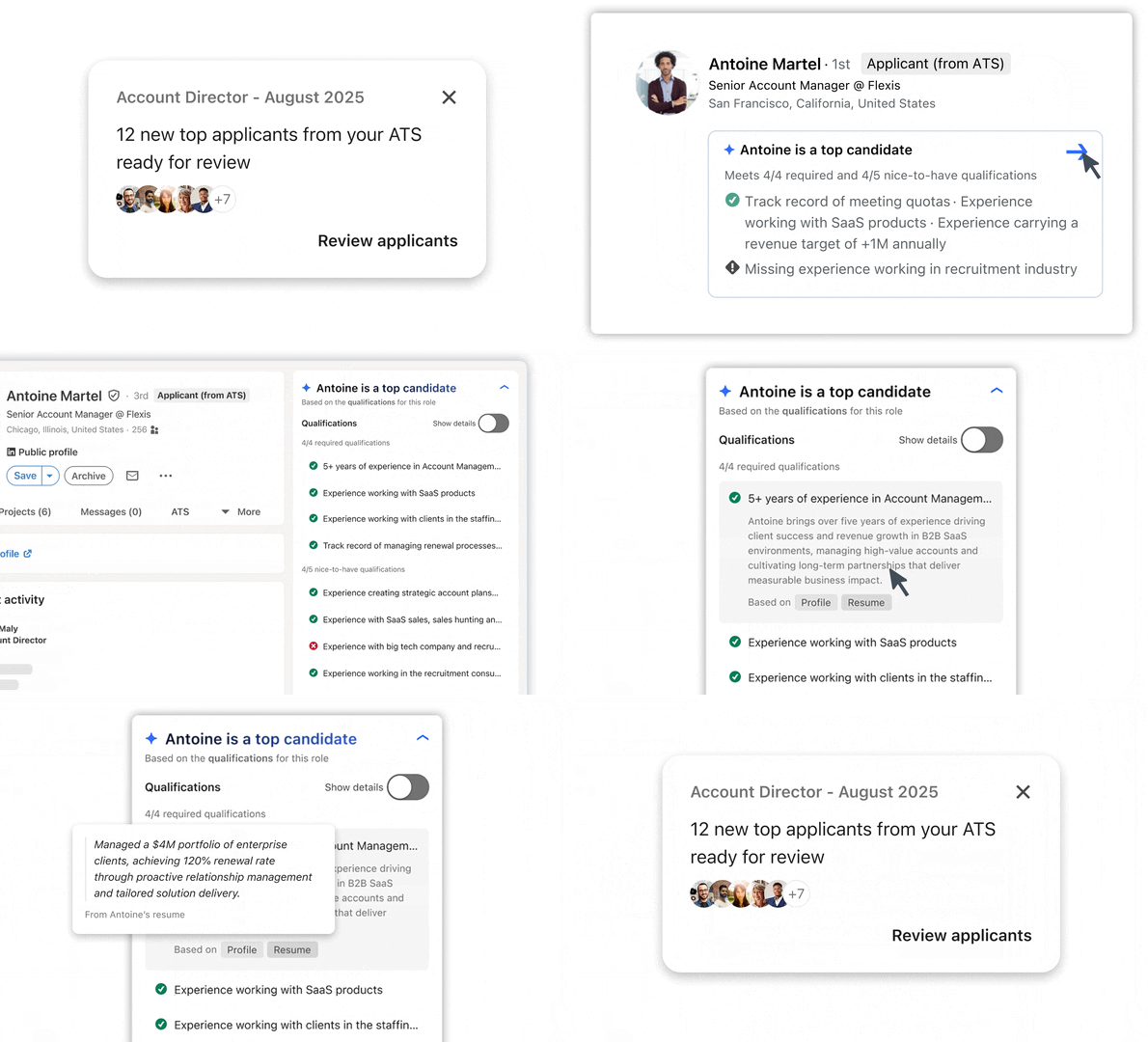
The number that actually matters, though, is the revenue, because revenue is the least gameable signal in a hype cycle. LinkedIn's agentic-AI hiring products are on track for roughly $450 million in annual sales, a figure Satya Nadella broke out on Microsoft's FY26 third-quarter earnings call - Microsoft, and first reported off LinkedIn's own statement - Reuters via Yahoo Finance. To put that in perspective, most standalone recruiting-software companies would consider $50M in ARR a strong outcome. A single incumbent reaching nearly ten times that on agentic hiring products, sold as an add-on to Recruiter, tells you the willingness to pay is real and that the buyers with the largest budgets are the ones adopting first. This is the demand-side confirmation that the technology has crossed into production, not just pilots.
Key adoption and revenue signals for autonomous recruiting agents, 2026
The strategic reason LinkedIn's headline metrics deserve careful reading is that they reveal what agentic recruiting actually optimizes. The 81% fewer profiles figure is not a claim that the agent finds better candidates; it is a claim that the recruiter wastes less attention on obvious non-matches, which is a throughput gain, not a quality gain. The 66% higher InMail acceptance is more interesting because it is an outcome metric: it suggests the agent's personalization and targeting produce messages candidates actually respond to, which is the part of outreach that is hardest to automate well. And the 1.5 hours per role saved is the honest, modest version of the value: a real but bounded time saving on one step, not the "lights-out hiring" the hype implies. Read together, LinkedIn's own numbers describe an agent that makes recruiters faster on volume work, which is exactly the pattern the rest of this guide argues is the durable one.
There is a competitive-dynamics point hiding in LinkedIn's lead that buyers should factor into any purchase, because it shapes the whole market. LinkedIn is part of Microsoft, which means Hiring Assistant can integrate with the productivity stack (Teams, the calendar, the corporate identity layer) in ways a standalone startup cannot, and it can bundle agentic hiring into an existing enterprise relationship. That distribution advantage is why the category's revenue is so concentrated at the top, and it is also why the startups profiled next tend to differentiate on things LinkedIn does not do well: engineering-specific talent, natural-language search over external data, or verticalized outreach. The lesson for a buyer is that LinkedIn is the safe default for graph-native sourcing inside the existing LinkedIn relationship, while the startups earn their place by owning a niche the incumbent cannot serve as precisely. That structural tension recurs across the whole player landscape.
It is also worth naming the limits of LinkedIn's position, because "the incumbent owns the graph" can be over-read into "the incumbent wins everything," which is not what the structure predicts. LinkedIn's graph is dominant for white-collar, English-first, actively-networked professionals, and it is thinner for exactly the populations where much high-volume hiring happens: hourly and frontline workers who do not maintain rich profiles, engineers who live on GitHub rather than LinkedIn, and non-Western labor markets where other networks lead. An agent is only as good as its data, so LinkedIn's agent inherits the coverage gaps of LinkedIn's graph, which is precisely the seam the niche startups exploit. Dex's focus on engineers is not a random vertical choice; it is a bet that the best signal for engineering talent lives in code and community activity that LinkedIn does not fully capture. Alex's multilingual interviewing is a bet on markets and volumes LinkedIn's flagship does not serve as deeply. The correct reading of the flagship, then, is not that it wins by default but that it wins where its graph is dense and cedes ground where its graph is thin, which is exactly why a buyer's first diagnostic question should be whether the talent they need lives on LinkedIn's graph or somewhere the graph does not reach. Where it does, the incumbent is hard to beat; where it does not, a niche agent with better data for that specific population is the stronger buy, and that data-coverage question matters more than any feature comparison in the demo.
4. The Player Landscape and Where the Money Is
The category splits into three tiers by architecture and buyer, and mapping it this way (rather than as a flat list of logos) is what lets a buyer reason about which tier fits their problem. The first-principles reason there are three tiers is that agentic recruiting requires three things that rarely coexist in one company: a large candidate-data graph, a capable agent loop, and a distribution channel into buyers. Incumbents have the graph and distribution but were slow to build the agent. Enterprise talent-intelligence platforms have deep data and matching but sell long, heavy deployments. Funded startups have the sharpest agent loops but must acquire data and buyers from scratch. The tiers are the natural consequence of who had which asset when the technology arrived.
The first tier is the funded startup cohort, and it is where the newest ideas and the honest small-number ARR live. Juicebox (its PeopleGPT product) lets recruiters describe an ideal candidate in natural language and search across a large profile index, then runs AI outreach; it reached over $10M ARR at its Series A with more than 2,500 organizations as customers, part of what was then $36M in total funding including a $30M Series A led by Sequoia - The AI Insider; in March 2026 it added an $80M Series B led by DST Global at an $850M valuation, taking total funding to $116M and its base past 5,000 recruiting teams - Juicebox. Dex focuses on sourcing and outreach for engineering talent and reached about $1.8M ARR since it began charging in late 2025, with more than 15,000 engineers signed up, on a $5.3M seed led by Notion Capital - Fortune. These figures come from credible third-party reporting rather than podcast boasts, which is exactly the filter a buyer should apply to every ARR claim in this space.
Two more startups in this tier illustrate how differently "agentic recruiter" can be scoped. Tezi positioned its agent Max as an autonomous recruiter that proactively sourced, screened, scheduled, and personalized outreach, and the company estimated Max saved customers over 10,000 recruiting hours in its initial months - Tezi. Max is no longer sold: Headway, a mental-health care company, acquired Tezi in early 2026 - Tezi. Alex AI narrows the agent to a single high-value step, running structured screening interviews with candidates, and reports 1,000,000 candidates interviewed cumulatively with support for 30 languages - Alex AI. The contrast is instructive: Tezi automated the whole funnel with a human at checkpoints, while Alex automates one deep step (the screen) exceptionally well. Neither model is more "correct"; they answer different problems, and a buyer choosing between them is really choosing which step of the workflow hurts most.
Disclosed total funding for selected agentic recruiting startups
Source: Juicebox, Fortune (2026)
The second tier is the enterprise talent-intelligence platforms, which approach agentic recruiting from the opposite direction: deep data and matching first, autonomy layered on. Eightfold AI runs a deep-learning talent graph for sourcing, matching, internal mobility, and skills intelligence, one of the largest such platforms by deployment scale, sold as enterprise SaaS on quote-based pricing - Eightfold AI. SeekOut is a talent-intelligence and sourcing platform with deep candidate profiles, diversity sourcing, and analytics for enterprise teams - SeekOut. hireEZ is an outbound-recruiting and sourcing platform that aggregates candidate data and automates personalized outreach at scale - hireEZ. These platforms did agentic-adjacent work (automated matching and outreach) before "agentic" was a word, and they are now wrapping that capability in an agent interface. Their strength is data depth and enterprise integration; their weakness is the long, heavy deployment that makes them impractical for a small team.
The third tier is the recruiting CRM and all-in-one systems where agentic features are being retrofitted onto an existing workflow spine. Gem is a widely adopted recruiting CRM and talent-engagement platform with sourcing automation, pipeline analytics, and an ATS - Gem. Loxo bundles an ATS, CRM, and sourcing/outreach automation into one system - Loxo. Fetcher builds and nurtures candidate pipelines through automated sourcing and outreach - Fetcher. GoPerfect is an AI sourcing-and-recruiting copilot that automates candidate discovery and outreach - GoPerfect. The value of this tier is that the agent lives where the recruiter already works, so there is no new system to adopt; the cost is that the agent is usually a copilot bolted onto a CRM rather than a ground-up autonomous loop, which caps how much of the funnel it can truly run. The full structure of the system-of-record layer these tools sit beside is covered in our ATS Market Structure and Buyer Sentiment 2026.
A note on reading the funding and ARR figures in this section is warranted, because the recruiting-AI space is exactly the kind of ecosystem where inflated self-claims spread fastest. The figures cited here (Juicebox at over $10M ARR and $116M raised, Dex at ~$1.8M ARR on an $8.4M total, Tezi's ~$9M) all come from named third-party reporting or the companies' disclosed funding rounds, which is the standard a buyer should hold every number to. The claims to discount are the ones that appear only on a podcast, a founder's social feed, or a promotional post with no verifiable filing behind them; the pattern in AI generally is that the loudest revenue boasts are the least auditable. Applied here, the discipline means treating Dex's $1.8M as a real but early number (it is small, recent, and honestly reported) rather than dismissing it, and treating any vendor that quotes a dramatic ARR without a source as unproven until a credible outlet confirms it. The healthiest signal in this tier is not the size of the number but the quality of the source behind it, and Fortune reporting a modest figure is worth more than a viral thread claiming a huge one.
The money question, "where is the value actually accruing," has a clear first-principles answer once the tiers are laid out. The largest revenue sits with the incumbent that owns the graph (LinkedIn's ~$450M), because distribution plus proprietary data beats a better agent with neither. The fastest-growing revenue sits with the startups that own a sharp niche (engineering sourcing, natural-language search, autonomous interviewing), because they can grow from zero without fighting the incumbent head-on. And the stickiest revenue sits with the enterprise platforms and CRMs, because their deployments are expensive to rip out. For a buyer, this means the right tier depends less on which agent is "best" in a demo and more on which asset you most need: graph coverage, niche precision, or workflow integration. The market's overall size backs the concentration: the broader AI-in-HR market is projected to reach $15.24 billion by 2030 at a 24.8% CAGR from a 2023 base of $3.25B - Grand View Research, while the narrower dedicated AI-recruitment-software market sat at about $596.16 million in 2025 - Mordor Intelligence, the lowest of the published estimates for that year.
The gap between those two market figures is itself analytically useful, because it quantifies how much of the value is bundled versus standalone. The AI-in-HR market at $15.24B by 2030 includes every AI feature inside every HR system (payroll anomaly detection, learning recommendations, engagement analytics, and much more), while the dedicated AI-recruitment-software market at ~$596M in 2025 is the narrow slice of tools sold specifically to hire people. The order-of-magnitude difference tells you that most AI-in-HR spend is embedded in suites the buyer already owns, and that the pure-play agentic-recruiting market is still small and early relative to the total. For a buyer, the implication is that a lot of the agentic capability they will use in the next two years will arrive as a feature of Workday, LinkedIn Recruiter, or their existing ATS rather than as a new standalone purchase, which is another reason the incumbents' revenue is so concentrated. The standalone startups are competing for the ~$596M slice and the attention of teams whose incumbent suite has not shipped a good-enough agent yet, which is a real but bounded opportunity, and it explains why so many of them niche down rather than trying to be a horizontal LinkedIn competitor.
5. The ROI: Where It Works and What It Really Returns
The single most valuable thing a research house can do on ROI is refuse the vendor number and report the measured one, because the gap between them is enormous and it is where buyers get disappointed. The structural reason the vendor number and the measured number diverge is incentive: a vendor's ROI figure describes the best case under ideal conditions with a motivated pilot team, while the measured number describes the average case across real deployments with real friction. Both are "true" in the narrow sense, but only one predicts what you will actually get. The honest framing is that agentic recruiting delivers a real, bounded return on top-of-funnel volume work, and anyone quoting a single dramatic percentage is quoting a ceiling, not an expectation.
Start with the ceiling so it can be named and then discounted. Vendors commonly cite time-to-hire reductions of up to 70% when AI automates sourcing, screening, and scheduling end to end, a figure that has no single audited source and functions as an upper bound rather than a typical result - Pin. That number is not a lie, but it describes a specific, favorable scenario: a high-volume role where the funnel was previously entirely manual, the data is clean, and the team fully adopts the tool. Change any of those conditions and the return falls. The mistake buyers make is treating the 70% ceiling as a forecast, then judging the tool a failure when they get a fraction of it, when the fraction was always the realistic number.
Time-to-hire reduction, vendor upper bound vs measured average
Source: Pin, InCruiter (2026)
The measured number is more modest and more useful. Organizations deploying AI in recruiting report roughly a 30% cost-per-hire reduction (with some teams reaching up to 40%) alongside about 31% faster overall hiring - InCruiter. A 30% cost reduction and a 31% speed gain are excellent outcomes by any normal software standard; they simply are not the 70% ceiling, and the distance between the two is the credibility gap the category has to manage. The recruiter-time-saving evidence points the same way: the roughly 20% of the work week that generative AI saves recruiters is real and repeatable, but it is one workday reclaimed, not a headcount eliminated - LinkedIn Future of Recruiting via Pin. The consistent shape of the honest data is a meaningful-but-bounded return concentrated on volume and speed, not a wholesale replacement of the recruiting function.
Where agentic recruiting works best follows directly from the workflow analysis, and naming the conditions is more useful than naming a percentage. It works on high-volume roles, because the agent's scale advantage compounds when there are hundreds of candidates to source and screen rather than a handful. It works on well-specified roles, because a clean intake produces a clean search, and a clean search produces outreach worth sending. And it works where the previous process was manual, because automating a manual funnel returns far more than automating an already-optimized one. Tezi's estimate of over 10,000 recruiting hours saved in its initial months is credible precisely because it aggregates many high-volume, previously-manual funnels - Tezi. The corresponding lesson is that if your roles are low-volume, highly specialized, or already efficiently sourced, the return will be smaller, and a vendor who promises otherwise is selling the ceiling.
Where it works worst is equally predictable and equally important to state, because the failure to state it is why so many deployments disappoint. Agentic recruiting struggles on senior and executive roles, where the candidate pool is tiny, the intake is subtle, and the value is in relationship and judgment rather than throughput. It struggles on roles that require deep, non-obvious qualification that a document plus a profile cannot capture. And it struggles anywhere the employer brand is fragile, because an agent that sends high-volume outreach can amplify a bad candidate experience as fast as a good one. The practical ROI framework, then, is not "will this tool save 70%" but "is this a high-volume, well-specified, previously-manual funnel where a bounded 30% cost-and-speed gain on a lot of roles adds up to real money." For most large employers, the answer is yes on a subset of their roles and no on the rest, and the discipline is to deploy agents on the yes-subset rather than everywhere. The function-by-function breakdown of where hiring effort concentrates, and therefore where automation pays, is in our Hiring Effort Benchmarks by Function.
It is worth pressure-testing the ROI claim from the cost side, because a headline "30% cost-per-hire reduction" hides where the savings actually come from and whether they survive contact with the tool's own price. The cost-per-hire of a role is mostly recruiter time plus advertising plus agency fees, and an agent attacks the recruiter-time component by absorbing sourcing and first-touch outreach. If a recruiter previously spent, say, 15 hours per hire on sourcing and screening and the agent cuts that to 10, the raw labor saving is real, but the agent has a cost too (a per-seat or per-role fee that is often quote-based and volume-dependent), and the net saving is the labor saved minus the tool's price minus the governance overhead the tool now requires. On high-volume roles this math works handily, because the fixed tool cost is amortized across many hires and the labor saving compounds. On low-volume roles it can invert: the tool fee and the new governance process cost more than the handful of recruiter hours they save. This is the quantitative version of the "high-volume only" rule, and it is why a buyer should model cost-per-hire on their actual role mix rather than accepting the vendor's blended average, because the blended average was computed on a favorable mix that may not match theirs.
A second-order ROI effect that rarely appears in vendor decks, but that experienced operators care about most, is quality-of-hire rather than speed-or-cost. A faster, cheaper funnel that produces worse hires is a false economy, because the cost of a mis-hire (ramp time, backfill, team disruption) dwarfs the recruiting savings. The honest position is that the current evidence base measures speed and cost far better than it measures quality, precisely because quality-of-hire takes months to observe and is hard to attribute cleanly to the sourcing tool. This measurement gap cuts both ways: it means the optimistic case (agents improve quality by widening the top of funnel and reducing recruiter fatigue) and the pessimistic case (agents degrade quality by over-relying on keyword-adjacent matching) are both under-evidenced, and a disciplined buyer should treat quality as an open question to monitor rather than a settled benefit to assume. The practical move is to instrument quality-of-hire before deploying an agent (define it, baseline it) so that the tool's real effect can be measured against the baseline rather than inferred from a speed number that says nothing about whether the faster hires were better ones.
6. Failure Modes: Agent Washing, Cancellations, and Cold Starts
A guide that only lists the upside is a brochure, so the honest core of this piece is the catalog of how agentic recruiting fails, reasoned from why rather than merely listed. The most important failure is not technical; it is definitional. Agent washing is the practice of rebranding an assistant, a chatbot, or a rules-based automation as an "agent" to ride the hype, and it is rampant enough that Gartner estimates only about 130 vendors out of thousands making agentic claims actually offer genuine agentic features - MarTech. The buyer harm is direct: you pay for autonomy and receive a feature, then blame "agentic AI" when the disappointment is really a mislabeled product. The three-question test from Section 1 (does it hold a goal, sequence its own actions, and use tools in a continuous loop) is the defense, and applying it before purchase prevents most of this category's regret.
The second failure is the project-cancellation rate, and it is worth understanding structurally rather than as a scare statistic. Gartner predicts over 40% of agentic-AI projects will be canceled by the end of 2027, driven by escalating costs, unclear business value, and inadequate risk controls - Gartner. The reason so many die is not that the technology cannot work; it is that most projects are early experiments driven by hype and misapplied to problems where an agent has no advantage, with no clear ROI target and no governance to keep them safe. In recruiting specifically, this maps to teams deploying an agent on their hardest, lowest-volume roles (where it works worst) rather than their high-volume ones (where it works best), then concluding the category failed when they mis-scoped the pilot. The cancellation rate is a warning about deployment discipline, not a verdict on the technology.
The failure tree from mislabeling to cancellation
The third failure is the cold-start data problem, which is the most technical and the most decisive for standalone agents. An agent's output quality is bounded by its input data: it can only source from the profiles it can see, and it can only rank well if the data behind those profiles is rich and current. A startup agent without LinkedIn's graph has to acquire candidate data, and thin, stale, or biased data produces thin, stale, or biased shortlists no matter how sophisticated the agent loop is. This is the structural reason graph-owning incumbents have an advantage that funding cannot easily close, and it is why a buyer should probe the data layer as hard as the agent layer. An agent demo on curated data tells you nothing about how it performs on your actual, messy hiring problem, and the cold-start gap is where impressive demos become disappointing deployments.
The fourth failure is the candidate-experience blowback, which is the one that shows up in the labor market rather than the software. When agents send high-volume outreach and run one-way screens without care, candidates disengage, and the data on disengagement is stark. Job seekers ghosted by an employer in the past year hit 53% in 2026, a three-year high, up from 48% in 2025 and 38% in 2024 - Fortune, citing Criteria. And roughly one in three candidates have walked away from a job rather than sit through a one-way AI interview - ReadySetExec. The causal chain is not subtle: automating the funnel without human warmth degrades the experience, degrading the experience raises ghosting, and rising ghosting corrupts the very pipeline the agent was supposed to build. An agent that optimizes for send-volume while ignoring experience is optimizing itself into a worse funnel, which is the deepest failure mode of all.
There is a fifth failure that is quieter and more insidious than the others, and it deserves its own beat because it undermines the case for autonomy from the inside. An autonomous agent that runs unsupervised will, over time, drift toward whatever its metric rewards, and if that metric is response rate or shortlist size, the agent will learn to over-message, over-broaden, or over-promise to hit the number. Because the agent is persistent and acts across time (the property from Section 1 that makes it powerful), a small misalignment compounds: a slightly-too-aggressive outreach cadence becomes a spam pattern over thousands of sends, and a slightly-too-loose qualification threshold becomes a pipeline full of mismatches by the end of the quarter. This is why the strongest deployments treat the agent's objective function as a governance concern, not just a technical one, and why the human checkpoint at outreach and shortlist is not bureaucratic friction but the mechanism that keeps a persistent optimizer honest. The failure modes are not independent; agent washing, cold starts, and misalignment all funnel into the same outcome, an unsupervised system producing plausible-but-wrong results at scale, which is exactly the pattern the governance section exists to prevent.
7. The Candidate-Experience and Legal Reckoning
The failure modes in the previous section are not only operational; several are becoming legal, and the reckoning arriving in 2026 is the reason human-in-the-loop is no longer optional. The first-principles point is that an autonomous system acting on real people at scale generates legal exposure that a manual process spreads across many individual human decisions. When a recruiter rejects a candidate, the decision is one person's judgment; when an agent rejects ten thousand candidates on the same logic, a single flaw in that logic becomes a systemic, class-actionable pattern. Automation does not just speed up hiring; it concentrates the legal consequences of any bias into one reviewable system, which is precisely what makes agentic recruiting a litigation target.
The landmark case is Mobley v. Workday, which has moved from a novel theory to a certified collective action and reframed how the whole industry thinks about AI-vendor liability. The core allegation is that algorithmic hiring tools can produce disparate impact on protected groups, and the case's significance is that it treats the AI vendor, not only the employer, as a potential agent in the hiring decision. That is a structural shift: it means the company that builds the agent shares in the liability the agent creates, which changes the incentives of every vendor in the category. We cover the full legal architecture, the disparate-impact theory, and what it means for buyers and builders in our dedicated analysis, AI Hiring Liability: Mobley v. Workday. For the purposes of this guide, the takeaway is that autonomy without auditability is now a legal risk, not just an operational one.
Where regulation and checkpoints wrap the autonomous loop
The regulatory layer is thickening in parallel, and three regimes matter most for anyone deploying an agent. NYC Local Law 144 requires bias audits and candidate notice for automated employment decision tools, with non-compliance penalties of $500 to $1,500 per violation per day of ongoing non-compliance - Employsome. The EU AI Act classifies employment and recruitment AI as high-risk, imposing conformity assessments, transparency, and human-oversight obligations on systems that screen or rank candidates. And Colorado has already rewritten its rules once: SB 26-189, signed 14 May 2026 and effective 1 January 2027, repealed and replaced the 2024 Colorado AI Act, dropping its duty of reasonable care, risk-management programs, and annual impact assessments in favor of a narrower set of duties around automated decision-making in consequential decisions: notice that a consumer is interacting with AI, disclosure within 30 days of an adverse outcome, correction of inaccurate personal data, and meaningful human review - Davis Wright Tremaine. The common thread across all three is that they mandate exactly the things agent washing skips: auditability, notice, and human oversight, which means the compliant way to run an agent is also the well-governed way to run one. Colorado also shows the second-order risk, that a regime an operator built for can be rewritten mid-cycle, so the durable investment is the audit trail rather than any one statute's checklist.
The candidate-experience data makes the legal exposure worse rather than better, because a bad experience is often also a discriminatory one. When 53% of job seekers report being ghosted and one in three walk away from one-way AI interviews, the disengagement is not evenly distributed; it falls hardest on candidates already less likely to have the network to bypass the automated funnel. Public opinion has hardened accordingly: 71% of Americans oppose AI making the final hiring decision, with just 7% in favor - Pew Research Center. That opposition is not sentimentality; it is a signal that a fully autonomous hiring decision carries reputational and legal risk that no efficiency gain justifies, which is why even the most aggressive agent vendors stop short of automating the final decision. The line the market has drawn (automate the funnel, keep the human on the decision) is the same line the law is drawing.
It is worth reasoning about why bias concentration is a structural property of automation rather than a bug that better engineering will fully remove, because that framing changes how a buyer should think about vendor promises of "bias-free" AI. Any screening system, human or machine, applies some decision rule to a population of candidates, and any decision rule that correlates with a protected characteristic (even indirectly, through a proxy like a zip code, a school, or a gap in employment history) produces disparate impact. A human recruiter applies an inconsistent, idiosyncratic version of such rules, so their biases are real but scattered and hard to prove as a pattern. An agent applies one consistent rule to everyone, which is the whole point of automation, but consistency means that if the rule has a biased proxy baked in, every single candidate is judged by the same biased proxy, turning scattered individual bias into a clean statistical pattern that a plaintiff's expert can measure. This is the uncomfortable core of the Mobley theory: automation does not necessarily create more bias per decision, but it makes whatever bias exists systematic, measurable, and therefore actionable. A vendor claiming their agent is "bias-free" is either misunderstanding the problem or overselling, because the honest claim is not zero bias but tested, monitored, and mitigated bias with an audit trail to prove the mitigation.
That reframing has a direct operational consequence, which is that bias testing cannot be a one-time certification at purchase; it has to be a continuous cadence, because an agent that acts across time drifts. The candidate population changes, the model behind the agent gets updated, the labor market shifts, and a rule that passed a bias audit in January can fail one in July without anyone touching the code, simply because the inputs moved. This is why the laws increasingly mandate periodic audits rather than one-time approvals, and why the governance layer described in the next section treats bias testing as a recurring process with an owner, not a checkbox at deployment. The buyer's mental model should be that an agent is less like a certified appliance and more like a financial model that needs re-validation as conditions change, and the vendors worth trusting are the ones that build the re-validation in rather than the ones that sell a certificate and move on.
The practical synthesis is that the legal and experiential failures point to the identical mitigation, which is convenient for buyers because it means compliance and quality are the same investment. An agent that logs its reasoning, keeps a human approving outreach and shortlists, provides candidate notice, and submits to bias audits is simultaneously the compliant agent, the auditable agent, and the one that produces a better candidate experience. There is no trade-off here between doing right and doing well; the governed agent is the good agent. The deep treatment of how the verification and trust stack fits around all of this, including the deepfake and identity-verification problem that agentic outreach amplifies, is in our Hiring Fraud and the Deepfake Verification Stack. The governance section that follows turns this synthesis into an operating model.
8. Human-in-the-Loop and Governance
Given the ROI, the failure modes, and the legal reckoning, the central operating question of agentic recruiting is not "how autonomous can we make it" but "where must the human stay," and answering it from first principles produces a clearer policy than any vendor default. The structural principle is that a human belongs at every step where the agent acts on a candidate or makes a decision with legal or reputational weight, and the agent can run freely at every step where it merely informs a recruiter. That single rule (human on the acting-and-deciding steps, agent on the informing steps) resolves most of the governance question, because it maps cleanly onto the seven-step workflow: sourcing and screening inform, so the agent runs them; outreach, reply-handling, and final selection act or decide, so the human approves them.
The market has independently converged on this same line, which is strong evidence that it is the right one. When an AI recommendation conflicts with a recruiter's judgment, recruiter judgment overrides the AI in 58% of organizations, and recruiters remain the most frequent users of these tools at 46% - iCIMS and Aptitude Research, and 71% of Americans oppose AI making the final hiring decision, with just 7% in favor - Pew Research Center. When practitioners and the public agree this strongly on where the human line sits, a vendor who crosses it is fighting both their users and their users' candidates. The demand signal reflects the same discipline: 52% of talent leaders plan to add autonomous AI agents to their recruiting teams in 2026 - Korn Ferry, and 84% plan to use AI in some form - Korn Ferry, but they are adding agents as team members under human supervision, not as replacements for the human decision.
2026 adoption intent and the human-in-the-loop insistence
The governance gap, however, is real and dangerous: intent to supervise is not the same as infrastructure to supervise. About 45% of companies report they do not yet have a formal AI governance framework in place, even though 82% say transparency and explainability matter - iCIMS and Aptitude Research, which means nearly half of the organizations deploying these tools have no policy defining where the human checkpoint sits, no audit trail, and no bias-testing cadence. This is the quiet crisis of the category: the human-in-the-loop consensus is strong in principle and weak in practice, because "the recruiter approves the shortlist" is a checkpoint only if there is a process that forces the approval and logs it. Without governance infrastructure, an agent that is nominally supervised is effectively autonomous, because a rubber-stamp approval is not oversight. The 45% figure is the single most actionable number for a talent leader, because closing that gap is entirely within their control and is the precondition for deploying agents safely.
Building the governance layer is less exotic than it sounds, and reasoning about it from the failure modes tells you exactly what it must contain. It needs a defined human checkpoint at outreach and at selection, because those are the acting-and-deciding steps. It needs an audit trail of the agent's reasoning, because Mobley v. Workday and the bias-audit laws require you to reconstruct why a decision was made. It needs candidate notice, because Local Law 144, the EU AI Act, and Colorado's replacement law all mandate it, and a bias-testing cadence, because Local Law 144 and the EU AI Act require it even though Colorado no longer does. And it needs an objective function for the agent that rewards quality-of-hire rather than raw send-volume, because that is what keeps a persistent optimizer from drifting into spam. None of these are optional if the goal is an agent that survives an audit and a labor market, and together they are the difference between supervised autonomy and unsupervised risk.
The deeper first-principles reason human-in-the-loop is durable, rather than a transitional phase until models improve, is worth stating because a lot of commentary assumes autonomy will inevitably win as capability rises. It will not, and the reason is accountability, not capability. Even a perfect model cannot hold a professional license, cannot be deposed, cannot bear liability, and cannot be the accountable party a regulator or a court requires. Hiring is a consequential decision about a person's livelihood, and consequential decisions require an accountable human by law and by norm, regardless of how good the machine gets. This is the same structural logic that keeps a liability-bearing human in the loop for regulated filings and medical decisions, a pattern we examine in the context of entry-level work in our Entry-Level Hiring Collapse and AI. The agent will get better at the informing steps indefinitely, but the accountable human on the deciding step is a permanent fixture, which means the winning architecture is not lights-out hiring but a durable human-agent partnership.
9. Build vs Buy and the Hybrid Default
With the operating model settled, the question every serious team eventually faces is whether to build an agent, buy one, or combine them, and the first-principles answer has shifted decisively toward a hybrid in 2026. The reason to reason from primitives here is that "build vs buy" is usually framed as a binary when it is actually a decomposition: an agentic recruiter is made of a data layer, a model layer, an agent-orchestration layer, and a workflow-integration layer, and the right decision differs for each layer. Almost no one should build the model layer (the frontier labs have that), almost no one should build the data layer at LinkedIn's scale (the graph is a decade-long moat), and the interesting decisions are in orchestration and integration, which is exactly where a hybrid emerges.
The case against building the whole stack is overwhelming for all but the largest tech companies. Building a competitive agent means acquiring or licensing candidate data (the cold-start problem from Section 6), keeping pace with frontier models that change every few months, engineering an agent loop that handles the messy reality of intake and reply-handling, and then maintaining all of it against a moving regulatory target. The current frontier models are strong enough to power a capable agent (Anthropic's newest frontier model is Claude Opus 5.5, released on September 22, 2026 - Anthropic, and OpenAI's flagship is GPT-6 Astra, introduced on September 3, 2026 - OpenAI), but the model is the easy part; the data, the orchestration, and the governance are where build projects die. This is a large part of why Gartner's 40%+ cancellation rate is so high: many of those canceled projects were ambitious internal builds that underestimated the layers below the model.
The hybrid default: buy the hard layers, own the workflow fit
The case for buying, and specifically for buying the agent while owning the governance, follows from where the durable value sits. What you cannot buy off the shelf is your own hiring process, your own definition of quality-of-hire, your own governance checkpoints, and your own employer brand voice in outreach. What you should not try to build is the graph, the model, or the core agent loop. The hybrid default that has emerged is therefore to buy the agent from a tier that fits your problem (LinkedIn for graph-native sourcing, a startup for a sharp niche, a platform for enterprise depth) and to invest your own effort in the workflow-and-governance layer that wraps it: the checkpoints, the audit trail, the objective function, and the integration into your ATS. This is the pattern that survives the failure modes, because it puts your control exactly where the legal and quality risk lives while outsourcing the parts where scale and data win.
There is a middle path that some larger teams take, which is to buy the model and orchestration primitives and thin-build the agent on top, and it is worth understanding when it makes sense. If your hiring is unusual enough that no off-the-shelf agent fits (a highly specialized talent pool, an idiosyncratic process, a regulatory environment no vendor serves), then a thin build over bought primitives lets you encode your specificity without rebuilding the model or the graph. The trade-off is that you now own the orchestration maintenance and the governance engineering, which is real ongoing cost, so this path only pays when your specificity is a genuine competitive advantage rather than mere habit. For the large majority of teams, the specificity is not that valuable and the maintenance burden is not worth it, which is why the pure hybrid (buy the agent, own the governance) is the default rather than the thin-build.
The maintenance point deserves emphasis because it is the hidden cost that kills build projects after the launch celebration, not before it. A frontier model that was state-of-the-art when the build started is superseded within months (the cadence from Claude Sonnet 5 and Claude Opus 4.8 to OpenAI's GPT-5.6 family has been a new flagship roughly every quarter), which means a self-built agent needs continuous re-testing and re-tuning just to keep pace, on top of the ordinary maintenance of the orchestration, the integrations, and the data pipeline. A bought agent externalizes all of that: the vendor absorbs the model churn, the data refresh, and the regulatory updates, and the buyer inherits the improvements without doing the work. This is the same logic that makes almost no company build its own database engine or email-deliverability stack: the layer is hard, fast-moving, and not where the buyer's advantage lives. The recruiting-specific version is that the agent's model-and-data layer is exactly the kind of commoditizing infrastructure that should be rented, while the process-and-governance layer is exactly the kind of proprietary advantage that should be owned, and the whole build-vs-buy debate resolves once you decompose it that way instead of treating "the agent" as one indivisible thing.
There is also a cost-of-failure asymmetry that should weight the decision toward buying for all but the most sophisticated teams. If a bought agent underperforms, the buyer switches vendors, absorbs a migration cost, and moves on, with the sunk cost bounded by the contract. If a self-built agent underperforms, the buyer has sunk engineering headcount, data-acquisition spend, and months of calendar time into an asset that may need to be rebuilt or abandoned, which is precisely the profile of the projects inside Gartner's 40%+ cancellation rate. The asymmetry means that even when a build looks marginally cheaper on a spreadsheet, the risk-adjusted cost usually favors buying, because the spreadsheet rarely prices the probability and the magnitude of a failed build. A rational team treats the build decision the way it would treat any bet with a high failure rate and a large downside: it requires a genuinely compelling reason (real, durable specificity) to justify the risk, and in the absence of that reason it buys, wraps the bought agent in owned governance, and puts its scarce engineering effort into the workflow fit that actually differentiates its hiring.
The decision that ties this section to the rest of the guide is to match the tier to the problem before touching the build-vs-buy question at all, because buying the wrong tier is a more common failure than building versus buying. A high-volume team drowning in applicants should buy graph-native sourcing and own the outreach governance. An engineering-heavy team should look at niche agents built for technical talent and own the technical-screen checkpoint. An enterprise standardizing across thousands of reqs should buy a talent-intelligence platform and own the cross-req audit trail. In every case the owned layer is governance and workflow fit, and the bought layer is data and agent capability. The talent marketplaces and AI-native hiring models that are absorbing some of this demand, and that change the build-vs-buy calculus for certain roles, are the subject of our Talent Marketplaces and AI-Native Hiring forecast.
10. The 2026-2028 Outlook
Forecasting agentic recruiting requires holding two truths at once: the inflection is real and money-backed, and the category is mid-hype with a high failure rate, which means the next two years will sort the durable from the disposable rather than confirm a foregone conclusion. The structural forecast, reasoned from everything above, is that autonomous agents will become standard infrastructure for high-volume top-of-funnel work while the human decision layer stays firmly in place, and that the market will consolidate as agent washing collapses and a trust reckoning separates the real vendors from the rebranded ones. Rather than predict a single outcome, the useful contribution is to specify the indicators that will reveal which way the category breaks, so an operator can update in real time.
The demand-side trajectory is the clearest signal, and it points up. Gartner projects that 30% of recruitment teams will rely on AI agents for high-volume hiring and early-stage tasks by 2028 - Gartner via Pin, and 52% of talent leaders already plan to add autonomous agents this year - Korn Ferry. The precise wording of the Gartner projection is the tell: "high-volume hiring and early-stage tasks," not "hiring." The forecast itself encodes the human-in-the-loop pattern, projecting agents into exactly the informing-and-volume layer this guide argues is durable and staying silent on the deciding layer. When even the bullish forecast draws the same line practitioners and the public draw, the line is real, and the 2028 picture is one of agents everywhere in the funnel and humans firmly on the decision.
Near-term intent and the 2028 reliance projection measure different things, so the two bars are not comparable year over year
The first indicator to watch is consolidation, because the current fragmentation is unsustainable. With only about 130 genuinely agentic vendors among thousands of claimants, the gap between real and rebranded will close through acquisition and failure, not through everyone succeeding. Watch for incumbents (LinkedIn, the enterprise platforms, the major ATS vendors) acquiring the sharp-niche startups to fill capability gaps, and watch for the agent-washed products to quietly drop the label as buyers get better at the three-question test. The 40%+ project-cancellation rate Gartner projects is the mechanism of this consolidation: the canceled projects and the failed vendors are the same phenomenon viewed from the buyer and seller sides. A healthy sign for the category will be a shrinking number of vendors with a growing share of real deployments, which is what a market looks like after a hype cycle resolves.
The second indicator is the trust reckoning, and it will play out in the candidate experience and the courts simultaneously. If ghosting stays at its 53% three-year high and one-way-interview walkaways stay near one in three, the category will face a backlash that forces vendors to compete on experience and governance rather than raw automation, which would be healthy. If the Mobley v. Workday collective action produces a large adverse outcome, vendor liability will become a design constraint that reshapes every product toward auditability. Watch the resolution of that case, the enforcement patterns under Local Law 144 and the EU AI Act, and whether candidate-experience metrics improve or degrade as agent adoption rises. The category's long-term legitimacy depends on the trust reckoning breaking toward governed autonomy rather than unaccountable automation, and the leading vendors are already positioning for that outcome.
The closing judgment is that the apocalyptic frame ("AI recruiters replace recruiters") and the dismissive frame ("it is all agent washing") are both wrong, and the structural frame is right. Autonomous agents are becoming real infrastructure for the high-volume, well-specified, previously-manual top-of-funnel, delivering a bounded but genuine 30%-range return on cost and speed, governed by a durable human-in-the-loop on the acting-and-deciding steps. The category is simultaneously money-backed and mid-hype, which is exactly what an early-innings real technology looks like, and the operators who win will be the ones who scope agents to where they work, wrap them in governance the law now requires, and keep the accountable human on the decision. The industry veteran's framing that best captures the shift comes from Yuma Heymans (@yumahey), co-founder and CEO of HeroHunt.ai, the Amsterdam-based AI recruiting engine that publishes AIRecruiter.co and whose own autonomous sourcing agent (branded AI Recruiter) is a live instance of the pattern this guide describes: the recruiter's job moves from doing the sourcing to supervising the agent that does it, and the firms that win are the ones that move their people up the value chain rather than the ones that try to remove them.
Decision Framework
The practical takeaway compresses into a sequence a talent leader can act on this quarter. First, apply the three-question test (goal, self-sequencing, tool-loop) to disqualify agent-washed products before you evaluate anything else. Second, scope the agent to your high-volume, well-specified, previously-manual roles, where the bounded 30%-range return actually compounds, and keep it off your senior and specialized reqs, where it works worst. Third, match the tier to your binding constraint: buy graph-native sourcing if coverage is your problem, a niche agent if precision is, and an enterprise platform if standardization is. Fourth, own the governance layer regardless of what you buy, closing the 45% no-framework gap with defined checkpoints at outreach and selection, an audit trail, candidate notice, bias testing, and a quality-of-hire objective. Fifth, keep the accountable human on the final decision, because that line is fixed by law and norm no matter how capable the model becomes. Do these five things and agentic recruiting is a real, bounded, governable advantage; skip them and it is a canceled project waiting to happen.
This guide reflects the agentic AI recruiting landscape as of July 2026. Funding rounds, pricing, product capabilities, model versions, and the legal and regulatory picture change quickly, and several cited figures are company-supplied or forecast rather than audited, so verify current details against the linked primary sources before acting on them.