03The full analysis
How one vendor ruling re-routed the entire liability map of automated hiring, just as federal enforcement walked away.
A single AI vendor now sits as the named defendant in a nationwide collective action tied to roughly 1.1 billion rejected job applications - Workday's own court filings put that number on the record. That figure is not a typo and it is not hyperbole. It is the structural fact that should reorganize how every recruiting leader, general counsel, and HR-tech buyer thinks about who carries the bias risk when software decides who gets an interview.
For two decades, the default liability map of hiring discrimination was simple and stable. An applicant who believed they were rejected because of age, race, or disability sued the employer. The employer carried the duty under Title VII, the Age Discrimination in Employment Act (ADEA), and the Americans with Disabilities Act (ADA). The software vendor that supplied the screening tool sat behind a contract, shielded by the framing that it merely sold a tool and the human employer made the decision. The problem this guide unpacks is that Mobley v. Workday has inverted that map. A federal court in California has held that an AI vendor can be sued directly as an agent of the employer, and as an employer itself under the three core federal anti-discrimination statutes. The thousands of separate employer defendants collapse into one deep-pocketed, nationwide vendor defendant. And this inversion is landing at the exact moment the federal disparate-impact machinery is being dismantled by executive action, leaving the binding enforcement to a plaintiffs' bar armed with a certified collective. The load-bearing question for 2026 to 2028 is no longer "is the AI biased?" It is "who is contractually and legally holding the bag when a plaintiff proves it is, and what does that do to the unit economics of selling screening software?"
Contents
- The Liability Inversion: Why a Single Vendor Ruling Reorders an Entire Market
- Anatomy of Mobley v. Workday: From One Rejected Applicant to a Nationwide Collective
- The Agent Theory: How Software Became an "Employer"
- The Federal Retreat: EO 14281, the EEOC Vacuum, and the June 2026 DOJ Opinion
- Enforcement Migrates to Three New Channels: Private Bar, State AGs, and the Courts
- The Slipping Compliance Calendar: Why the 2025 Deadlines Are Wrong
- What the Audits Actually Show: AI Bias by the Numbers
- The Litigation Wave Beyond Workday: Eightfold, HireVue, Aon, SafeRent, and FCRA
- Repricing the Stack: Indemnification, Procurement, and HR-Tech Valuations
- The Named Field: Platforms, Auditors, and Their Exposure
- The Counter-Narrative: Why This Might Be Overstated
- Playbook 2026 to 2028: What Buyers and Builders Should Do Now
1. The Liability Inversion: Why a Single Vendor Ruling Reorders an Entire Market
Start with the fundamental structure, because the structure is what makes this a market event rather than a niche employment-law story. Hiring discrimination law in the United States was built around a one-to-one relationship between an aggrieved applicant and an employer. The statutes name the employer as the duty-holder. The remedies run against the employer. The class certification mechanics, the burden-shifting frameworks, and the damages models all assume that the entity making the hire is the entity that pays when the hire is tainted by bias. Software vendors were never the target of this architecture. They sold a product, the employer bought it, and the contract between them allocated risk privately through indemnification, limitation of liability, and warranty disclaimers. The plaintiff almost never reached the vendor, because the plaintiff's statutory hooks pointed at the employer.
What Mobley v. Workday does is sever that assumption at the root. By holding that a vendor whose algorithm performs the rejection can be treated as an agent of the employer, and therefore falls within the statutory definition of employer for purposes of Title VII, the ADEA, and the ADA, the Northern District of California created a new kind of defendant that the old map did not contemplate: a single vendor whose tool touched the hiring decisions of thousands of employers simultaneously. The economic consequence is a kind of liability aggregation. Where a discriminatory pattern in one company's hiring would once have produced one lawsuit against one employer, a discriminatory pattern baked into one widely-deployed algorithm now produces one lawsuit against one vendor that aggregates the harm across the vendor's entire customer base. This is why the 1.1 billion rejected applications figure matters so much. Workday represented to the court that roughly 1.1 billion job applications were rejected using its tools during the relevant period, and speculated the collective could reach "hundreds of millions" of people. That is not 1.1 billion individual plaintiffs and it is not 1.1 billion distinct people. It is a count of rejections that defines the universe from which a nationwide collective is drawn, and it is an order of magnitude no single-employer case has ever approached.
The reason this inversion is not merely a curiosity is timing. The same eighteen-month window that produced the agent theory also produced a coordinated federal retreat from disparate-impact enforcement. Executive Order 14281, signed in April 2025, directed agencies to reduce reliance on disparate impact. The EEOC removed its AI guidance. And in June 2026, the Department of Justice's Office of Legal Counsel concluded that the EEOC's disparate-impact guidelines are unconstitutional. A naive reading is that this kills disparate-impact liability for AI hiring. The first-principles reading is the opposite: the federal channel that once absorbed and managed this risk through regulators with deadlines has been hollowed out, and the displaced enforcement energy is flowing into private litigation, where there is no regulator to negotiate with and no agency discretion to soften the blow. Risk did not disappear. It privatized and re-routed.
It is worth pausing on why the single-defendant geometry is so much more dangerous than the distributed model it replaced, because the difference is not just cosmetic. In the old world, a discriminatory hiring pattern at one employer produced a claim bounded by that employer's headcount, its hiring volume, and its insurance. The damages were finite and the defendant was one of thousands, which diffused both the legal and the reputational pressure across the market. In the new world, a flaw in one widely-deployed algorithm becomes a single point of failure for the entire customer base that runs it. The same network effects that make a dominant hiring platform valuable (more employers, more applicants, more data) also make it a more concentrated target, because every additional employer that adopts the tool enlarges the collective and deepens the aggregated harm. The economics of a platform business and the economics of its litigation exposure scale together, in the same direction, which is a property no single-employer defendant ever had.
Consider what the old diffusion actually bought the system, because it was doing more work than anyone noticed at the time. When a thousand employers each carried their own slice of hiring-discrimination risk, the legal system processed that risk in a thousand separate, manageable pieces. Each case had its own facts, its own damages ceiling tied to one company's payroll, and its own insurer pricing a known and contained exposure. No single judgment could threaten the existence of the underlying screening technology, because no single employer's case implicated the tool itself rather than that employer's use of it. The diffusion was, in effect, a shock absorber: it spread the impact of any one discriminatory outcome thinly enough that the market never had to confront the question of whether the tool category itself was lawful. The agent theory removes the shock absorber. It routes every employer's slice back to a common origin point, the vendor, and asks that origin point to answer for the aggregate. A risk that was previously processed as a thousand small claims is now processed as one enormous one, and the enormous one cannot be settled quietly the way a small one can, because the settlement number itself becomes a public reference point that reprices every comparable deal in the market.
The insurance consequence deserves its own beat, because it is where the abstraction becomes a line item on a budget. Employment practices liability insurance (EPLI) was built and priced around the distributed model: a carrier insuring a single employer could estimate that employer's exposure from its headcount, its hiring volume, and its claims history, and could cap its own downside with policy limits tuned to a single-company worst case. A vendor sitting inside the agent theory presents a fundamentally different actuarial object. Its potential exposure is not bounded by its own headcount but by the aggregate hiring decisions of its entire customer base, which is a number orders of magnitude larger and far harder to model. Carriers respond to unmodelable tail risk in predictable ways: they raise premiums, they tighten exclusions (often carving out algorithmic-bias claims specifically), and they push insureds to demonstrate independent audits before they will write the policy at all. So the inversion does not only change who gets sued. It changes who can get insured, on what terms, and at what cost, and that change flows straight through to the price and the contractual shape of every AI hiring tool sold into the market.
How Mobley collapses many employer defendants into one vendor defendant
To see why this repriced an entire category rather than just one company, hold the structural insight next to the market data. AI is no longer a fringe input into hiring decisions. The broader AI-in-HR market is estimated at $6.3 billion for 2026, up from $3.25 billion in 2023 and projected to reach $15.24 billion by 2030 at a 24.8% CAGR - Grand View Research. That figure counts AI across every HR function; published estimates for AI recruitment software alone are about a tenth of it. Adoption is broad enough that the liability is systemic, not isolated. About 43% of organizations now use AI in HR, up from 26% in 2024, and among those that do, recruiting is the most common application, cited by 51% - SHRM, and the forward indicator is steeper still. Gartner reports that 82% of HR leaders plan to deploy agentic AI in HR by May 2026 - the firm's own 2026 trends release. When a category this large and this fast-growing suddenly acquires a new, concentrated, vendor-side liability vector, the effect ripples through procurement contracts, indemnification clauses, insurance pricing, and equity valuations. To understand how a single ruling can carry that much weight, you need the full structural picture of adoption, and the State of AI in Recruiting 2026 lays out the adoption baseline that makes vendor liability a market-wide problem rather than an edge case.
The rest of this guide builds outward from that inversion. We trace the case itself, the doctrine that powers it, the federal retreat that sharpens it, the new enforcement channels that absorb the displaced risk, the corrected compliance calendar, the empirical evidence on whether AI is actually biased, the broader litigation docket, the commercial repricing, the named field of exposed and profiting players, the honest counter-arguments, and finally a concrete playbook for buyers and builders. Throughout, the throughline is the same: disparate-impact risk is migrating up the supply chain, from the buyer to the builder, and that migration is the single most important structural fact in talent acquisition technology right now.
2. Anatomy of Mobley v. Workday: From One Rejected Applicant to a Nationwide Collective
Every structural shift in employment law starts with a specific person, and this one starts with Derek Mobley. He is a Morehouse College graduate who, like millions of job seekers, encountered the same hiring software again and again because so many employers run it. Mobley submitted more than 100 job applications through Workday's platform and was rejected every single time - as recited in the court's own opinion, often within the hour and sometimes in the middle of the night, without ever reaching an interview. The detail about timing is not color. It is evidence. A rejection that arrives at 1:50 a.m., less than an hour after submission, is a rejection no human reviewed. It is the signature of a fully automated decision, and it is exactly the kind of delegated, machine-made rejection that the agent theory targets. The speed that recruiting software sells as efficiency is the same speed that, in a discrimination case, reads as the absence of human judgment.
Mobley's theory was that the algorithmic screening disadvantaged him on the basis of race, age, and disability, and that because the same tool sat between him and a hundred different employers, the harm was not idiosyncratic to any one company's hiring manager. It was systematic, embedded in the tool, and reproduced at scale. That framing is what eventually transformed a single applicant's complaint into a nationwide collective. The procedural path matters because each milestone widened the aperture, and the cumulative effect is a case that now functions as the test bed for vendor liability across the entire industry. The contrast between the speed of these automated rejections and the deliberate, human-reviewed pace that is now legally advisable is exactly the tension explored in the Hiring Effort Benchmarks by Function, which puts numbers to how long real human-reviewed hiring actually takes.
The timeline is worth tracing carefully, because the sequence is the argument. The original complaint was filed in 2023. The pivotal doctrinal ruling came in 2024. The certification and notice machinery turned in 2025. And 2026 has been a year of escalation rather than resolution.
From a single 2023 complaint to a nationwide collective heading into discovery
The first load-bearing event was the July 12, 2024 ruling. The Northern District of California allowed claims that Workday acted as an agent of employers to proceed, holding Workday falls within the definition of employer for Title VII, the ADEA, and the ADA, while dismissing the separate employment-agency theory. The next was May 16, 2025, when Judge Rita Lin granted preliminary certification of a nationwide ADEA collective, finding that applicants "are alike in the central way that matters: they were allegedly required to compete on unequal footing due to Workday's discriminatory AI recommendations" - as reported by HR Dive. The certified collective is specific in scope. It covers all individuals aged 40 and over who, from September 24, 2020 through the present, applied for jobs using Workday's platform and were denied employment recommendations - per the case tracking by AI Governance for HR. When Workday argued that the sheer breadth of the alleged discrimination should weigh against sending notice, the court was blunt. Judge Lin wrote that "allegedly widespread discrimination is not a basis for denying notice" - as covered by Bloomberg Law. That single sentence is a tell about how the court views the scale: breadth is the plaintiff's argument, not the defendant's shield.
The 2026 escalation deepened the case rather than narrowing it, which is the opposite of what defendants normally achieve as litigation matures. The notice and opt-in machinery moved forward on a defined schedule. The court ordered Workday to disclose its HiredScore customer list with an August 20, 2025 deadline, and authorized opt-in notice on February 17, 2026 with a March 7, 2026 deadline - according to the AI Governance for HR tracking. Then came the decisive March 6, 2026 ruling. Judge Lin rejected Workday's argument that the ADEA does not cover job applicants, holding that the Supreme Court's Loper Bright decision did not disturb the EEOC's interpretation that the ADEA protects applicants - as reported by HR Dive, allowing the age-discrimination collective to proceed into discovery. In direct response, plaintiffs filed an amended complaint on March 30, 2026, re-adding California state-law and physical disability discrimination claims - as detailed by Maynard Nexsen.
It is worth dwelling on the mechanics of conditional certification, because the procedural posture is doing more work in this case than most observers credit. An ADEA collective is not a Rule 23 class action; it proceeds under the Fair Labor Standards Act opt-in mechanism that the ADEA borrows, which means members must affirmatively join rather than being swept in automatically. Conditional certification is a deliberately low bar: the plaintiff need only make a modest showing that the members are "similarly situated" enough to justify sending notice. That low bar is precisely why the order to send notice is so consequential. Once notice goes out to a pool drawn from the 1.1 billion-rejection universe, every opt-in who joins enlarges the collective, and each addition compounds both the potential damages and the settlement pressure. The defendant's usual hope, that the collective will stay small because few people bother to opt in, runs into the reality that contingency-fee plaintiff firms are highly motivated to drive opt-in rates up, and that a rejection notice arriving in the middle of the night is a memorable grievance that recipients are inclined to act on. The procedural design of the ADEA, in other words, is unusually well-suited to converting a diffuse population of rejected applicants into an organized, growing litigation bloc.
The other under-appreciated feature of the timeline is how each ruling foreclosed a different escape hatch the defendant might have used. The July 2024 ruling closed the "we are just a tool" exit by accepting the agent theory. The May 2025 certification closed the "this is too individualized for collective treatment" exit by finding the applicants similarly situated. The March 2026 ADEA-coverage ruling closed the "the statute does not even protect applicants" exit by rejecting the argument that the ADEA reaches only employees, not those applying. The HiredScore expansion closed the "that was a different product" exit. Read in sequence, the case is a methodical elimination of the procedural off-ramps a sophisticated defendant would normally take to dismantle a collective before it reaches discovery. By mid-2026, the off-ramps are gone, and the case is on the highway toward a merits fight and a class-certification battle on the disparate-impact claims, which is the destination defendants most want to avoid because it is where the damages model gets built.
The HiredScore expansion is the part of the story most likely to be underestimated, and it is the part that should worry every vendor watching from the sidelines. After the original complaint was filed, Workday acquired HiredScore, an AI recruiting and talent-mobility vendor, and the natural defense move was to argue that HiredScore was a separate product on a separate platform and therefore outside the collective. The court did not buy it. The court expanded the collective definition to include individuals whose applications were scored, sorted, ranked, or screened using Workday's HiredScore AI features - per the AI Governance for HR analysis, rejecting the separate-product argument. The implication is structural and it travels far beyond Workday: acquiring an AI screening capability can fold the acquired tool's entire decision history into your liability exposure. That reframes how every HR-tech acquirer should price a deal. The doctrinal weight of the case has also drawn the regulator that is otherwise retreating. The EEOC filed an amicus brief in Mobley addressing the scope of vendor and agent liability - as noted on the agency's own litigation page, a signal that even an agency stepping back from disparate-impact investigations still views the agent-liability question as doctrinally significant.
3. The Agent Theory: How Software Became an "Employer"
The doctrine doing all the work here is deceptively small. It is the word agent, which appears in the definition of "employer" across the federal anti-discrimination statutes. Congress wrote that an employer includes "any agent" of the employer, originally to make sure a company could not escape liability by pointing at the individual supervisor who actually made a discriminatory decision. The supervisor was the company's agent, so the company was on the hook. For decades that clause did exactly that narrow job. What Judge Rita Lin did, at first principles, was ask a simple question: if a human supervisor who screens and rejects applicants is the employer's agent, why is a software vendor whose algorithm performs the identical screening-and-rejecting function not also an agent? The function is the same. The delegation is the same. Only the substrate is different, and the statute does not say agency requires a pulse.
The court's reasoning fastened on the act of delegation. The court wrote that "Workday's customers delegate traditional hiring functions, including rejecting applicants, to the algorithmic decision-making tools provided by Workday" - as quoted in Mondaq's analysis. That is the hinge of the entire theory. When an employer hands the rejection decision to the vendor's tool, the vendor is no longer a passive supplier. It is performing a core employment function on the employer's behalf, which is the textbook definition of an agent. The "we just provide a tool" defense fails because the tool is not sitting inert on a shelf. It is making the call. The more autonomous the screening, the stronger the agency argument, because autonomy is precisely what proves the function was delegated rather than merely assisted.
It helps to separate the two theories the plaintiffs ran, because the court accepted one and rejected the other, and the distinction tells you exactly where the liability line now sits.
- Employment-agency theory (dismissed). Plaintiffs argued Workday was a statutory "employment agency" that procures employees for employers. The court rejected this framing, reasoning Workday does not function as a traditional employment agency in the statutory sense.
- Agent theory (survived). Plaintiffs argued Workday acts as an agent of its client-employers because those employers delegate the rejection decision to Workday's tools. The court accepted this, bringing Workday within the definition of employer.
- The decisive distinction. The agency category turns on whether the vendor performs a delegated employment function, not on whether it matches the older template of a staffing or placement firm.
The reason this distinction matters commercially is that it defines the trigger. Liability does not attach because a company sells recruiting software. It attaches because the software performs a delegated decision: screening, scoring, ranking, sorting, or rejecting. Any vendor whose product does any of those things sits inside the agent theory's blast radius, whether or not it is named in a current lawsuit. That includes AI sourcing tools that rank and surface candidates, which occupy the same delegated-decision zone, and the full landscape of those tools is mapped in the Sourcing Tools Landscape 2026 buyer guide. It also includes conversational screening assistants, ranking-based matching engines, and any system that converts applicant data into a keep-or-reject signal.
Workday's counter-arguments were sophisticated, and they failed in instructive ways. Workday argued that "agent" in the anti-discrimination statutes only establishes employer liability for an agent's acts and does not allow agents to be separately liable, and that recognizing agency liability would render the "employment agency" category superfluous - as detailed by Epstein Becker Green. The superfluity argument is a serious one in statutory interpretation: if agency liability already covers vendors, why did Congress bother naming employment agencies separately? The court's answer was that the two categories cover different conduct and can coexist, and that the statute's remedial purpose favors a reading that does not let a delegated decision-maker escape simply because it is a vendor. The practical upshot is that a vendor performing a hiring function can be a defendant in its own right, not merely a source of indemnification for the employer. That is the inversion stated in doctrinal terms.
It is worth naming the limit the court itself flagged, because honest analysis requires it. Legal commentators caution that the agent-theory holding "should not be overstated," because it arose at the motion-to-dismiss stage, may be appealed, and courts in other jurisdictions may interpret the same statutes differently - as Epstein Becker Green emphasized. At the motion-to-dismiss stage, the court assumes the plaintiff's allegations are true and asks only whether they state a claim. It is not a finding that Workday discriminated. It is a finding that the theory is legally viable enough to proceed. That distinction is the crux of the counter-narrative in Section 11, and it is a real one. But viability is exactly what changes behavior in a litigation-driven risk environment, because a viable theory that survives dismissal and reaches discovery is a settlement-pressure machine regardless of how the merits eventually resolve.
4. The Federal Retreat: EO 14281, the EEOC Vacuum, and the June 2026 DOJ Opinion
Here is where the analysis has to resist the obvious storyline. The intuitive reading of the federal developments is that Washington has decided AI hiring discrimination is not a problem, so the legal exposure must be shrinking. That reading is wrong, and understanding why it is wrong is the key to the whole guide. The federal retreat does not reduce the total quantity of disparate-impact risk in the system. It removes the channel that used to absorb, manage, and meter that risk. When a regulator with discretion, deadlines, and an interest in orderly compliance steps back, the risk does not vanish. It flows to a venue with none of those moderating features: private litigation, where a plaintiff who proves a violation collects, and there is no agency to negotiate a softer landing.
Trace the dismantling step by step, because the sequence is deliberate and each step removed a different piece of the federal apparatus. The pattern is consistent: every action targets disparate impact, the doctrine that lets a plaintiff prove discrimination through outcomes rather than intent, which is precisely the doctrine that algorithmic-bias cases depend on.
- April 23, 2025: Executive Order 14281. President Trump signed EO 14281, directing federal agencies to eliminate or reduce reliance on disparate-impact theories of liability to the maximum degree possible - as documented by Maynard Nexsen.
- January 2025: EEOC guidance removed. After Andrea Lucas became acting EEOC chair, the agency removed its May 2023 AI technical-assistance document on Title VII adverse impact and its May 2022 ADA guidance on AI "screen outs" from eeoc.gov - as Cooley reported.
- September 2025: investigations narrowed. The EEOC ceased investigating discrimination claims based solely on disparate impact - as Jackson Lewis reported.
- June 9, 2026: the DOJ/OLC opinion. The DOJ announced its Office of Legal Counsel concluded the EEOC's Title VII disparate-impact guidelines are unconstitutional, arguing they allow liability based on unequal outcomes alone and pressure employers toward race-conscious decisions - per the DOJ's press release.
That list reads, on its face, like a wholesale dismantling, and in the federal-enforcement sense it is. But two things keep it from closing the litigation channel, and both are crucial. The first is that the guidance documents were never the law. The title of Cooley's analysis says it precisely: the federal laws still apply despite the guidance disappearance. Title VII, the ADEA, and the ADA are statutes passed by Congress. Removing an EEOC technical-assistance document changes the agency's enforcement posture; it does not repeal the statute or erase the cause of action that a private plaintiff can bring. The second is the precise legal status of the June 2026 OLC opinion, which is easy to overstate. An OLC opinion is an executive-branch legal position. It binds the executive branch's own enforcement decisions. It is not a court ruling, it does not repeal Title VII, and it does not bind federal courts deciding private disparate-impact cases. A judge in the Northern District of California is free to apply the disparate-impact framework as the Supreme Court has articulated it, regardless of what the DOJ thinks of the EEOC's old guidelines.
The nuance in the OLC's own reasoning actually sharpens this point. EEOC Chair Andrea Lucas requested the DOJ review, and the OLC opinion treats disparate impact as an evidentiary mechanism to "smoke out" intent rather than as a basis for outcome-only liability - as Jackson Lewis explained. Read carefully, the opinion does not claim disparate-impact analysis is meaningless. It claims it should be a tool for inferring intentional discrimination rather than a standalone outcome-based theory. That is a narrower position than "disparate impact is dead," and it leaves the statistical evidence that audits and studies produce fully relevant in a private courtroom. The "smoke out intent" framing is also a double-edged sword for defendants: it elevates the importance of internal documents, model design choices, and audit findings, because those become the evidence from which intent (or its absence) is inferred.
So the federal retreat does not close the door. It changes who walks through it. With the EEOC declining disparate-impact-only investigations and the DOJ questioning the doctrine's constitutional footing, the federal government is no longer the primary enforcer of algorithmic-bias claims in hiring. The enforcement does not stop. It migrates. The next section maps exactly where it goes, because for a buyer or builder, the displacement is the whole story: you are no longer answering to a regulator who might issue guidance and offer a path to compliance. You are answering to a plaintiffs' bar that has already certified a nationwide collective and is actively recruiting opt-ins.
5. Enforcement Migrates to Three New Channels: Private Bar, State AGs, and the Courts
The displacement effect is the practical heart of this guide, so it deserves a clear structural model. When you remove the dominant federal enforcement channel, the pressure that channel used to carry does not dissipate. It finds the path of least resistance through whatever channels remain open. In AI hiring, three channels remain open and are actively absorbing the displaced energy: the private plaintiffs' bar wielding collective and class actions, state attorneys general enforcing a fast-growing patchwork of state AI laws, and the courts applying older statutes like the Fair Credit Reporting Act (FCRA) that never depended on the disparate-impact doctrine at all. Each channel has a different trigger, a different remedy structure, and a different strategic logic, and a buyer now has to navigate all three at once.
Displaced disparate-impact pressure flows into three live channels
The first channel is the private bar, and it is the one with the sharpest teeth, because it has no discretion to decline a case and no political incentive to soften a remedy. Mobley is the lead example, but the plaintiff-side infrastructure is institutionalizing around the theory. The Eightfold case discussed in Section 8 is run by Towards Justice and former EEOC chair Jenny Yang, a sign that the talent and organizational capacity that once sat inside the federal agency is now staffing the private channel. This is the deepest irony of the federal retreat: the people who understand disparate-impact and consumer-protection law best are no longer constrained by an agency's enforcement priorities. They are free to pursue the theory on behalf of private plaintiffs, with contingency-fee economics that reward exactly the kind of large, aggregated collectives that the Mobley structure makes possible.
The second channel is state law, which has expanded into a genuine patchwork precisely because the federal floor dropped. The states have not moved in one direction, which is itself the compliance problem: a national employer now faces materially different rules in different jurisdictions.
- California (effective October 1, 2025). Amended FEHA regulations on automated-decision systems cover tools that screen, score, rank, or recommend candidates even where humans retain final authority, and make anti-bias testing admissible evidence - as Jackson Lewis detailed.
- Illinois HB 3773 (effective January 1, 2026). It prohibits employers from using AI that results in discrimination including unintentional disparate impact, with draft rules requiring AI-use notices and four-year recordkeeping - per Manatt's analysis.
- New Jersey (December 2025). The Division on Civil Rights adopted rules on December 15, 2025 applying disparate-impact liability to automated employment decision tools even where there is no intent to discriminate - per the New Jersey Attorney General, building on DCR guidance that a regulated entity can be liable for algorithmic discrimination from a tool developed by a third party - also per the New Jersey Attorney General.
- Texas (business-friendly). Texas drafted its AI law so that a showing of disparate impact is not sufficient to demonstrate discriminatory intent, and provided no private right of action - per K&L Gates.
What that list reveals is a country splitting in two on algorithmic-hiring liability. California, Illinois, and New Jersey are building state-level disparate-impact regimes that explicitly reach third-party AI and unintentional impact, which is to say they are re-creating at the state level exactly the federal doctrine that Washington is dismantling. Texas is moving the opposite way, deliberately raising the bar so disparate impact alone proves nothing and giving private plaintiffs no statutory hook. Colorado, discussed in detail in the next section, started toward the California model and then retreated toward a lighter disclosure framework. For a multistate employer, the practical consequence is that the same hiring tool can be lawful in one state and a liability in another, which makes the single-vendor exposure in Mobley even more dangerous: a nationwide tool is a nationwide attack surface, exposed to whichever state's plaintiffs find the most favorable forum. The original Colorado AI Act and the EU AI Act both classified recruitment AI as high-risk, the EU listing recruitment among its Annex III high-risk uses - as Gibson Dunn observed. The practical effect of the 2026 delays is that the binding near-term constraint is private litigation and state-AG action, not the headline regulatory deadlines.
The third channel is the cleverest, because it sidesteps the disparate-impact uncertainty entirely. The FCRA is a 1970s consumer-protection statute that governs "consumer reports" used to make decisions about people, including employment decisions. It requires disclosure, consent, and the right to dispute. Crucially, an FCRA claim does not require proving that a score is biased. It requires proving only that a score functioned as a consumer report and that the required disclosures were not made. That is a far easier case to win than a disparate-impact case, and it is completely insulated from the DOJ's constitutional arguments about outcome-based liability. The Eightfold lawsuit is the proof of concept for this theory, and because it bypasses the doctrine the federal government is attacking, it may turn out to be the more durable channel. To place all of these enforcement vectors against the full map of the talent-acquisition technology stack, the Talent Acquisition Tech Market Map 2026 shows where each category of tool sits and therefore which categories carry which flavor of exposure.
6. The Slipping Compliance Calendar: Why the 2025 Deadlines Are Wrong
If you built your AI-hiring compliance plan around the deadlines that circulated in 2024 and early 2025, your plan is out of date, and the direction of the error is consistent: nearly every binding regulatory deadline slipped to the right and several were materially weakened. This matters because a lot of organizations treated those deadlines as the forcing function. The logic was, "We have until the EU high-risk date or the Colorado date to get compliant, so we have runway." That logic has quietly collapsed. The regulatory deadlines moved out, but the litigation risk did not, which means the real forcing function is now a lawsuit, not a calendar. Correcting the record on the dates is not pedantry. It is the difference between thinking you have until 2027 or 2028 and realizing the binding constraint is already live.
Start with the headline reversal, the EU AI Act, which classifies recruitment tools as high-risk under Annex III and was widely expected to bite in August 2026. That expectation is now wrong. The EU AI Act Omnibus political agreement, reached May 6, 2026 and confirmed by Member States May 13, 2026, pushed the high-risk application date for stand-alone Annex III systems including recruitment tools from August 2, 2026 to December 2, 2027 - as Gibson Dunn reported. That agreement is now settled law rather than a proposal: the European Parliament gave its final approval on June 16, 2026 and the Council formally adopted the text on June 29, 2026, so December 2, 2027 is now a fixed statutory deadline - Consilium. That deadline is no longer contingent on publication: the amending act was published in the Official Journal on July 24, 2026 - as Lewis Silkin noted, and it entered into force on July 27, 2026 - European Commission. The embedded-product track moved too. High-risk AI embedded in regulated products under Annex I moved from August 2, 2027 to August 2, 2028, while Article 50 transparency obligations remain due around August 2, 2026 despite the high-risk postponement - per the same Gibson Dunn analysis. So the one EU obligation that still binds on the original timeline is transparency: telling people when they are interacting with or being assessed by an AI system. The penalties remain the reason anyone cares. EU AI Act penalties for the most serious violations, non-compliance with the prohibited-practices rules in Article 5, reach administrative fines of up to EUR 35 000 000 or 7% of total worldwide annual turnover for the preceding financial year, whichever is higher - EU AI Act, Article 99(3).
How far each deadline buyers were planning around moved, from its original to its revised effective date
Source: Gibson Dunn (EU AI Act Omnibus); Hunton (Colorado SB 189)
The Colorado story is the more instructive one, because it did not just slip, it shrank, and the way it shrank reveals the political center of gravity. Colorado passed the most ambitious state AI law in the country, modeled on a duty of care and risk-management regime that looked like a domesticated version of the EU framework. Then it retreated. On May 14, 2026, Governor Polis signed SB 189, delaying the Colorado AI Act effective date from June 30, 2026 to January 1, 2027 and significantly scaling back its requirements - as Hunton reported. The substance of the rollback matters more than the date. The amended Colorado AI Act eliminates the original duty of care to prevent algorithmic discrimination, drops deployer risk-management and impact-assessment obligations, voids certain indemnification clauses, and is enforceable only by the Colorado Attorney General with no private right of action - as Littler detailed. One precision correction is worth making because it is widely garbled: the original Colorado law was AG-only from the start and never contained a private right of action, so it is accurate to say the duty of care and the risk-management regime were stripped, but inaccurate to say a private right of action was removed. There was never one to remove.
The pattern of slippage extends to the most-cited city ordinance, New York City Local Law 144, the bias-audit mandate that everyone treated as the template for AEDT regulation. The reality has been an enforcement-light era, and the audit of that era is now official. In December 2025, the New York State Comptroller released an audit finding NYC Department of Consumer and Worker Protection enforcement of Local Law 144 ineffective, citing failures in complaint intake, compliance reviews, and use of expertise, prompting DCWP to commit to stronger enforcement in 2026 - per the Comptroller's audit page. The audit found that the supposed model for AEDT regulation was barely enforced in practice, which is a useful corrective to the assumption that the regulatory layer is the real constraint. It also signals that the enforcement-light era is ending, with DCWP committing to do better.
Put the corrected calendar together and the conclusion is stark. The EU high-risk deadline is now December 2027. Colorado is January 2027 and gutted of its toughest provisions. NYC's flagship audit law was, until now, barely enforced. Every binding regulatory deadline either moved out or weakened. And yet the Mobley collective is in discovery right now, the Eightfold FCRA case was filed in January 2026, and California's ADS regulations took effect in October 2025. The forcing function moved from the regulator's calendar to the courtroom's docket. The binding constraint on AI hiring in 2026 is not a deadline. It is a lawsuit, not a calendar. That single sentence is the reason this entire guide is organized around litigation rather than regulation.
7. What the Audits Actually Show: AI Bias by the Numbers
Now the uncomfortable empirical question. If AI hiring tools are the target of a nationwide collective and a wave of state regulation, the natural assumption is that the audits must show pervasive, severe bias. The data complicate that assumption in a way that is genuinely important, and getting it right requires holding two things in mind at once: AI screening can be measurably fairer than the human baseline it replaces, and AI screening can still be legally exposed, because the legal standard is not "fairer than a human" but "does not produce an unlawful disparate impact on a protected class." The gap between statistical fairness and litigation risk is the most misunderstood part of this entire debate, and it is where most vendor marketing and most plaintiff rhetoric both go wrong.
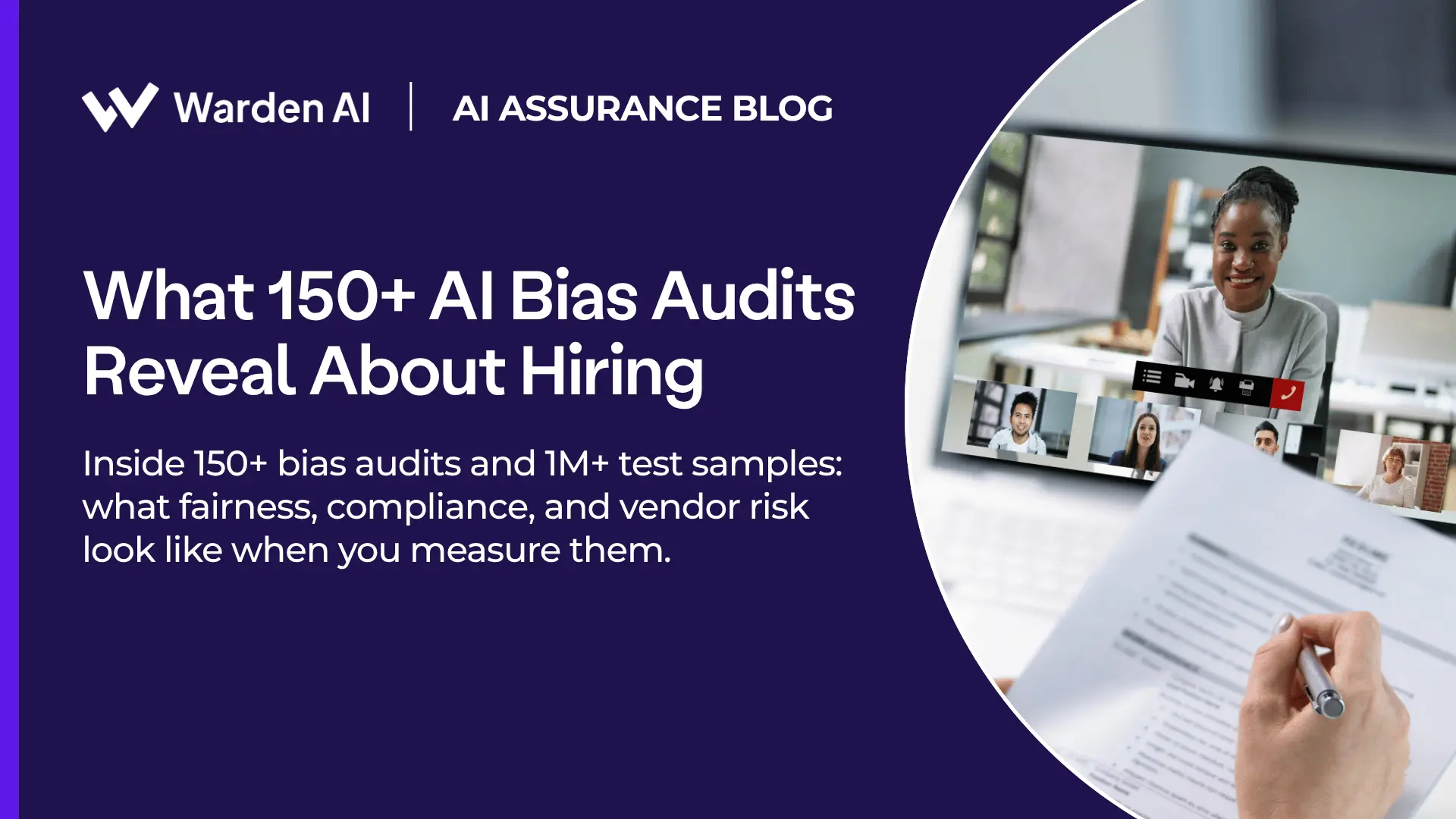
Begin with the largest structured dataset available, with an explicit caveat about its source. Warden AI's analysis of 150+ bias audits across over 1 million test samples found that 85% of audited AI systems scored above the 0.8 four-fifths impact-ratio threshold and 15% failed at least one demographic threshold - per Warden AI's published report. The headline comparison is the one that gets quoted everywhere. The average AI impact ratio was 0.94, above the 0.8 threshold, versus a human baseline of 0.67, below it, with AI delivering up to 45% fairer outcomes for racial minorities and 39% fairer outcomes for women - also from Warden AI's dataset. Two things must be said about these figures honestly. First, they are reproducible from the source and they are striking. Second, they are vendor self-reported figures from a company that sells bias-audit assurance services, which means there is a built-in selection and incentive effect: the vendors who choose to get audited self-select toward confidence in their results, and Warden profits when the "AI is fairer" narrative holds. Treat 0.94 versus 0.67 as a real and well-sourced data point, not as industry-wide ground truth.
Average disparate-impact ratio; 0.80 is the EEOC four-fifths threshold (higher is fairer)
Source: Warden AI, AI Bias in Hiring: What 150+ Bias Audits Reveal (May 2026), self-reported
Now the counterweight, because the optimistic story has a serious academic rebuttal. A 2024 University of Washington study (Wilson and Caliskan) testing over 3 million resume-job comparisons found that leading text-embedding models favored white-associated names 85% of the time and female-associated names only 11% of the time, with Black male names disadvantaged nearly 100% of the time - as the University of Washington reported. Two framing corrections are essential to use this responsibly. First, the "85% white-favored" figure is a preference rate while the "nearly 100% Black men" figure is a never-preferred finding: the models essentially never preferred Black male names over white male names. Those are different metrics measuring different things, and they should not be plotted on a single shared axis as if directly comparable. Second, this study used three text-embedding models from Mistral AI, Salesforce, and Contextual AI, which are research artifacts, not the production ATS systems that Workday, Eightfold, or HireVue actually run. The study is powerful suggestive evidence that name-based bias can be baked into the embedding layer of language models, but it is not direct proof about any litigated tool.
It helps to be precise about what the four-fifths rule actually measures, because the number gets thrown around as if it were a verdict when it is really just a screening heuristic. The four-fifths (or 80%) rule comes from the Uniform Guidelines on Employee Selection Procedures, and it says that if the selection rate for a protected group is less than four-fifths of the rate for the most-selected group, that disparity is treated as evidence of adverse impact worth investigating. It is a rule of thumb, not a legal threshold of liability. A tool can clear the 0.8 ratio and still be challenged if the disparity is statistically significant in a large sample, and a tool can dip below 0.8 in a small sample without that dip being legally meaningful. So when Warden reports an average impact ratio of 0.94, the honest reading is "the average audited system clears the standard screening heuristic comfortably," not "the average audited system is immune from suit." The ratio is a first filter, and clearing the first filter is necessary but not remotely sufficient. Plaintiffs' experts will go straight past the average to the specific deployment, the specific protected class, and the specific selection rate that fell below the line, because that is where a winnable case lives.
There is also a sampling subtlety that buyers routinely miss and that materially changes how much comfort the headline numbers should provide. An audit reports the impact ratio for the demographic mix and job context that happened to be in the test sample. Change the applicant pool, the role, or the labor market, and the same model can produce a different ratio, because disparate impact is a property of the model interacting with a population, not a fixed attribute of the model alone. A screening tool that shows a 0.94 ratio across a vendor's aggregated test data can show a 0.7 ratio for a specific employer hiring for a specific role in a specific region where the applicant demographics differ from the test mix. This is why a single vendor-level certificate, however reassuring its average, does not fully protect an individual employer: the employer's own deployment is the unit that gets litigated, and the employer's own applicant pool is the population that determines the ratio that matters. The most defensible posture combines a vendor-level audit with deployment-level monitoring, so that the ratio is measured where the legal exposure actually sits.
How do these two datasets coexist without contradiction? The resolution is the central insight of this section. The Warden data measure deployed, audited, often debiased systems that vendors chose to test and tune. The UW study measures raw embedding models with no debiasing applied. Both can be true: an off-the-shelf embedding model can carry severe name-based bias, and a carefully audited production screening system built on top of mitigations can outperform a human baseline. The legal exposure does not come from the average being good. It comes from the tail. In Warden's own data, 15% of audited systems failed at least one demographic threshold - per the report, and a single failing protected class in a single deployment is all a plaintiff needs. Averages do not get sued. Specific failures do.
The audit-coverage data expose the most dangerous blind spot, and it maps directly onto the litigated case. In Warden's dataset, sex and race/ethnicity were tested in 100% of audits, but age in only 5%, disability in 5%, religion or orientation in 2%, and national origin in 1%, leaving the exact protected classes at issue in Mobley largely untested - as Warden documented. Read that against the case. Mobley's certified collective is an ADEA age-discrimination collective. The industry audits age in 5% of cases. The litigated risk is concentrated in precisely the protected class the assurance market barely measures. That is not a coincidence the plaintiffs missed; it is a structural gap they are exploiting.
Share of 150+ HR-tech audits that tested each protected class (Warden AI)
Source: Warden AI, AI Bias in Hiring: What 150+ Bias Audits Reveal (May 2026)
The governance data complete the picture and they are sobering. Most vendors do not meet the bar that the litigation environment now implies. Only 45% of HR-tech vendors undergo independent third-party audits, 75% do internal bias testing, just 20% meet all four responsible-AI practices, and only 38% comply with NYC Local Law 144 - per Warden AI. The interpretation is direct. Internal testing is common, but the independent, third-party, documented auditing that actually holds up in a courtroom is the exception. Four out of five vendors fall short of the full responsible-AI practice set. In a world where the binding constraint is litigation and where a plaintiff needs only one failing class in one deployment, that governance gap is the exposure surface. The companies most at risk are not the ones whose averages look bad. They are the ones with no documented, independent audit trail to show a court when the subpoena arrives.
Share of HR-tech vendors meeting each governance practice (Warden AI)
Source: Warden AI, AI Bias in Hiring: What 150+ Bias Audits Reveal (May 2026)
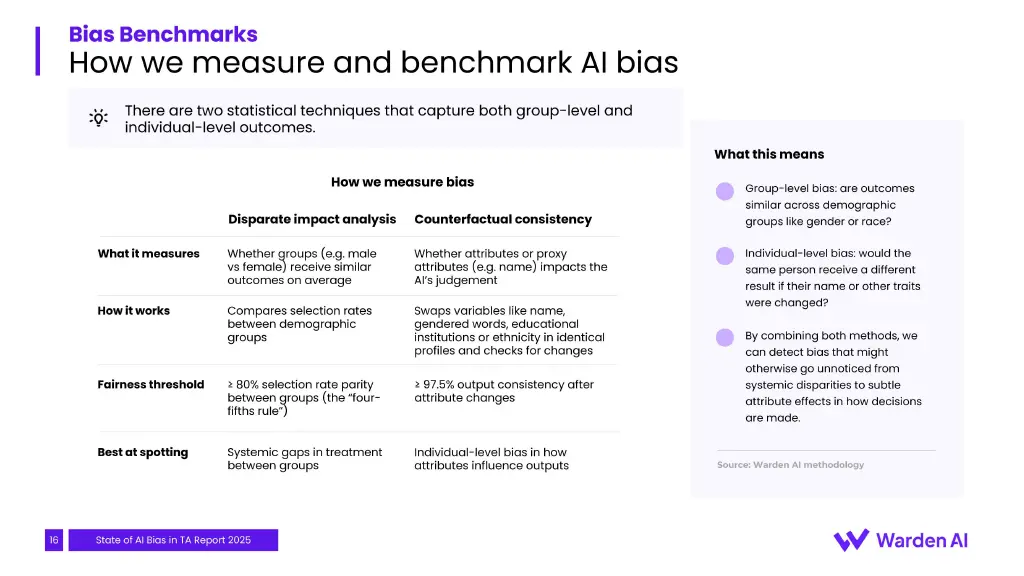
The takeaway for how to apply this is precise. Do not let a vendor's favorable average lull you, and do not let an academic horror story panic you. Demand the tail data (which protected classes were tested, and which, if any, failed) and demand it from an independent auditor with a documented methodology that combines disparate-impact analysis with counterfactual testing. Statistical fairness on average is necessary but nowhere near sufficient for litigation safety.
8. The Litigation Wave Beyond Workday: Eightfold, HireVue, Aon, SafeRent, and FCRA
Mobley is the lead case, but it is not the only one, and treating it as a single anomaly misses the structural point: a docket is forming. Multiple cases, multiple theories, and multiple plaintiff organizations are converging on AI hiring tools at once, which is what an enforcement migration looks like in practice. The most important development in this broader wave is not another disparate-impact case. It is the emergence of a theory that bypasses disparate impact entirely, which is precisely the kind of move you would expect from sophisticated plaintiffs when the underlying doctrine is under constitutional attack. That theory is the FCRA, and the Eightfold case is its test vehicle.
Walk through the Eightfold filing carefully, because the legal architecture is the innovation. A January 2026 class action by Towards Justice and former EEOC chair Jenny Yang alleges Eightfold AI scraped personal data on over one billion workers, scored applicants on a zero-to-five scale, and discarded low-ranked candidates before human review, framing the claim under the Fair Credit Reporting Act rather than disparate impact - as Built In reported. The procedural specifics sharpen the strategy. The lawsuit was filed January 20, 2026 in California state court and does not allege the algorithm was biased; it alleges the scoring operated in secret, testing whether AI candidate scoring is subject to FCRA - per HR Brew's coverage. Read those two facts together and the elegance is obvious. The plaintiffs do not need to prove bias. They need to prove only that a candidate score is a "consumer report" and that the FCRA's disclosure and consent requirements were skipped. Eightfold denied the allegations, stating its platform "operates on data submitted by candidates to our customers or provided by our customers" - also via Built In. Whether the FCRA theory ultimately succeeds is unsettled, but its strategic logic is impeccable: it is immune to everything the DOJ's June 2026 opinion does to disparate impact, because it has nothing to do with disparate impact.
The disability-access front is the second growing vector, and it targets a different category of tool. In 2025 the ACLU filed a complaint alleging that an AI video-interview tool (HireVue) used by Intuit was inaccessible to a deaf applicant, advancing a disability-discrimination theory - as Quinn Emanuel documented. This theory does not require statistical impact analysis at all; it requires showing that the tool itself was not accessible to a person with a disability, which is a more concrete and often more provable claim. AI video-interview and assessment tools are the natural home of this front because they impose modality-specific demands (speech, facial expression, real-time interaction) that can systematically exclude applicants with sensory or motor disabilities. For the category context on how these video-interview and assessment platforms actually work and where their accessibility risk concentrates, the Interview Intelligence category deep dive maps the full landscape.
The settled cases provide the price signals, and they are worth studying because they show what these claims are worth when they resolve. Two prior settlements anchor the range, in two different contexts.
Known monetary outcomes in algorithmic-screening cases, USD
Source: EEOC (iTutorGroup); Quinn Emanuel (SafeRent over $2M)
The first is the original landmark. In September 2023, iTutorGroup paid $365,000 to settle the EEOC's first AI-discrimination lawsuit, after its recruiting software was programmed to auto-reject female applicants 55 and older and male applicants 60 and older, rejecting over 200 qualified applicants - per the EEOC's press release. The detail that makes iTutorGroup almost quaint by 2026 standards is that the discrimination was hard-coded: a literal age cutoff in the software. Modern algorithmic bias is far subtler, emerging from training data and proxy variables rather than an explicit rule, which is exactly why disparate-impact statistics matter, because there is no smoking-gun line of code to point to. The second is the tenant-screening precedent that the hiring bar watches closely. In 2024, SafeRent Solutions settled a tenant-screening algorithm disparate-impact case for over $2 million, with claims its score disproportionately harmed Black and Hispanic rental applicants - as Quinn Emanuel reported. SafeRent is a housing case, not a hiring case, but the structural template is identical: a third-party algorithmic score that produces a disparate impact on a protected class, settled with both money and an injunction against using the score the same way going forward. That injunctive component is the part HR-tech vendors should fear most, because a court order changing how your product works hits the unit economics far harder than a one-time payment.
The interpretation of this docket is the whole point. These are not isolated incidents. They are a portfolio of theories being tested in parallel against the AI hiring stack: agent-and-employer liability in Mobley, FCRA in Eightfold, disability access in HireVue, and disparate impact in the SafeRent template. If any one of them produces a large judgment or a precedent-setting ruling, it becomes the model for the next wave. The plaintiff-side bar is doing what a well-run litigation strategy does: diversifying its legal theories so that the dismantling of any single doctrine, even one as central as disparate impact, does not close the entire front. That resilience is exactly why the federal retreat does not buy vendors the safety it appears to promise.
9. Repricing the Stack: Indemnification, Procurement, and HR-Tech Valuations
Now follow the money, because the legal doctrine is upstream of a set of commercial consequences that are already reshaping how HR-tech is bought, sold, and valued. The core mechanism is simple once you internalize the inversion. If a vendor can be a defendant, then the contract between buyer and vendor is no longer a private convenience for allocating routine commercial risk. It is the front line of an existential liability question, because it determines who pays when a plaintiff proves the tool discriminated. Every clause that touches liability allocation (indemnification, representations and warranties, limitation of liability, the master services agreement) gets repriced, because each one is now load-bearing in a way it was not when the vendor was effectively unsuable.
The procurement response is the clearest early signal, and the legal advisory consensus has already formed around it. Counsel advise HR-tech procurement contracts to include EEO-compliance representations and warranties plus indemnification provisions covering AI-tool bias claims, as an explicit response to the Mobley vendor-liability theory - as set out by Lexology. Translate that into what a buyer now does at the negotiating table. The buyer demands that the vendor warrant its tool's compliance with anti-discrimination law, demands an indemnity that makes the vendor pay if a bias claim arises from the tool, and demands evidence (a current, independent bias-audit certificate) before signing. The vendor, knowing it is now a potential co-defendant, resists broad indemnity and pushes liability caps. The result is that the bias-audit certificate and the indemnity clause become the two most negotiated terms in an HR-tech deal, displacing the price and feature haggling that used to dominate. Agencies feel this acutely, because an agency deploying a third-party AI screening tool inherits exactly the vendor-liability and indemnity exposure analyzed here, a dynamic the Staffing and Agency Tech 2026 outlook examines for the agency side of the market.
The indemnity negotiation itself has a structure worth unpacking, because it is where the inversion gets priced in dollars rather than doctrine. Before Mobley, a buyer asking a hiring-software vendor for a broad bias indemnity would often have been met with a shrug, because both sides understood the vendor was unlikely ever to be reached by a plaintiff, so the clause was close to free for the vendor to give and close to worthless for the buyer to hold. The agent theory changes the expected value on both sides simultaneously. The buyer now genuinely needs the indemnity, because the buyer can be sued and wants a backstop. The vendor now genuinely fears the indemnity, because the vendor can also be sued and does not want to additionally guarantee every customer's exposure on top of its own. The result is a real negotiation with real money at stake, and it tends to resolve into a few recognizable compromises: a capped indemnity tied to a multiple of fees paid, a carve-out that limits the vendor's obligation to claims arising from the tool's design rather than the employer's configuration, and a condition that the buyer maintain human review to preserve the indemnity. Each of those compromises is a small allocation of the disparate-impact risk, negotiated clause by clause, and in aggregate they are how a market reprices a category without anyone issuing a regulation.
There is a second-order effect on the build-versus-buy decision that follows directly from this. As vendors absorb more indemnity obligation and price it into their contracts, the cost of buying a third-party screening tool rises relative to building one in-house, which superficially looks like it should push large employers toward building. But the agent theory cuts against that conclusion, because an employer that builds its own screening tool internalizes the entire risk with no vendor to indemnify it and no shared defense to fall back on. The buyer who builds becomes both the employer-defendant and the de facto vendor-defendant in one entity, concentrating rather than diffusing the exposure. So the rational response for most employers is not to build but to buy carefully: to keep the third-party vendor in the chain precisely so that there is a deeper-pocketed co-defendant to share the liability and an external audit trail to point to, while negotiating hard for the indemnity and the human-in-the-loop conditions that preserve it. The litigation environment, counterintuitively, strengthens the case for buying over building, as long as the buying is done with the contractual discipline the new risk demands.
This is where the assurance market enters as a direct beneficiary, and the funding pattern proves the causal link. When liability migrates to the vendor and certificates become a procurement requirement, demand for independent audits spikes, and capital follows. Warden AI, founded in 2023 by Jeffrey Pole and Eduard Schikurski, raised its July 2025 round led by the founders of Onfido and early-stage investor Playfair amid surging demand for independent HR-AI audits driven by Mobley v. Workday, bringing its total funding to roughly $1.6M at a $10M valuation - as Tech Funding News reported. Read the causal chain in that sentence: the lawsuit drives the demand, the demand drives the funding. The assurance layer is monetizing the exact risk the litigation created, which is the clearest possible market confirmation that the risk is real and that buyers are paying to manage it. Warden prices bias audits per tool audited with volume discounts for multi-algorithm platforms, with each audit including a full disparate-impact analysis, a public summary, and a compliance certificate covering up to 14 protected classes - per Warden's platform page. The 14-protected-class scope is a direct commercial answer to the coverage gap exposed in Section 7: if age was tested in only 5% of historical audits and age is the litigated class in Mobley, a certificate that covers all 14 classes is worth paying for precisely because it closes the gap a plaintiff would otherwise exploit.
Now scale this up to the financial exposure of the named defendant, using audited figures rather than market-cap guesses. Workday reported FY2026 operating cash flow of $2.939 billion (up 19.4%), free cash flow of $2.777 billion (up 26.7%), and cash and marketable securities of $5.443 billion as of January 31, 2026, with FY2027 subscription-revenue guidance of $9.925 billion to $9.950 billion - per its SEC Form 8-K. Those numbers cut two ways, and both ways matter. On one hand, Workday has the balance sheet to fight Mobley for years, which is part of why this case will be a long one. On the other hand, a company with billions in cash and a nationwide collective tied to 1.1 billion rejections is the single most attractive defendant the plaintiffs' bar has ever had in employment-AI litigation: deep pockets plus aggregated harm plus a viable legal theory is the trifecta that funds contingency-fee litigation. The concentration of buyer reliance on a handful of platforms amplifies this, because the more employers run one tool, the larger the aggregated collective and the more attractive the single-vendor target, a concentration dynamic the ATS Market Structure and Buyer Sentiment 2026 analysis quantifies across the leading systems of record.
Estimated total AI-in-HR market size, USD billions (Grand View Research)
The macro backdrop tells you why none of this slows the underlying adoption, which is the paradox that makes the repricing so consequential. Forrester projects global technology spend will grow 7.8% in 2026 to reach $5.6 trillion, up from $5.2 trillion in 2025 - Forrester. Money keeps pouring into technology, AI hiring tools keep getting bought, and the market keeps compounding even as the litigation wave builds. The repricing does not stop adoption; it changes the terms of adoption. Buyers still buy autonomous recruiting, but they now buy it with indemnity clauses, audit certificates, and human-in-the-loop checkpoints bolted on. Vendors still sell it, but they narrow the scope of fully autonomous rejection to limit the agency exposure. The product does not disappear; its contractual and architectural shape changes. That repricing of growth, where the trajectory continues but the risk premium climbs, connects directly to how analysts are valuing autonomous-hiring platforms, a thread the Talent Marketplaces and AI-Native Hiring forecast follows into 2028.
10. The Named Field: Platforms, Auditors, and Their Exposure
It helps to lay the field out explicitly, because the liability gradient runs differently for different kinds of players. Three groups occupy this market: the screening and matching vendors whose tools perform the delegated decisions and therefore sit at the top of the exposure gradient, the assurance layer that audits those tools and profits from the risk, and the plaintiff-side infrastructure that converts the risk into litigation. Where a company sits on this gradient is determined by one question: does its product score, sort, rank, screen, or reject candidates? The more autonomously it does so, the closer it sits to the Mobley blast radius. To rank the exposure transparently, the scorecard below weights four criteria that map to actual litigation risk, and it covers the most-named platforms in the 2026 docket.
The scoring uses four weighted criteria summing to 100%: Delegated-decision exposure (35%, how directly the tool performs autonomous screening or rejection, the core Mobley trigger), Litigation status (25%, whether the player is named in active suits), Audit and governance posture (25%, the strength of documented independent bias auditing), and Protected-class coverage (15%, breadth of demographic testing). Higher total means a more favorable overall position for a buyer or investor weighing the risk, so the assurance players score high (they reduce risk) and the most-litigated, least-audited screening vendors score low.
| Player | Delegated-decision exposure (35%) | Litigation status (25%) | Audit & governance (25%) | Protected-class coverage (15%) | Total |
|---|---|---|---|---|---|
| Warden AI | 9.0 (audits, does not screen) | 9.5 (no suits, benefits) | 9.5 (its entire business) | 9.0 (up to 14 classes) | 9.25 |
| Holistic AI | 8.5 (governance, not screening) | 9.0 (no suits) | 9.0 (audit and GRC) | 8.5 (multi-class) | 8.75 |
| Paradox | 4.0 (conversational screening) | 7.0 (no current suit) | 5.5 (limited public audits) | 5.0 (partial) | 5.28 |
| HireVue | 3.5 (video scoring, assessments) | 4.0 (ACLU complaint, prior FTC) | 5.5 (post-FTC reforms) | 5.0 (partial) | 4.35 |
| Eightfold AI | 3.0 (0-to-5 candidate scoring) | 2.5 (FCRA class action) | 4.5 (denies, limited public audit) | 4.5 (partial) | 3.48 |
| Workday (with HiredScore) | 2.5 (autonomous rejection at scale) | 1.5 (named defendant, collective certified) | 5.0 (scale, but litigated) | 4.0 (age undertested) | 3.10 |
The screening and matching vendors anchor the high-exposure end, and they are the names in the docket. Workday with HiredScore is the test case, custom-quoted at enterprise HCM scale with FY2027 subscription revenue guided to roughly $9.93 billion to $9.95 billion, and its March 6, 2026 ruling let the nationwide ADEA collective proceed into discovery with HiredScore screening features folded into the certified collective. Eightfold AI is the FCRA test case, estimated at roughly $7 to $10 per employee per month with large-org annual contracts of $150,000 to $500,000-plus and implementation fees of $5,000 to $50,000 - per Pin's pricing analysis, facing the January 2026 class action over secret candidate scoring. HireVue is the disability-access target, with contracts estimated to run from about $35,000 per year for the Essential tier to $145,000-plus per year for large enterprise AI scoring, with an average deal near $49,855 and onboarding fees of $15,000 to $40,000 - also per Pin. Paradox is not itself named in a suit, but Workday completed its acquisition of Paradox on October 1, 2025 - Workday, so its conversational AI assistant (Olivia), which automates screening and scheduling at high-volume employers, now sits inside the named defendant, squarely in the delegated-rejection zone the agent theory targets.
It is worth a short interpretive note on why those four sit where they do, because the pattern is instructive. The exposure does not track company size or revenue; it tracks decision autonomy. Workday scores lowest on exposure not because it is the worst-behaved vendor but because its tools perform autonomous rejection at the largest scale and it is the named defendant in a certified collective. Eightfold and HireVue follow because each faces an active, novel theory (FCRA and disability access, respectively) that sidesteps the disparate-impact uncertainty. Paradox scores higher only because it is not yet litigated, not because conversational screening is inherently safer. The lesson for a buyer is that the tool's decision autonomy, not the vendor's brand strength, predicts its liability, and a procurement process that screens on brand reputation alone will misprice the risk.
The assurance layer sits at the favorable end of the gradient because it sells risk reduction rather than incurring it. Warden AI is the independent, continuous bias-auditing platform, priced per tool audited, that published the 150-plus-audit dataset and raised on demand driven directly by Mobley. Holistic AI offers AI governance, risk, and bias-auditing across NYC LL144 audits, EU AI Act readiness, and algorithmic risk management, an enterprise SaaS custom-quoted by module. Both are part of the fast-growing AI-assurance layer that profits precisely because enforcement shifted to private litigation and state law. The plaintiff-side infrastructure is the third group: Towards Justice, the nonprofit worker-rights litigation organization that co-counsels the Eightfold FCRA class action with Jenny Yang, represents the institutionalization of the private enforcement channel replacing the retreating EEOC. To situate all three groups within the full category taxonomy of the talent-acquisition stack, the TA Tech Market Map 2026 provides the structural map these players slot into.
11. The Counter-Narrative: Why This Might Be Overstated
Intellectual honesty requires steelmanning the skeptics, and there is a serious case that this entire analysis overstates the durability of the threat. A reader who has followed the argument this far should hold it up against its strongest objections, because the difference between a settled rule and a contested one determines how much you should change your behavior today. The agent theory is powerful, but it is not yet a final judgment, and several distinct forces could blunt it before it reaches the merits.
The first and most important caveat is procedural posture, and the case's own supporters concede it. The agent theory survived at the motion-to-dismiss stage, which means the court assumed the plaintiff's factual allegations were true and asked only whether they stated a legal claim. It is not a finding that Workday discriminated against anyone. Commentators stress the holding "should not be overstated," because it arose at the motion-to-dismiss stage, may be appealed, and other jurisdictions may interpret the same statutes differently - as Seyfarth Shaw cautioned. A single district court in the Ninth Circuit accepting a theory is not the same as that theory becoming the law of the land. An appeal to the Ninth Circuit, or eventually circuit splits as other courts weigh in, could narrow or reject the agent framing entirely. The doctrine is real, but it is one ruling in one district, and the history of employment law is full of district-court theories that did not survive appellate review.
The second is that disparate impact is genuinely hard to prove at the merits stage, and the procedural survival of a claim says nothing about whether the plaintiffs can carry that burden. Several factors complicate the eventual merits fight.
- Statistical proof is demanding. A plaintiff must establish a specific employment practice that causes a statistically significant adverse impact on a protected class, then survive the employer's business-necessity defense. That is a high evidentiary bar even with good data.
- Causation is murky in aggregated tools. When a tool sits between thousands of employers each with different job criteria, attributing a specific disparate outcome to the tool rather than to legitimate job requirements is analytically hard.
- The doctrine itself is under attack. The June 2026 OLC opinion may presage a Supreme Court that narrows disparate impact, shrinking the underlying claim even if agent liability survives.
- The tool framing still has advocates. Vendors continue to argue the "we provide a tool, the employer decides" framing has legs at the merits stage even where it failed on a motion to dismiss.
That list adds up to a real argument that the eventual merits outcome is far from certain, and a fair-minded reader should weight it. But here is the rejoinder that keeps the threat live regardless of how the merits resolve, and it is the crux of why behavior should change now anyway. In a litigation-driven risk environment, a viable theory that survives dismissal and reaches discovery is itself the threat, independent of the final judgment. Discovery is expensive, intrusive, and reputationally costly. A certified nationwide collective creates settlement pressure measured in the hundreds of millions whether or not the plaintiffs would ultimately win at trial, because the downside of losing at trial is catastrophic and the cost of fighting through to a verdict is enormous. Rational defendants settle viable claims they might win, simply because the expected cost of litigating to victory exceeds the cost of settling. The agent theory does not have to win at the merits to reprice the market. It only has to be viable enough to survive dismissal, which it has done.
The status of the June 2026 DOJ opinion cuts in the skeptics' favor on the substantive doctrine but not on the litigation mechanics, and keeping those two effects separate is essential. The OLC opinion may genuinely shrink the disparate-impact doctrine over time, especially if it influences the Supreme Court. That would help defendants on the underlying claim. But the opinion does nothing to the FCRA theory in Eightfold, nothing to the disability-access theory in HireVue, and nothing to the agent-liability question itself, which is about who can be sued, not about whether the conduct was discriminatory. So the honest accounting is this: the disparate-impact doctrine is contested and may narrow, but the diversification of plaintiff theories means the overall litigation front is more resilient than any single doctrine. The skeptics are right that any one theory could fail. They are wrong if they conclude that the failure of one theory makes the front safe, because the plaintiffs have deliberately built a portfolio precisely so that no single doctrinal defeat closes it.
12. Playbook 2026 to 2028: What Buyers and Builders Should Do Now
The analysis only matters if it changes what you do on Monday, so this final section converts the structural argument into concrete actions for the two parties who carry the risk: the buyers who deploy AI hiring tools and the builders who sell them. The organizing principle is the inversion itself. Because liability now runs to the builder as well as the buyer, both parties have to act, and their actions are complementary: the buyer contracts and documents to push risk back onto the builder, while the builder audits and narrows scope to limit the risk it now carries. A buyer who does nothing inherits the vendor's exposure through silence; a builder who does nothing becomes the deep-pocketed defendant by default.
For buyers, the playbook is built around shifting and documenting risk, and the legal advisory consensus has already converged on the core moves. The priority is to make the vendor warrant compliance and pay for failure, and to keep the records that a regulator or a court will demand.
- Contractual indemnity and warranties. Require EEO-compliance representations and warranties plus indemnification for AI-tool bias claims, the exact response counsel now advise to the Mobley theory - per Lexology.
- Independent audit certificates. Demand a current, independent bias-audit certificate covering all relevant protected classes, especially age, given the Mobley coverage gap.
- Human-in-the-loop checkpoints. Insert meaningful human review at rejection, because California's ADS rules reach tools that screen or rank even where humans retain final authority - per Jackson Lewis.
- Four-year record retention. Retain automated-decision data for four years, the retention period tied to California's ADS regulations and echoed in Illinois HB 3773.
The deeper point behind that checklist is that a human-in-the-loop is not a paperwork formality; it is the single design choice that most directly weakens the agent theory. Recall the doctrinal hinge from Section 3: the vendor becomes an agent because the employer delegates the rejection decision to the tool. If a qualified human actually reviews and owns the rejection, the delegation is incomplete, and the agency argument weakens at its root. The near-instant, middle-of-the-night rejections that defined Mobley's experience are the worst-case fact pattern precisely because they prove no human was involved. The contrast with genuine human-reviewed timelines, where a real person spends real time on a decision, is documented in the Hiring Effort Benchmarks by Function, and that contrast is now a legal-risk variable, not just an efficiency metric.
For builders, the playbook is about narrowing the agency exposure and building the documentary record that survives discovery, because a builder is now a potential defendant in its own right. The moves are different in kind from the buyer's: where the buyer shifts risk through contracts, the builder reduces risk through product design and auditing.
- Continuous, independent bias auditing. Move from one-off internal tests to continuous third-party auditing across all protected classes, closing the age and disability gaps the industry historically undertested - per Warden AI's coverage data.
- Document the model lifecycle. Maintain records of training data, design choices, and mitigations, because the OLC's "smoke out intent" framing makes internal documentation the evidence from which intent is inferred - per Jackson Lewis.
- Narrow autonomous-rejection scope. Design tools to assist rather than autonomously reject, reducing the delegated-decision exposure at the center of the agent theory.
- Price the indemnity into the deal. Treat indemnification and audit certification as standard cost of goods, not optional add-ons, since buyers now require them.
Look ahead to the 2028 horizon and the scenarios resolve into a clear set of forks. The EU high-risk deadline arrives in December 2027, which means the transparency-then-high-risk sequence will have fully landed by 2028, and any organization operating in the EU will face the full Annex III obligations. Colorado's lighter regime begins in January 2027, and other states will likely keep splitting along the California-versus-Texas axis. Most consequentially, Mobley has already cleared the motion-to-dismiss stage on its amended complaint (in June 2026 Judge Lin sustained the California FEHA and ADA disability claims and let the core Title VII race disparate-impact claim proceed, while dismissing only one plaintiff's newly added, unauthorized race-based claim and the new direct-employer theory), and by 2028 it will have moved toward the merits and toward class certification, not just the conditional ADEA collective. If the plaintiffs reach the merits and prevail, or if Workday settles a certified nationwide collective, the number that anchors the settlement will be drawn from that 1.1 billion-rejection universe, and it will become the reference point that prices every HR-tech indemnity clause for years. If the agent theory is narrowed on appeal, the front shifts toward FCRA and disability-access theories that do not depend on it. Either way, the structural fact holds.
The throughline of this entire guide is one sentence worth repeating: disparate-impact risk is migrating up the supply chain, from the buyer to the builder. That migration is why a single district-court ruling reorganized an entire market's contracts and valuations, why the federal retreat sharpened rather than closed the threat, and why the binding constraint in 2026 is a lawsuit rather than a regulatory deadline.
It is fitting to give the last analytical word to a builder who is also a warner. Yuma Heymans (@yumahey), who founded AIRecruiter.co and is also co-founder and CEO of HeroHunt.ai (a tie we disclose because he is quoted here as a source rather than as our publisher), builds autonomous AI recruiters, which is to say he ships products squarely in the delegated-rejection category the agent theory targets. His own HeroHunt.ai guidance argues that recruiting AI is inherently high-risk under the EU framework and that buyers should never assume an AI is neutral by default - as set out in HeroHunt.ai's EU AI Act analysis (HeroHunt.ai is a site we also run). The sharp angle is that the operator shipping autonomous recruiting is also the one telling the market that the builder, not just the buyer, now owns the disparate-impact risk. That is not compliance theater from someone selling caution. It is a founder pricing his own category's liability honestly, which is exactly the posture the Mobley inversion now demands of everyone in the field.
This guide reflects the AI hiring liability landscape as of July 2026. The legal, regulatory, and market facts described here are moving quickly: Mobley v. Workday is in active litigation, the EU AI Act Omnibus and the June 2026 DOJ opinion are recent and contested, several state laws take effect in 2027, and the figures, dates, and procedural postures cited will change. Treat every number and deadline as a snapshot, verify against the linked primary sources before relying on any of it, and consult qualified employment counsel for decisions about your own AI hiring tools.