03The full analysis
A first-principles guide to what the EU Pay Transparency Directive actually changes for hiring, why it forces structured job architecture and pay-equity data, and how talent teams should operationalize it across a messy transposition patchwork.
On 7 June 2026 two hiring norms that had held for decades quietly stopped being legal across large parts of Europe: employers can no longer keep a salary figure secret until an offer, and they can no longer ask a candidate what they currently earn - European Commission. That single date is the hinge of this entire guide, because it converts pay from a negotiated private fact into a disclosed public one at the very front of the funnel. A recruiter who opens a req now has to name a number before a candidate ever walks into the interview, and the word "competitive" no longer discharges the obligation. The switch flipped, and most employers were not ready for it.
The problem is that almost everyone is reading this as a job-ad tweak, and it is not. The EU Pay Transparency Directive (2023/970) does mandate salary ranges in vacancies, but it also mandates gender-pay-gap reporting "by category of worker," a two-month right-to-information response for every employee, and a mandatory joint pay assessment whenever an unexplained gap of 5% or more appears in any worker category and the employer cannot justify it - Europe HR Solutions. You cannot satisfy those obligations with a spreadsheet and a copywriting pass on your job templates. To report by category and defend every gap, you need a defensible job architecture, gender-neutral leveling criteria, and always-on pay-equity analytics. The directive does not ask employers to disclose a number. It asks them to build the plumbing that makes the number defensible, which is a far larger project.
This guide reconstructs that project from first principles. We start with what the directive actually mandates and why "negotiable" no longer works, then trace the reporting engine (thresholds, cadences, the 5% trigger) that forces structured job architecture. From there we map the transposition patchwork (only four of 27 member states hit the deadline), the parallel wave of US state laws that already normalized ranges in job ads, and the reality gap between the rule and actual employer behavior. Then we survey the comp-intelligence and pay-equity tooling stack that talent teams are now buying, give the counter-narrative its full weight (transparency can compress and even lower wages), and close with an operational playbook and a decision framework. This piece sits alongside our State of AI in Recruiting: 2026, which covers the broader automation of the hiring function that this compliance shift now intersects.
Contents
- The Switch That Flipped on 7 June 2026
- The Reporting Engine Behind the Ranges
- Why This Forces Structured Job Architecture
- The Transposition Patchwork
- The US State-Law Parallel
- The Reality Gap Between Rule and Behavior
- The Comp-Intelligence and Pay-Equity Stack
- The Counter-Narrative Talent Teams Should Not Ignore
- The Operational Playbook for Talent Teams
- Decision Framework and Outlook
1. The Switch That Flipped on 7 June 2026
The defining mistake in how 2026 talks about pay transparency is treating the directive as a disclosure rule when it is actually a bargaining-structure rule. Disclosure is the visible surface; the deeper change is that the directive strips two informational advantages employers held during hiring and hands them to candidates. The first advantage was pay opacity: not knowing the range let employers anchor low and capture surplus from candidates who guessed conservatively. The second was salary-history leverage: asking what you earn now let employers peg the offer to your past pay rather than the role's value, which is exactly how historical underpayment compounds across a career. The directive removes both at once, and that is why it reshapes hiring rather than merely documenting it.
Start with what is not in dispute about the mechanics. From the moment a member state transposes, employers must inform job seekers about the starting salary or pay range in the vacancy notice or ahead of the interview, and they can no longer ask candidates about pay history - European Commission. The transposition deadline every state had to meet was 7 June 2026 - Ogletree Deakins. Those two rules alone break the standard European hiring script, in which a recruiter probes current comp early to calibrate an offer and keeps the band vague until the candidate has invested enough interview time to accept an anchor. Neither move survives the directive. The number comes first, and it comes from the role, not from the candidate's history.
The EU frames pay transparency as a fairness and information right

The reason "negotiable" or "competitive" no longer discharges the obligation is worth reasoning through, because it is where most employers will get caught. The directive's purpose is to give the candidate a usable pay signal before they invest in the process, and a placeholder word carries zero information. A range of "competitive" tells a candidate nothing about whether the role pays 40,000 or 90,000, so it fails the directive's intent even if it technically appears in the ad. Transposing states are drafting around exactly this loophole: the disclosed figure has to be a real starting salary or a genuine range with a floor and a ceiling that reflect the role's actual pay band. That requirement quietly forces a second, invisible task on the employer, which is to actually have a defensible band in the first place, and most employers discover at this point that they do not.
The salary-history ban deserves its own beat, because it is the piece most likely to be violated by accident. Recruiters have asked "what are you making now?" for so long that it is reflexive, embedded in intake calls, screening scripts, and applicant-tracking-system fields. The directive makes that question, and any indirect version of it, off-limits before an offer - Europe HR Solutions. The reason this matters structurally is that salary history is the transmission mechanism for pay inequity across a career. A worker underpaid in their first job carries that number forward into every subsequent offer if each employer pegs to the prior salary, so banning the question is not a courtesy, it is the directive severing the wire that lets historical bias propagate. Employers who leave a "current salary" field in their ATS or let a screener ask it in passing are not committing a minor process slip, they are re-connecting the exact wire the directive was written to cut.
The candidate-rights layer completes the switch and is the part employers most underestimate. Beyond the front-of-funnel disclosure, every worker gains the right under Article 7 to request how their pay compares to colleagues doing equal work or work of equal value, and the employer must respond in writing within two months - Directive 2023/970, Article 7. That right converts pay from a one-time disclosure at hiring into an ongoing, auditable claim any employee can trigger. An employer who names a clean range in the job ad but cannot, on request, explain why two people in the same category earn different amounts has satisfied the easy half of the directive and failed the hard half. The practical implication is that the job-ad change is the shallow end. The Article 7 right means the underlying pay structure has to be defensible on demand, which is the requirement that pulls every employer toward the comp-intelligence stack the rest of this guide describes.
There is a first-principles reason the two-month clock is more disruptive than it looks. A deadline to answer a comparison request is only manageable if the comparison data already exists in a structured, queryable form. If an employer has to assemble, for each request, a manual analysis of who counts as "equal work," what the pay of that group is, and how the requester sits within it, then two months is barely enough and the process does not scale past a handful of requests. The directive therefore does not just create a right, it creates a latent operational load that only stays manageable if the employer has pre-built the category structure and the pay analytics. That is the quiet mechanism by which a candidate-facing transparency rule turns into an internal data-infrastructure mandate, and it is why treating the directive as a job-ad problem is the single most expensive misread a talent team can make this year.
It is worth dwelling on why the directive's designers bundled these obligations together rather than shipping the job-ad rule alone, because the bundling is deliberate and it explains the whole architecture. A pure disclosure rule (put a range in the ad) would have been trivially easy to comply with and almost useless for closing pay gaps, because it informs one candidate about one role without touching the internal structure that produces inequity. The designers understood that gaps live inside the organization, in the accumulated pay decisions across a category of workers, not at the point of a single job ad. So they wired the front-of-funnel disclosure to a back-of-house reporting and remediation engine, ensuring that the visible, easy obligation drags the invisible, hard one behind it. An employer that tries to comply with only the visible half will pass a superficial audit and fail the moment a single employee exercises Article 7 or the first report exposes a category above the threshold. The bundling is the mechanism that prevents cheap, cosmetic compliance, and recognizing it is what separates a talent team that builds the real system from one that decorates its job ads and waits to be surprised.
The behavioral shift this forces on recruiters is larger than any single rule, and it is worth naming because it is where day-to-day resistance shows up. The entire craft of recruiting was built partly on managing information asymmetry: qualifying budget early, keeping the range flexible, reading a candidate's constraints, and constructing an offer that captured surplus for the employer. The directive removes the levers that craft depended on and replaces them with a discipline of pre-committed, defensible numbers. A recruiter who thrived on negotiation now has to operate inside a published band, and a hiring manager who used to approve above-band exceptions quietly now has to justify them publicly. That is a genuine change in how the function works, not a paperwork adjustment, and talent leaders who underestimate the cultural friction will find their recruiters quietly reverting to old habits (asking about current pay, hedging the range) precisely because those habits are what the job used to reward.
2. The Reporting Engine Behind the Ranges
The visible half of the directive is the salary range in the job ad; the load-bearing half is the reporting engine that sits behind it, and understanding that engine is what separates a compliant employer from one that merely looks compliant. Reason about what the directive is actually trying to produce. A range in an ad, on its own, does nothing to close a pay gap, it just informs one candidate. The mechanism that actually moves the gender pay gap is the obligation to measure, report, and remediate gaps at the level of the worker category, on a fixed cadence, with an escalation trigger that forces action. The range is the marketing; the reporting engine is the enforcement. The EU's unadjusted gender pay gap still sits at 11.1% on 2024 data, which is the number the whole apparatus exists to shrink - Eurostat.
The engine runs on employer-size thresholds with different cadences, and getting these right is the difference between an on-time filing and a penalty. Employers with 250 or more employees report annually, those with 150 to 249 report every three years, and those with 100 to 149 first report by 2031, with the first reports for the 150-plus tier due 7 June 2027 on 2026 data - Visas Update. The critical scheduling fact hiding in that structure is that the reporting obligation looks backward: the first report in June 2027 covers the 2026 calendar year, which means the data an employer needs to file was being generated the moment the directive took effect. There is no grace period on the underlying data collection. An employer that waited for the 2027 deadline to start structuring its pay data has already missed the year it needs to report on.
EU Pay Transparency Directive gender-pay-gap reporting frequency by headcount band
Source: Visas Update, EU Salary Transparency Directive analysis
The 5% trigger is where the engine acquires teeth, and it is the mechanism most likely to force real change. If an employer's report shows an unexplained gender pay gap of 5% or more within any category of worker, and that gap cannot be justified by objective, gender-neutral factors, the employer must conduct a joint pay assessment with worker representatives - Europe HR Solutions. Reason about why this specific design is clever. A pure reporting rule with no consequence tends to produce reports that get filed and ignored. By attaching a mandatory, collaborative remediation process to any gap above a bright-line threshold, the directive converts measurement into obligated action, and it does so through worker representatives rather than a regulator, which distributes enforcement across every workplace instead of concentrating it in an under-resourced agency. The 5% line is low enough that many employers will cross it in at least one category, which means the joint assessment is not an exceptional event but a likely recurring one.
The phrase "unexplained gap" is doing enormous work in that trigger, and misunderstanding it is a common trap. The directive does not require zero pay difference between men and women, it requires that any difference be explainable by legitimate, gender-neutral factors such as tenure, performance, or scarce skills. A raw gap of 8% that is fully accounted for by seniority differences is not an "unexplained" gap and does not trigger the joint assessment; a raw gap of 6% that cannot be attributed to any objective factor does. The practical consequence is that the burden shifts to the employer to have documented, defensible, gender-neutral pay criteria ready in advance, because "we cannot explain it" is precisely what triggers the obligation. An employer without a documented rationale for its pay differences will find that every gap is "unexplained" by default, which is the worst possible position to be in when the report lands.
The first reports being due in June 2027 on 2026 data creates a specific and unforgiving timeline that reframes the whole compliance calendar. Because the report covers a year that is already underway, the real deadline for building the reporting engine is not 2027, it is now. An employer needs its worker categories defined, its pay data structured, and its gender-neutral criteria documented across the entire 2026 reporting year, not assembled retroactively in early 2027 when the data is already fixed. This is the single most important scheduling insight in the directive, and it explains the surge of comp-intelligence tooling purchases in 2025 and 2026, because the tooling is what makes it possible to structure a year of pay data continuously rather than reconstruct it under deadline pressure. The employers who understood the backward-looking data window bought the plumbing early; the ones who read only the 2027 headline are now trying to rebuild a year they cannot go back and re-collect.
The gap the whole engine targets is stubborn, which is why the directive's designers chose a mechanism with teeth rather than a voluntary reporting regime. The EU's unadjusted gender pay gap has barely moved for years, sitting at 11.1% on the most recent data, the same figure the European Commission cited in its June 2026 explainer of the new rules - European Commission. Reason about what a persistent, near-flat gap tells you about prior policy: decades of equal-pay principle in EU law, without mandatory measurement and remediation, produced a gap that would not close on its own. The directive is a direct response to that failure, an admission that stating the principle was not enough and that closing the gap requires forcing employers to measure it, report it by category, and remediate the unexplained portion. That history is the reason the reporting engine looks the way it does, and it is why voluntary or cosmetic compliance defeats the entire purpose.
Unadjusted EU gender pay gap, the metric the directive's reporting engine targets
The choice to route remediation through worker representatives rather than a state regulator is a design decision worth understanding, because it shapes how the directive will actually be enforced in practice. A regulator-led model concentrates enforcement in an agency that has finite inspectors, a backlog, and limited visibility into any given company's pay structure. A worker-representative model, by contrast, distributes enforcement to the people closest to the pay decisions, who have both the standing and the incentive to press a joint pay assessment when a gap appears. Reason about the practical effect on employers: it means the pressure to remediate does not depend on catching a regulator's attention, it arrives from inside the workplace the moment a report shows a category over the line. That makes the 5% trigger far more consequential than a comparable rule enforced only by an under-resourced agency, and it is why employers should treat the joint pay assessment as a likely recurring event to prepare for, not a remote regulatory risk to discount.
3. Why This Forces Structured Job Architecture
The deepest structural consequence of the directive is one it never states explicitly: to comply, an employer must build a job architecture, because every other obligation depends on one. Reason from the requirement backward. To report "by category of worker," you need consistent, defensible categories. To disclose a real range in a job ad, you need a pay band attached to a level. To answer an Article 7 request about "equal work or work of equal value," you need a way to say which roles are equivalent. To defend a gap as "explained," you need objective criteria that distinguish one level from another. Every single one of those obligations presupposes a structured map of roles, levels, and pay bands. The directive does not mention job architecture, but it makes job architecture the precondition for satisfying almost everything it does mention.
The directive specifies the criteria that categories must rest on, and those criteria are the anchor of the whole architecture. Roles must be grouped and compared using gender-neutral factors: skills, effort, responsibility, and working conditions - Directive 2023/970. Reason about why those four and not job titles. Job titles are notoriously gamed and inconsistent, the same work carries a dozen names across a company, and titles often encode gendered history (a "secretary" versus an "administrator") rather than actual work content. By forcing categories to rest on the underlying dimensions of the work rather than its label, the directive prevents employers from hiding pay differences behind title inflation or from claiming two identical jobs are different because one has a fancier name. The four-factor test is the directive's defense against the most common way employers evade equal-pay logic, which is to relabel rather than re-level.
A defensible leveling structure is the precondition for all four duties
The move from a spreadsheet to a system is not optional, and understanding why reveals the real cost of compliance. A spreadsheet can hold a snapshot of who earns what, but it cannot maintain a consistent leveling logic, cannot answer an Article 7 request on demand within two months, cannot flag a category crossing the 5% line as pay changes through the year, and cannot document the gender-neutral rationale for each pay difference in an auditable way. The directive's obligations are continuous, not point-in-time: pay changes with every promotion, merit cycle, and new hire, and the compliance state has to stay current. A spreadsheet is a photograph of a moving system, and the directive regulates the motion. That is precisely why continuous pay-equity analytics, rather than an annual manual audit, became the baseline requirement, and it is the structural reason the tooling market described in Section 7 exists at all.
Consider a concrete example of how the architecture requirement bites, because the abstraction hides the difficulty. Imagine a mid-sized software company with "engineers" spread across a dozen title variants, no formal levels, and pay set historically through individual negotiation. Under the old regime this was fine; under the directive it is a compliance liability, because the company cannot say which engineers do "equal work," cannot attach a defensible band to a job ad, and cannot explain the pay differences that its negotiation-driven history produced. To comply, the company has to retroactively construct levels, map every person to one using the four-factor criteria, build a band per level from market data, and then confront the gaps the exercise reveals, some of which will exceed 5% and trigger a joint assessment. This is not a paperwork task, it is a re-architecture of how the company thinks about roles and pay, and it is why the directive is genuinely hard rather than merely administrative.
The pay-equity data requirement layers on top of the architecture and is where the analytical work concentrates. Once roles are leveled, the employer has to run a gap analysis within each category, decompose any raw gap into its explained and unexplained components, and document the gender-neutral factors that account for the explained part. Reason about what this demands: it is a regression-style analysis, run continuously, with an audit trail, across every worker category, refreshed as pay changes. Doing this by hand across even a few hundred employees is impractical, which is why the always-on analytics layer is not a luxury but the only feasible way to stay compliant between reporting cycles. The directive, in effect, mandates a permanent pay-equity monitoring function inside every covered employer, and the job architecture is the coordinate system that function operates on. This is the same shift toward structured, data-backed talent operations that we track across the whole stack in our Talent Acquisition Tech Market Map: 2026.
There is a subtle trap in the "explained versus unexplained" decomposition that catches employers who think they can justify any gap after the fact, and understanding it changes how the architecture must be built. The directive requires that the factors explaining a gap be objective, gender-neutral, and applied consistently, which means an employer cannot invent a rationale retroactively to explain away a gap the report surfaced. If two people in the same category earn different amounts and the employer's stated reason is "performance," that reason only holds if the employer actually has a documented, consistently-applied performance system that predates the gap, not a story assembled once a regulator asks. Reason about the consequence for architecture design: the gender-neutral criteria have to be defined, documented, and operating before pay decisions are made, because a criterion invented after the fact is by definition not the reason the pay was set. This is why the job architecture is not just a classification exercise but a governance one, and why employers with a history of ad-hoc, negotiation-driven pay face the hardest transition. Their pay differences are real but their documented rationale is thin, which means many of their gaps will read as "unexplained" not because they are discriminatory but because the paper trail justifying them never existed.
The scale of the retroactive work is easy to underestimate, so a sizing example helps. A company with 2,000 employees might discover, when it first attempts to level, that it has hundreds of distinct pay decisions made over a decade by dozens of managers under no consistent framework, plus a dozen legacy title schemes, plus acquired teams that came in with their own bands. Reason about the effort this implies: leveling that population against the four factors, mapping every person, building a defensible band per level from current market data, and then running the gap analysis is a cross-functional project spanning HR, rewards, legal, and often works councils, measured in quarters, not weeks. This is the concrete reason the tooling market exploded and the reason the June 2027 reporting deadline is functionally a 2025-2026 deadline for the underlying work. An employer that treats the architecture as something it can stand up in the final quarter before its first report will find the project is simply too large to compress, which is the single most common way well-intentioned employers end up non-compliant despite trying.
4. The Transposition Patchwork
Here the tidy story of a single European deadline collides with reality, and the collision is the most important operational fact for any employer running across borders. A directive is not directly binding law, it is an instruction to member states to pass their own national law by a deadline, and the deadline is where the uniformity ends. As of 7 June 2026, only four of the 27 member states (Slovakia, Italy, Lithuania, and Malta) had complete national transposition law in force - Trusaic. That means on the day the directive was supposed to be uniformly live across the Union, 23 of 27 states had not finished translating it into enforceable national rules. The "EU deadline" was, in practice, a starting gun that most runners were not standing at.
Only four member states had law in force on the deadline

Slovakia's status as first mover is instructive, because it shows how far ahead of the pack even the leaders were not. Slovakia became the first EU member state to formally transpose the directive, adopting its Equal Pay Act on 15 April 2026, less than two months before the deadline - L&E Global. Reason about what "first, and only two months early" tells you: even the most prepared state finished with almost no margin, which signals how genuinely hard the underlying legislative and technical work is. Transposition is not a rubber stamp, states have to resolve real design choices about thresholds, enforcement, worker-representative involvement, and how the four-factor test interacts with existing labor law. Italy, Lithuania, and Malta joined Slovakia in the on-time group, and Greece followed shortly after on 6 July 2026, but the fact that the on-time cohort is so small is the headline, not the exceptions.
The two largest economies missing the deadline is where the patchwork becomes a real operational problem rather than a curiosity. Germany missed the deadline entirely, with its implementing act now set to come into force in early 2027 and reporting obligations first applying only from June 2028 - Noerr. France also missed it, with a draft bill progressing toward entry into force scheduled for 1 January 2028 - Pinsent Masons. Reason about the implication for a multinational: an employer operating in Germany, France, Italy, and Slovakia now faces four different effective dates, four different reporting timelines, and four different sets of national specifics, all descending from one directive. The "single European rule" fractured into a staggered, multi-year rollout the moment it touched national legislatures, and the compliance calendar an employer actually has to manage is the union of all these divergent national schedules.
There is a crucial legal subtlety that prevents the missed deadlines from meaning "nothing applies yet," and getting this wrong is dangerous. Even without national transposition, obligations can already bite through two channels. First, the directive has direct effect against public-sector employers, because EU law can be invoked directly against the state and its emanations once a transposition deadline passes, so public bodies in Germany and France may be bound even though private employers are not yet. Second, primary EU law on equal pay, the directive's foundation, already exists independently, so the equal-pay principle the directive elaborates is not created from nothing on transposition day. The practical reading is that "my country missed the deadline" does not equal "I can ignore this," particularly for public-sector or public-adjacent employers, and it certainly does not mean the underlying equal-pay obligations vanished. The safe posture is to prepare as if the rules apply, because the direction of travel is fixed even where the exact date is not.
The strategic lesson from the patchwork is that employers should build to the strictest applicable standard rather than chase each national deadline separately, and the reasoning is efficiency, not caution for its own sake. If a multinational has any operations in an on-time state like Italy or Slovakia, it already needs the full architecture, the job leveling, the pay bands, the analytics, and the Article 7 response capability, to comply there. Building that infrastructure once, to the strictest standard, and then applying it everywhere is far cheaper than maintaining twenty-seven divergent compliance postures that each ratchet up as their national law arrives. The patchwork looks like an argument for delay in the late states, but structurally it is an argument for early, uniform investment, because the plumbing is the same everywhere and only the switch-on dates differ. That is why the sophisticated response to a fragmented rollout is a single, over-compliant system rather than a fragmented one.
Year national pay-transparency obligations take practical effect, selected states
Source: Noerr, Pinsent Masons, and Trusaic transposition tracking
The divergence in national design choices, not just dates, deserves a closer look because it multiplies the compliance burden in a way the "staggered dates" framing hides. A directive sets a floor, and member states are free to be stricter, so transposition does not merely stagger the same rule across time, it produces genuinely different rules across space. Slovakia's Equal Pay Act, Italy's transposition, and Lithuania's phased implementation each made distinct choices about penalty levels, the exact role of worker representatives in the joint assessment, how the four-factor test maps onto existing job-classification law, and whether additional national disclosure duties stack on top. Reason about the operational consequence: a multinational cannot write one European policy and apply it uniformly, it has to write a base policy calibrated to the strictest common denominator and then layer national specifics on top of it country by country. This is why the compliance function for a large employer is not a project that finishes but a standing capability that absorbs each new national law as it lands, and it is why the tooling that tracks jurisdictional divergence (rather than just building bands) became a distinct category of purchase.
5. The US State-Law Parallel
Europe is not inventing pay transparency, it is catching up to a US experiment that has been running for years, and studying that experiment is the closest thing employers have to a preview of what the directive does in practice. The United States has no federal pay-transparency law, so the change came bottom-up through states, which turned the country into a live laboratory of different disclosure designs. As of 2026, roughly 18 states plus DC have statewide pay-transparency laws - Paycor, and some form of salary-disclosure requirement now covers roughly 40% of the US workforce, on the order of 60 million-plus workers, and is on track to approach half by the end of 2026 - beqom. That coverage means US employers have already lived through the operational reality European employers are about to enter, which makes the US data the best available evidence on what actually changes.
Colorado is the origin point and the most instructive case, because it moved first and enforced hardest. Colorado was the first US state to require salary-range disclosure in job postings, effective 1 January 2021 under its Equal Pay for Equal Work Act - Koley Jessen. Crucially, Colorado did not just pass a rule, it enforced one, with per-violation fines ranging from $500 to $10,000 per posting - LegalClarity. Reason about why enforcement is the variable that matters: a disclosure rule with no penalty produces widespread quiet non-compliance, because the rational employer weighs the cost of disclosure against a near-zero probability of consequence. A rule with real per-posting fines flips that calculation, which is exactly why Colorado saw meaningful behavioral change while weaker regimes saw less. The lesson for Europe is that the 5% joint-assessment trigger and national penalties will determine real behavior far more than the disclosure mandate on its own.
Approximate share of US workforce under a salary-disclosure requirement by year
Source: beqom US Pay Transparency Index and Paycor state tracker
The enforcement point is not theoretical, and a concrete case makes it vivid. DaVita Inc. settled a Colorado pay-transparency penalty for $298,000 in 2025, a figure that turns the abstract "$500 to $10,000 per posting" into a real, material liability once violations accumulate across many job ads - Governing. Reason about the mechanism that produces a number that large: the fine is per posting, and a large employer runs hundreds or thousands of postings, so a systematic failure to disclose compounds into a six-figure settlement quickly. This is the American preview of what per-violation enforcement does at scale, and it should reframe how European employers think about the cost of getting job-ad disclosure wrong once national penalty regimes come online. A missing range is not one small violation, it is one small violation multiplied by every open req.
The US wave kept building through 2025, which shows the direction is one-way and accelerating rather than plateauing. Illinois joined the ranks with a pay-transparency law effective 1 January 2025, applying to employers with 15 or more employees - Foley & Lardner. Reason about the significance of the low 15-employee threshold: it pulls small and mid-sized employers into scope, not just large corporations, which mirrors the directive's eventual reach down to the 100-149 band by 2031 and signals that transparency is becoming a baseline expectation rather than a big-company obligation. The US and EU are converging on the same end state from opposite directions, the US bottom-up through states and the EU top-down through a directive, and the convergence means a multinational eventually faces a broadly transparent regime on both sides of the Atlantic. The specifics differ, but the strategic conclusion is identical: build for transparency as the default, because the exceptions are shrinking.
The US wave also seeded a set of enforcement precedents and design lessons that Europe will inherit whether it wants to or not, because the two systems are watching each other. The most transferable lesson is that the details of the disclosure requirement determine whether it works. Colorado's rule specifies not just that a range must appear but that it must be a good-faith range reflecting what the employer actually expects to pay, which is the US version of the "genuine range" problem Europe now faces. Reason about why this convergence is not a coincidence: any transparency regime, on either continent, immediately runs into the same evasion (post a meaninglessly wide range) and the same enforcement question (how do you police good faith), so the regimes converge on similar answers because they are solving the same underlying problem. An employer studying how Colorado defines and enforces "good faith" is effectively previewing how EU member states will eventually define and enforce "genuine range," which makes the US case law a genuinely useful forward indicator rather than a foreign curiosity.
The most useful thing the US parallel offers Europe is a preview of employer readiness, and the readiness data is sobering. Mercer's global survey found only about 54% of US employers felt prepared to meet pay-transparency compliance requirements in 2025, up from 39% in 2024, while globally the figure was nearly 50%, up from 32% - Mercer. Reason about what "half prepared, even after years of state laws" implies for Europe. The US has had transparency laws since 2021 and still only half of employers feel ready, which strongly suggests that European employers, most of whom faced a hard deadline only in June 2026, are collectively even less prepared. The readiness gap is the market opportunity that the tooling vendors are racing to fill, and it is why the comp-intelligence stack moved from optional to mandatory infrastructure almost overnight. The US shows that preparedness lags the law by years, and Europe is now entering exactly that lag.
The depth of that unpreparedness is worth quantifying because it reframes the compliance problem as an execution problem, not an awareness one. Mercer found that only about 17% of US employers had fully implemented their pay-transparency approach, even though a majority acknowledged the requirements were coming - Mercer. Reason about the gap between "aware" and "implemented": most employers know transparency is arriving, but knowing is cheap and building the job architecture, the bands, and the pay-equity analytics is expensive and slow, so the implementation rate lags the awareness rate by a wide margin. This is the single most important number for a European talent leader to internalize, because it says the binding constraint is not deciding to comply, it is executing the multi-quarter build that compliance requires. An employer that mistakes awareness for readiness (we know about the directive, so we are fine) is exactly the employer that will discover, in the final quarter before its first report, that the 17%-implemented statistic describes it precisely.
6. The Reality Gap Between Rule and Behavior
The most honest thing a research house can say about pay transparency in mid-2026 is that the rule and the behavior have not yet converged, and the gap between them is large. It is tempting to assume that a mandate produces compliance, but the actual data on job-posting disclosure shows that behavior is moving slowly and unevenly even where law exists. Reason about why a gap should exist at all: disclosure is costly to employers (it surrenders bargaining leverage and exposes internal pay structures), enforcement is still ramping in most of Europe, and habit is sticky. So the rational expectation is a lag between the rule taking effect and behavior fully changing, and the Indeed Hiring Lab data confirms exactly that lag in the numbers.
Salary disclosure in postings varies enormously across Europe
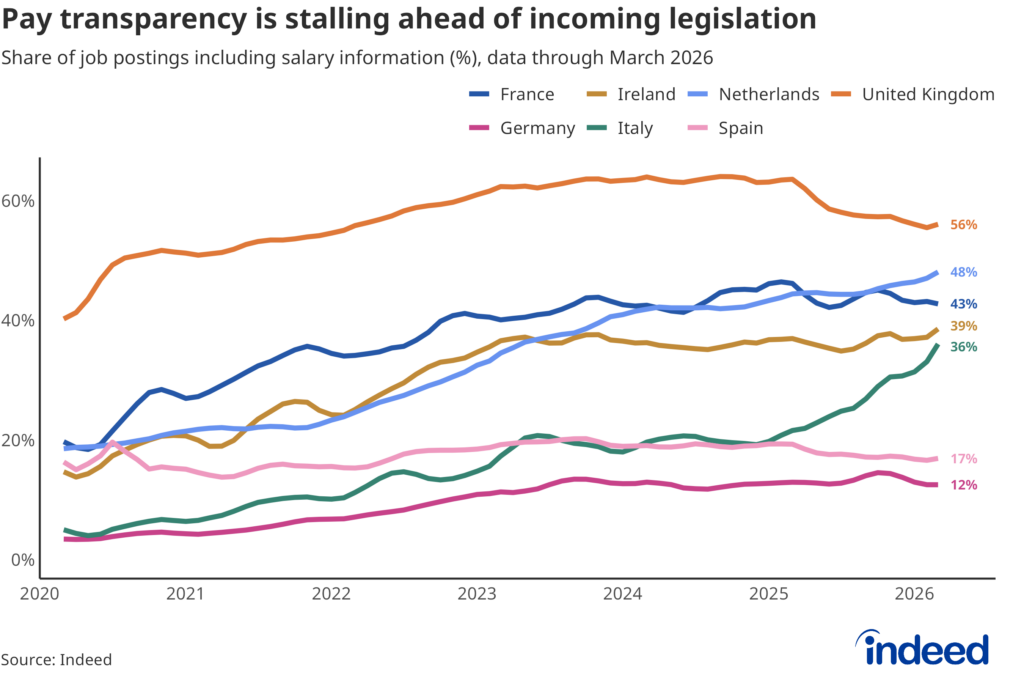
The cross-country spread is the clearest evidence that culture and enforcement, not the directive alone, drive behavior. As of March 2026, the UK had salary information in about 56% of job postings while Germany sat at just 12%, with France at 43%, Netherlands at 48%, Italy at 36%, and Spain at 17% - Indeed Hiring Lab. Reason about the paradox in those numbers. The UK, which is not even in the EU and thus not bound by the directive, leads Europe on disclosure, while Germany, the EU's largest economy, trails badly. This tells you that legal mandate is neither necessary nor sufficient for disclosure behavior: the UK got there through market norms and a WTW-documented cultural shift, while Germany's low rate reflects both a strong tradition of pay secrecy and the fact that it missed the transposition deadline. Behavior tracks culture and enforcement more tightly than it tracks the letter of the law, at least in the early years.
Share of job postings including salary information, March 2026
Source: Indeed Hiring Lab, March 2026
Italy's trajectory is the single most encouraging data point for anyone who believes the directive will eventually change behavior, because it isolates the effect of transposition. After Italy transposed the directive, the share of its job postings including salary information rose from about 22% to 36% within twelve months - Indeed Hiring Lab. Reason about what that 14-point jump demonstrates: when a state actually transposes and the obligation becomes concrete, disclosure does move, and it moves fast. Italy is the natural experiment that separates "the directive does nothing" from "the directive works but with a lag." The Italian data supports the latter. It also implies that Germany's 12% is a floor that will rise sharply once its implementing act arrives in 2027, which is why an employer betting that the late states will never really enforce is betting against the one clean piece of causal evidence available.
Even Italy's fast jump, though, only reached 36%, which is the honest limit of the good news and the fact that keeps the analysis from tipping into optimism. Reason about why transposition moved disclosure to a third of postings rather than to the near-universal level the law nominally requires: a rule takes time to propagate through recruiter habit, ATS configuration, agency practice, and manager buy-in, and enforcement in the first year after transposition is typically light while regulators build capacity. So even a working directive produces a gradient rather than a step change, and the gradient can stall well short of full compliance if enforcement never intensifies. The Italian case is therefore evidence for two things at once: that the directive works, and that "works" in year one means a partial shift, not a complete one. An operator should read Italy as proof of direction and a warning about pace, and should assume that the laggard economies will follow the same slow gradient rather than snapping instantly to compliance the moment their national law switches on.
The forward-looking survey data suggests the gap will close faster than the current disclosure rates imply, which is the counterweight to the pessimistic snapshot. Mercer's global survey of over 1,600 respondents across 60 markets found that the share of employers disclosing hiring pay ranges in job postings is expected to rise from 60% in 2024 to 94% by the end of 2026 - Mercer. In the UK specifically, WTW's 2025 survey found 76% of companies planning to share individual pay ranges with employees and 70% planning to share range information with external candidates - WTW. The tension to hold honestly is that intentions run well ahead of behavior: Mercer's own preparedness data (only half of employers ready) sits uneasily beside its 94%-disclosure projection, which means the projection is a statement of plan, not a measurement of practice. The right reading is that the direction is clearly toward near-universal disclosure, but the timeline in the laggard economies will be slower and messier than the survey headlines suggest, and an operator should plan for the behavior, not the aspiration.
The UK case inside that survey data is especially instructive because it shows the directive changing behavior in a country the directive does not even bind. The UK left the EU and is not obligated to transpose 2023/970, yet WTW documents a strong pull toward disclosure driven by the directive anyway - WTW. Reason about the mechanism of this spillover: many UK employers operate across the EU or compete for the same talent pool, so once their European operations must disclose, maintaining a two-tier policy (transparent in the EU, opaque in the UK) becomes awkward, inconsistent, and hard to defend to their own workforce. The directive therefore exports its norms beyond its legal borders through the practical impossibility of running divergent pay policies inside one company, which is why the UK, unbound, nonetheless leads Europe on disclosure. This spillover is a preview of how transparency becomes a global default not through global law but through the internal logic of multinational consistency, and it is why even employers with no EU footprint should expect the norm to reach them.
There is a deeper first-principles reason the gap persists that neither the pessimists nor the optimists fully articulate. Disclosure is a coordination problem. An individual employer that discloses while its competitors do not surrenders bargaining leverage without gaining a hiring advantage, because candidates cannot yet compare, so early unilateral disclosure is locally irrational even when universal disclosure is collectively better. What breaks the coordination problem is a credible mandate that forces everyone to disclose at once, which is exactly what a well-enforced directive does. This is why the behavior lags the law in the transition period (the mandate is not yet credibly enforced everywhere) and why it should snap toward the norm once enforcement becomes real (the coordination problem dissolves when non-disclosure carries a penalty). The Italian jump is the coordination problem breaking; the German lag is it still intact. Understanding disclosure as coordination, rather than as simple compliance, is what lets an operator predict which markets will move and when.
7. The Comp-Intelligence and Pay-Equity Stack
Everything to this point converges on a single operational conclusion: satisfying the directive requires tooling, and a distinct comp-intelligence stack has formed to provide it. Reason about why a stack rather than a single product emerged. The directive's obligations decompose into three separable jobs: figuring out what a role should pay (benchmarking), figuring out whether your pay is equitable and defensible (pay-equity analytics), and making sure your job ads actually comply (posting compliance). These are genuinely different problems requiring different data and different logic, which is why the market segmented into three layers rather than consolidating into one tool. An operator building a compliance program is really assembling one component from each layer, and understanding the layers is how you avoid buying the wrong thing. This tooling sits inside the broader talent-tech landscape we map in our Talent Acquisition Tech Market Map: 2026.
The benchmarking layer answers "what should this role pay," and it is being rebuilt around live data rather than annual surveys. Ravio provides real-time compensation benchmarking using anonymized live HR-system data across 46-plus countries and 100-plus roles, plus pay-band and merit-cycle tooling, and raised a $12M Series A led by Spark Capital in May 2025 - Ravio. Figures offers European salary benchmarking, pay-equity analysis, and directive compliance in one platform, purpose-built around EU compliance and used by 500-plus companies - Figures. Reason about why the "live data" model matters for compliance specifically: a directive that requires defensible, current pay bands is poorly served by a survey that is a year stale by the time it publishes, because the band you disclose in a job ad has to reflect the market now, not last year. The shift from static annual surveys to continuous "give-to-get" benchmarking is the benchmarking layer adapting to a regulation that regulates a moving target.
The enterprise end of benchmarking is anchored by incumbents with enormous datasets, and they matter because scale is a genuine differentiator here. Carta Total Comp combines salary and equity data from private companies drawing on real-time compensation data from over one million employees, now available beyond Carta's own customer base - Carta. Aon runs the Radford McLagan Compensation Database, covering over 8,500 organizations and roughly 30 million employees for enterprise compensation benchmarking - Aon. Reason about the trade-off between the startups and the incumbents: the newer platforms (Ravio, Figures) win on freshness, European specificity, and directive-native workflows, while the incumbents (Aon Radford, Carta) win on dataset breadth and the credibility of a name that a works council or auditor already recognizes. An employer's choice depends on whether its binding constraint is data recency and EU-specific compliance features or sheer statistical robustness across a huge sample, and most large multinationals end up using more than one.
Each directive obligation maps to a different tooling layer
The pay-equity and governance layer is the one the directive most directly forces, because it is where the 5% trigger and the Article 7 right get operationalized. Syndio provides AI-powered pay-equity and pay-governance analytics that help enterprises analyze, resolve, and monitor pay gaps, with over 200 companies covering 2.6 million-plus US employees running analysis on the platform, backed by a $50M Series C led by Bessemer - Syndio. Alongside it, PayAnalytics by beqom and Payscale provide pay-equity analysis and remediation modeling. Reason about why this layer is non-negotiable under the directive: it is the only layer that can continuously detect when a category crosses the 5% unexplained-gap line, decompose a raw gap into explained and unexplained components, and generate the audit trail an Article 7 response or a joint pay assessment requires. Benchmarking tells you what to pay; the equity layer tells you whether what you actually pay is defensible, and defensibility is the entire game once a regulator or a works council starts asking questions.
The third layer, job-posting compliance, is the least glamorous and the most immediately enforceable, which is exactly why it matters. Tools such as Datapeople and Payscale's posting products check that job ads contain a compliant, real pay range before they go live, catching the exact failure mode that produced Colorado's per-posting fines. Reason about why a dedicated layer exists for something as simple as "put a range in the ad": at scale, a large employer publishes thousands of postings through multiple systems and recruiters, and a single misconfigured template or a rogue posting without a range is a per-violation liability. Automated posting compliance is the control that prevents one careless req from becoming a settlement, which is why it is the layer most likely to pay for itself fastest. The sourcing-side changes that transparency forces are covered in depth in our Sourcing Tools Landscape: 2026 Buyer Guide, and how these tools plug into the applicant-tracking layer is the subject of our ATS Market Structure and Buyer Sentiment 2026.
The strategic point about the stack is that no single tool satisfies the directive, and understanding that prevents an expensive purchasing mistake. An employer that buys only a benchmarking product can set bands but cannot detect a 5% gap or answer an Article 7 request. An employer that buys only a pay-equity tool can find gaps but has no defensible market band to build ranges from. An employer that buys only a posting-compliance checker satisfies the visible job-ad rule while leaving the reporting engine and the Article 7 obligation completely unaddressed. Reason about the implication: compliance is a system, not a purchase, and the right architecture is one component from each layer, integrated so that the benchmark feeds the band, the band feeds the posting, and the equity analytics monitor the whole thing continuously. The vendors that will win the next few years are the ones that either span multiple layers convincingly (Figures and Payscale both reach across two) or integrate cleanly with the others, because the buyer's actual need is a coherent stack, not a single clever product.
8. The Counter-Narrative Talent Teams Should Not Ignore
Intellectual honesty requires giving the strongest case against pay transparency its full weight, because the pro-transparency consensus has hardened into a slogan and slogans hide trade-offs. The counter-narrative is not that transparency is bad, it is that transparency has second-order effects on wages and bargaining that can cut against the workers it is meant to help, and a talent team that ignores these effects will be surprised by them. Reason from the mechanism: when pay becomes public and comparable, it changes the strategic behavior of both employers and workers, and some of those behavioral changes lower or compress wages rather than raise them. This is not a fringe worry, it is a well-documented pattern in the economics of pay disclosure, and it deserves airtime precisely because the enthusiast literature tends to bury it.
The first counter-mechanism is the erosion of individual bargaining power, which is subtle and often missed. When pay is secret, a high-performing or scarce candidate can negotiate an above-band offer privately, because the employer can grant it without any obligation to match it across everyone else. When pay is transparent, that same above-band offer becomes visible and creates pressure to raise everyone in the category, which makes the employer far more reluctant to grant it in the first place. Reason about who this hurts: the strongest individual negotiators, who used to capture a premium through private information, lose that lever, so transparency can compress the top of the distribution downward toward the band even as it raises the bottom toward it. Compression is the point in one sense (it is how gaps close) but it also means transparency is not a universal raise, it is a redistribution that can lower pay for the workers who were previously winning the private-negotiation game.
The second and more troubling counter-mechanism is that transparency can lower average wages, not just compress them, and the logic is worth tracing carefully. Once an employer must post a band and honor it publicly, the band itself becomes a ceiling as much as a floor, because paying anyone above it publicly commits the employer to defend that number for the whole category. Employers respond by setting bands conservatively and resisting upward exceptions, which removes the quiet above-band offers that used to pull the average up. Reason about the equilibrium: in a transparent market, the employer's optimal strategy shifts from "pay what it takes to win each candidate privately" to "hold the public band and let candidates self-select," and that shift can lower the overall wage level in some labor markets by removing the upward pressure that private, competitive, above-band offers used to create. This is the finding the pro-transparency camp most wants to avoid, and it is real enough that a serious operator has to price it in.
Opaque bargaining versus published bands change who gains and who compresses
The diagram makes the redistribution visible, and it clarifies why transparency is a fairness win but not a universal raise. In the opaque regime, the strong negotiator captures a private premium and the weak negotiator, often anchored to a low salary history, gets underpaid, which is exactly the mechanism that produces persistent gender and demographic gaps. In the transparent regime, both are pulled toward the published band, so the gap narrows, but the narrowing happens partly by compressing the top downward rather than only by raising the bottom. Reason about the political economy this creates inside a company: the workers who benefit are diffuse and often unaware they were underpaid, while the workers who lose their private premium are concentrated, high-performing, and vocal. That asymmetry is why internal rollouts of transparency generate backlash from exactly the employees a company most wants to retain, and why the communication strategy (fairness, not raise) matters as much as the analytics.
The third mechanism is one the directive itself invites: overly wide ranges that hollow out the whole point. A range of "50,000 to 120,000" technically discloses a band while conveying almost nothing, and employers under pressure to disclose but reluctant to constrain themselves have a strong incentive to post ranges so wide they are meaningless. Reason about the enforcement problem this creates: the directive requires a real range, but "real" is hard to define crisply, and a determined employer can comply with the letter (there is a floor and a ceiling) while defeating the spirit (the band is useless to the candidate). This is why the posting-compliance layer and national enforcement guidance matter so much, because without a constraint on range width, transparency degrades into a box-ticking exercise. The US experience already shows some employers posting absurdly wide ranges precisely to satisfy the rule while preserving negotiating room, and Europe should expect the same evasion until national regulators define what "genuine range" means.
The honest synthesis is that transparency is net positive for equity and net ambiguous for wage levels, and a talent team should hold both truths at once rather than pretend the trade-off away. On the equity side, transparency demonstrably narrows gender and other gaps by making unexplained differences visible and actionable, which is the directive's core purpose and a genuine good. On the wage-level side, the compression and conservative-band effects mean transparency is not a straightforward raise for everyone, and in some markets it may lower averages while raising the floor. Reason about the practical posture this implies: an employer should not sell transparency to its own workforce as a universal pay increase, because that oversells it and invites backlash when compression bites the top performers. The credible internal message is that transparency makes pay fairer and more defensible, not uniformly higher, and a talent team that leads with the fairness case rather than the raise case will keep its credibility when the wage-level effects turn out to be mixed. The compensation strategy this demands is more sophisticated than "just post the numbers," and it is exactly the kind of structural rethink we trace across hiring functions in our Hiring Effort Benchmarks by Function.
9. The Operational Playbook for Talent Teams
Analysis is only worth as much as the decisions it improves, so this section converts everything above into a concrete sequence for a talent or rewards team facing the directive. The organizing insight, argued publicly by Yuma Heymans (@yumahey), co-founder and CEO of HeroHunt.ai and founder of AIRecruiter.co, is that pay transparency is an opening rather than a threat for employers willing to be structured about it: a published pay range turns a compliance obligation into a sourcing signal, so the same rule that constrains the opaque employer advantages the disciplined one. Reason about why that reframing is operationally useful: it turns a compliance cost into a sourcing advantage for teams that build the underlying architecture well, which is exactly the posture the playbook below is designed to produce.
The first and foundational move is to build the job architecture before touching the job ads, because everything downstream depends on it. A team that starts by editing templates to add ranges is fixing the symptom while ignoring the disease, because a range is only defensible if it maps to a level in a structured system. Reason about sequencing: you cannot disclose a real band until you have bands, you cannot report by category until you have categories, and you cannot answer Article 7 until you can define equal work, so the architecture is the prerequisite for all three. The practical first step is to level every role against the directive's four factors (skills, effort, responsibility, working conditions), map each employee to a level, and attach a market-derived band to each level using the benchmarking layer. This is unglamorous, months-long work, and it is the work that actually produces compliance, which is why the teams that started in 2025 are ahead of the ones scrambling now.
The second move is to rewrite the ATS and interview scripts to kill the salary-history question everywhere it hides, because this is the highest-risk, lowest-effort failure mode. Reason about where the risk actually lives: the salary-history ban is most often violated not by policy but by inertia, a legacy "current salary" field in the applicant-tracking system, a screening-call script that still asks "what are you targeting," a recruiter habit built over a decade. The operational fix is a systematic sweep: remove or disable current-salary fields in the ATS, rewrite screening and intake scripts to replace history questions with expectation-neutral framing, and train recruiters explicitly on why the question is now off-limits. This is the change that prevents an accidental, individually-actionable violation, and it costs almost nothing compared to the architecture work, which is why it should happen immediately and in parallel rather than waiting for the full program. How this intersects with the interview process itself is covered in our Interview Intelligence: Category Deep Dive.
The third move is to run a pre-emptive pay-equity audit before the first report is due, because the worst time to discover a 5% unexplained gap is when you are legally obligated to disclose it. Reason about the logic of getting ahead of the trigger: if you run the analysis early and find a category above the 5% line, you have time to either document a legitimate gender-neutral explanation or remediate the gap voluntarily, both of which are vastly preferable to a mandatory joint pay assessment sprung on you by a report you were forced to file. The audit uses the pay-equity layer (Syndio, PayAnalytics, Payscale) to decompose gaps within each category, and its output is either a documented justification or a remediation plan. Doing this pre-emptively converts a reactive, adversarial compliance event into a proactive, controlled one, and it is the single highest-leverage risk-reduction move a rewards team can make in the year before its first report lands.
There is a legal-privilege nuance to the pre-emptive audit that sophisticated teams handle deliberately and naive teams stumble into. Running a pay-equity analysis surfaces gaps, and once surfaced, those gaps are known, which can raise exposure if the analysis is discoverable and the employer then fails to act. Reason about the tension: you want to find your gaps early so you can fix them, but you do not want the analysis itself to become a liability if remediation lags. The practical answer, which the mature US market worked out over several years of pay-equity litigation, is to run the audit under appropriate privilege where available, to commit to a remediation timeline before running it, and to treat the finding as an obligation to act rather than a document to bury. The point for a European talent leader is that the audit is not just an analytical exercise, it is a legal one, and the sequencing (privilege, commitment to remediate, then analyze) matters as much as the analytics. This is one of several places where the US market's longer experience with enforcement gives European employers a tested playbook rather than a blank page.
The fourth move is to build the Article 7 response capability as a standing process rather than a scramble, because the two-month clock will eventually start on a request you did not schedule. Reason about what a standing capability requires: a defined intake for pay-comparison requests, a pre-built analysis that can pull a requester's category, the pay distribution of equal-work colleagues, and the gender-neutral factors explaining any difference, and a template response that a rewards analyst can complete within the window. The teams that treat Article 7 as an ad-hoc research project each time will miss deadlines and produce inconsistent, litigation-exposing answers, while the teams that pre-build the query and the template will answer in days. The key insight is that Article 7 readiness is a byproduct of the job architecture and the pay-equity layer being in place, which is why the first three moves make the fourth almost automatic, and why an employer that skipped them will find the fourth nearly impossible.
The fifth move is to monitor the multi-jurisdiction map continuously, because the transposition patchwork means the compliance calendar keeps changing under you. Reason about why this is a standing function and not a one-time setup: with member states transposing on different dates through 2028 and national specifics varying, an employer operating across borders faces a moving target where a new obligation switches on in a new country every few months. The practical discipline is to assign ownership of a live jurisdiction tracker, build to the strictest applicable standard so that a newly-transposing country requires activation rather than fresh construction, and treat US state laws as part of the same map given the transatlantic convergence. This is the move that turns the patchwork from a recurring fire drill into a managed schedule, and it is why the operational program has to be permanent rather than a project that closes once the first report is filed. The broader shift toward always-on, data-backed talent operations that this demands is the same one we track in our State of AI in Recruiting: 2026.
10. Decision Framework and Outlook
Forecasting where pay transparency goes from here requires separating what is settled from what is genuinely uncertain, because conflating the two produces bad decisions. What is settled is the direction: transparency is becoming the global default, driven by the EU directive top-down and US state laws bottom-up, converging on a world where opaque pay is the exception. What is uncertain is the pace in the laggard economies, the eventual strictness of national enforcement, and the size of the wage-level side effects. Reason about the decision this creates for an operator: because the direction is certain and only the timing is uncertain, the rational move is to build the infrastructure now and control the switch-on dates, rather than to wait for each national deadline and rebuild repeatedly. Betting on delay is betting against a one-way trend, and the Italian disclosure jump shows that when the rule becomes concrete, behavior follows fast.
The decision framework for choosing how deep to go is best organized around three employer situations, each implying a different priority. Reason through them from first principles rather than as a generic checklist. The variable that should drive the decision is not company size in the abstract but where the binding constraint sits: whether the employer's exposure is dominated by job-ad disclosure risk, by reporting and gap-remediation risk, or by cross-border complexity. Each situation points to a different first investment, and matching the investment to the actual constraint is what prevents both under-building (a compliance gap) and over-building (paying for a stack you do not yet need).
- Multinational with on-time-state operations: build the full three-layer stack now, to the strictest standard, and activate per country.
- Single-country employer in a laggard state: fix the salary-history ban and ATS immediately, sequence the architecture toward the national deadline.
- US-heavy employer: treat state-law posting compliance as the live risk today and use it as the on-ramp to the EU architecture.
The reason these three situations map to different first moves is that the cost of a mistake differs by situation. For the multinational, the cost of fragmented compliance across twenty-seven regimes is enormous, so the unified build pays for itself immediately, and the on-time-state operations already force the full stack anyway. For the single-country laggard employer, the immediate legal risk is the salary-history ban and job-ad disclosure once national law arrives, so fixing the cheap, high-risk items first and phasing the expensive architecture toward the deadline is the efficient path. For the US-heavy employer, the enforced risk today is per-posting fines, so posting compliance is the live priority, and it doubles as practice for the EU regime. In every case the logic is the same: identify the binding constraint, address it first, and build toward the settled direction. This same constraint-first reasoning is how we approach the whole talent stack in our Talent Marketplaces and AI-Native Hiring forecast.
The outlook to 2028 has three things worth watching, and specifying them lets an operator update in real time rather than wait for a verdict. The first is national enforcement intensity: whether states follow Colorado's model of real per-violation penalties or let disclosure rules sit unenforced, because enforcement, not the letter of the law, determines behavior. The second is how regulators define a "genuine range," because that definition determines whether the wide-range evasion described in Section 8 succeeds or gets closed, and it is the difference between transparency that informs candidates and transparency that only appears to. The third is the AI capability trajectory intersecting with comp intelligence, because the same models reshaping the rest of hiring are now automating pay-equity analysis and benchmarking, and the pace there is relentless: the current frontier includes the latest Anthropic Claude models (Claude Opus 5 and Claude Sonnet 5), OpenAI's GPT-5.6, and Google's Gemini 3.8 Flash, each of which makes continuous, defensible pay analytics cheaper to run at scale.
Share of employers disclosing pay ranges in job postings, Mercer global survey
The closing judgment is that pay transparency is neither the bureaucratic nuisance its critics claim nor the simple fairness fix its champions promise, and the structural frame is the right one. The directive overturns two hiring norms at once, salary secrecy and salary-history leverage, and in doing so it forces every covered employer to build the infrastructure (job architecture, gender-neutral leveling, continuous pay-equity analytics) that opaque pay let them avoid. Only four of twenty-seven states hit the deadline, the transposition patchwork will stretch to 2028, and behavior lags the rule everywhere except where enforcement is real, but the direction is fixed and the tooling to comply is mature. The question for every talent operator is not "will transparency arrive" but "have I built the defensible pay system that makes disclosure a sourcing advantage rather than a liability," and the employers who answer that question early, by building the stack rather than editing the job ads, are the ones who will treat the directive as an edge instead of a burden. That is the harder path, and it is the only one that actually works.
This guide reflects the pay-transparency landscape as of July 2026. Directive transposition dates, national enforcement rules, US state laws, and vendor details change quickly, and several cited figures come from surveys of employer intent rather than measured behavior, so verify current specifics against the linked primary sources before acting on them.